3M PESTLE Analysis

Skip the Research. Get the Strategy.
Unlock the external forces impacting 3M's success with our comprehensive PESTLE analysis. Understand how political shifts, economic volatility, and technological advancements are shaping the company's trajectory. Gain the strategic foresight needed to navigate these complexities and identify emerging opportunities. Download the full PESTLE analysis now for actionable intelligence that empowers your decision-making.
Political factors

Government Regulatory Landscape
Government regulations are a huge deal for 3M, affecting everything from their environmental practices to how safe their products are, especially in healthcare. For instance, in 2023, 3M faced significant legal settlements related to PFAS "forever chemicals," totaling billions of dollars, highlighting the direct financial impact of environmental regulations.
Staying compliant with these rules in different countries is essential for 3M to even sell its products and operate smoothly. A prime example is the EU's REACH (Registration, Evaluation, Authorisation and Restriction of Chemicals) regulation, which requires extensive data on chemical substances and can impact product formulations and market availability.
Changes in how strict these regulations are or how they're enforced can really shake things up for 3M. For example, increased scrutiny on medical devices in the US by the FDA can lead to longer product approval times and higher R&D costs, directly influencing their go-to-market strategies.
International Trade Policies and Tariffs
As a global company, 3M is significantly impacted by international trade policies and tariffs. For instance, in 2023, the U.S. continued to maintain tariffs on goods from China, affecting the cost of certain imported components that 3M might utilize. These trade dynamics directly influence 3M's supply chain costs and the competitiveness of its products in international markets.

Geopolitical Stability and Regional Conflicts
Geopolitical stability is a major concern for 3M. For instance, the ongoing conflict in Eastern Europe, which began in early 2022, has continued to impact global supply chains and energy prices throughout 2024. This instability can directly affect 3M's manufacturing facilities and the sourcing of raw materials, potentially leading to increased costs and delivery delays.
Regional conflicts and political unrest in other key markets could also pose risks. In 2024, several regions experienced heightened tensions, which can disrupt market demand for 3M's diverse product portfolio, ranging from healthcare to industrial adhesives. Such disruptions necessitate robust risk management strategies to safeguard operations and maintain market access.
The financial implications of geopolitical instability are significant. Increased operational risks can translate into higher insurance premiums for 3M's global assets. Furthermore, potential loss of market access due to sanctions or trade restrictions in affected regions could impact revenue streams, underscoring the need for continuous geopolitical risk assessment and mitigation planning.

Government Spending and Infrastructure Initiatives
Government spending on infrastructure, like the Bipartisan Infrastructure Law enacted in the US, which allocates $1.2 trillion, directly impacts demand for 3M's materials in construction and transportation. This increased investment in public health and industrial development, such as semiconductor manufacturing incentives, creates new avenues for 3M's products in healthcare and electronics sectors. Conversely, shifts towards fiscal conservatism or reduced public investment can lead to a slowdown in these project-driven sales.
Healthcare Policy and Reimbursement Changes
Healthcare policy and reimbursement changes significantly influence 3M's Health Care segment. For instance, shifts in Medicare and Medicaid reimbursement rates directly affect the profitability of medical devices and supplies. In 2024, ongoing discussions around drug pricing and potential reforms to the Affordable Care Act could alter demand for 3M's diverse product portfolio, impacting revenue streams.
Policy changes can create both opportunities and challenges. For example, government initiatives promoting value-based care might favor innovative solutions that 3M offers, potentially boosting sales. Conversely, increased regulatory scrutiny on medical device approvals or stricter pricing controls could dampen market growth.
- 2024 Healthcare Spending Projections: Global healthcare spending is projected to continue its upward trend, with significant government investment in public health initiatives.
- Impact of Inflation Reduction Act: The IRA's provisions on drug pricing negotiations could indirectly influence the market for medical devices and supplies by altering overall healthcare cost structures.
- Reimbursement Rate Adjustments: Anticipated adjustments to reimbursement rates for various medical procedures in 2025 will be closely watched by 3M for their impact on device utilization.
Government Influence: Billions at Stake
Government regulations significantly shape 3M's operational landscape, impacting everything from product safety standards to environmental compliance. The company's substantial settlements in 2023, amounting to billions related to PFAS, underscore the financial weight of environmental rules. Navigating diverse international regulations, like the EU's REACH, is crucial for market access and product formulation.
Trade policies and geopolitical stability present ongoing challenges and opportunities for 3M. Tariffs on imported goods, as seen in 2023, affect supply chain costs. Geopolitical conflicts, like the one in Eastern Europe, continue to disrupt global supply chains and energy prices, impacting 3M's operations and raw material sourcing throughout 2024.
Government spending on infrastructure and healthcare policy directly influences demand for 3M's products. The US Bipartisan Infrastructure Law, with its $1.2 trillion allocation, boosts demand for materials in construction and transportation. Changes in healthcare reimbursement rates, particularly for Medicare and Medicaid, critically affect the profitability of 3M's Health Care segment.
| Political Factor | Impact on 3M | Relevant Data/Examples (2023-2025) |
| Regulatory Compliance | Affects product development, market entry, and operational costs. | 3M's ~$10.3 billion settlement in 2023 for PFAS litigation. EU REACH compliance impacts chemical use. |
| Trade Policies & Tariffs | Influences supply chain costs and product pricing in global markets. | Continued US tariffs on Chinese goods in 2023 affected component costs. |
| Geopolitical Instability | Disrupts supply chains, increases operational risks, and affects market demand. | Ongoing conflicts in Eastern Europe impacting energy prices and logistics in 2024. |
| Government Spending | Drives demand for materials in infrastructure, healthcare, and technology sectors. | US Bipartisan Infrastructure Law ($1.2 trillion) supports demand for construction materials. |
| Healthcare Policy | Impacts revenue and profitability of the Health Care segment through reimbursement and pricing. | 2024 projections show continued global healthcare spending growth; IRA drug pricing impacts considered. |
What is included in the product
 Detailed Word Document
This PESTLE analysis provides a comprehensive examination of the external macro-environmental factors influencing 3M, categorized into Political, Economic, Social, Technological, Environmental, and Legal dimensions.
It offers actionable insights for strategic decision-making by identifying potential threats and opportunities arising from these dynamic global forces.

 Customizable Excel Spreadsheet
The 3M PESTLE analysis offers a structured framework to identify and address external challenges, acting as a pain point reliever by providing clarity on potential disruptions and opportunities.
It simplifies complex external factors into actionable insights, enabling proactive strategy development and mitigating risks that could otherwise hinder business growth.
Economic factors

Global Economic Growth and Recession Risks
3M's revenue is significantly influenced by global economic growth trends. For instance, the International Monetary Fund (IMF) projected global growth to be 3.2% in 2024, a slight slowdown from 2023, indicating a mixed economic environment. This growth rate directly impacts demand for 3M's products in sectors like manufacturing and automotive.
Recessionary risks, however, pose a considerable threat. A potential economic slowdown in major markets like the US or Europe could dampen industrial production and consumer spending, directly affecting 3M's sales volumes. For example, if key markets experience a contraction, demand for 3M's adhesives, abrasives, and safety equipment would likely decrease.
Inflation and Raw Material Costs
Persistent inflationary pressures have a direct impact on 3M's operational costs. For example, the Producer Price Index for manufactured goods in the US saw a notable increase throughout 2023 and into early 2024, directly affecting the cost of chemicals, metals, and other essential inputs for 3M's diverse product lines. This surge in raw material and energy prices can squeeze profit margins if not effectively managed through pricing adjustments or enhanced operational efficiencies.
3M's extensive global supply chain, crucial for sourcing a wide array of components, is particularly vulnerable to these cost escalations. Managing these rising input costs requires sophisticated supply chain strategies, including long-term supplier contracts and exploring alternative material sourcing. Furthermore, 3M's ability to pass these increased costs onto consumers through pricing strategies is vital for maintaining its competitive edge and profitability in a dynamic market environment.

Currency Exchange Rate Fluctuations
As a global company, 3M is significantly influenced by currency exchange rate fluctuations. For instance, in the first quarter of 2024, 3M reported that unfavorable currency movements negatively impacted sales by 0.7%, highlighting the real-world effect of these shifts on their top line.
When foreign currencies weaken against the U.S. dollar, the value of 3M's overseas earnings and assets decreases when converted back into dollars. This can directly reduce reported profits and make their products more expensive in those local markets, potentially impacting sales volume.
Conversely, a stronger dollar can make imported materials cheaper for 3M, but it also diminishes the dollar value of earnings generated in countries with weaker currencies. Managing this volatility through hedging and diversification is crucial for maintaining stable financial performance.

Consumer Spending Patterns and Disposable Income
Consumer spending patterns significantly impact 3M's diverse product portfolio. In 2024, a notable trend is the continued consumer focus on value and durability, particularly in categories like home improvement and automotive aftermarket, where 3M has a strong presence. Disposable income levels, influenced by inflation and employment rates, directly correlate with demand for 3M's non-essential goods, such as certain consumer electronics accessories and craft supplies.
For instance, the U.S. Bureau of Economic Analysis reported that personal consumption expenditures increased by an annualized rate of 3.1% in the first quarter of 2024, indicating robust consumer activity. This suggests a favorable environment for 3M's consumer-facing segments. However, shifts towards sustainability and eco-friendly products are also shaping purchasing decisions, requiring 3M to adapt its product development and marketing to meet these evolving preferences.
- Increased discretionary spending in Q1 2024: Personal consumption expenditures rose by 3.1% annually in the US.
- Value-driven purchasing: Consumers are prioritizing durability and cost-effectiveness in home and automotive goods.
- Sustainability demand: Growing consumer preference for eco-friendly products influences buying choices across various categories.
- Impact on 3M's segments: Trends affect demand for DIY products, office supplies, and household items.
Interest Rates and Access to Capital
Fluctuations in interest rates directly impact 3M's cost of capital. For instance, the Federal Reserve's benchmark interest rate, which influences borrowing costs across the economy, saw increases through 2023 and early 2024, potentially raising the expense for 3M to secure loans for R&D or capital projects. This environment can temper investment in growth opportunities.
The broader credit market's health, influenced by interest rate policies, also plays a role. A tightening credit environment can make it harder for 3M's customers to access financing, potentially dampening demand for its products. Similarly, suppliers facing higher borrowing costs might see their own financial stability affected, creating ripple effects in 3M's supply chain.
- Impact on Borrowing Costs: Rising interest rates increase the cost of debt for 3M, affecting the feasibility of new investments.
- R&D and Capital Expenditure Financing: Higher borrowing costs can limit funding available for innovation and facility upgrades.
- Customer and Supplier Financial Health: The credit environment influences the ability of 3M's partners to conduct business, impacting demand and supply.
- Federal Reserve Policy: Actions by central banks, such as adjusting the federal funds rate, directly shape the interest rate landscape.
Navigating Economic Headwinds and Tailwinds
Global economic growth is a primary driver for 3M's revenue. The IMF projected 3.2% global growth for 2024, a slight dip from 2023, impacting demand across 3M's industrial and automotive sectors. Conversely, recessionary fears in major economies could significantly reduce sales volumes for adhesives, abrasives, and safety equipment.
Inflationary pressures directly increase 3M's input costs. The US Producer Price Index for manufactured goods saw considerable increases through early 2024, raising expenses for raw materials and energy, which can pressure profit margins if not offset by price increases or efficiency gains.
Currency exchange rates also affect 3M's financial performance. In Q1 2024, unfavorable currency movements negatively impacted 3M's sales by 0.7%, illustrating the tangible effect of currency fluctuations on the company's top line.
Consumer spending, particularly on durable and value-oriented goods, influences 3M's consumer segments. US personal consumption expenditures increased by 3.1% annually in Q1 2024, suggesting a positive environment for 3M's consumer products, though demand for eco-friendly options is also growing.
| Economic Factor | 2024 Projection/Trend | Impact on 3M | Example Data/Event |
|---|---|---|---|
| Global Economic Growth | Projected 3.2% (IMF) | Influences demand for industrial and automotive products. | IMF forecast for 2024. |
| Inflation | Persistent Pressure | Increases raw material and energy costs, potentially squeezing margins. | US Producer Price Index increases through early 2024. |
| Currency Exchange Rates | Volatile | Affects reported sales and profitability of international operations. | Q1 2024: 0.7% negative impact on sales due to currency. |
| Consumer Spending | Increased in Q1 2024 | Boosts demand for consumer-facing segments; sustainability is a growing factor. | US Personal Consumption Expenditures up 3.1% annually in Q1 2024. |
What You See Is What You Get
3M PESTLE Analysis
The preview shown here is the exact document you’ll receive after purchase—fully formatted and ready to use. This comprehensive 3M PESTLE analysis breaks down the Political, Economic, Social, Technological, Legal, and Environmental factors impacting the company. You'll gain a deep understanding of the external forces shaping 3M's strategic landscape.

Original: $10.00
-70%$10.00
$3.00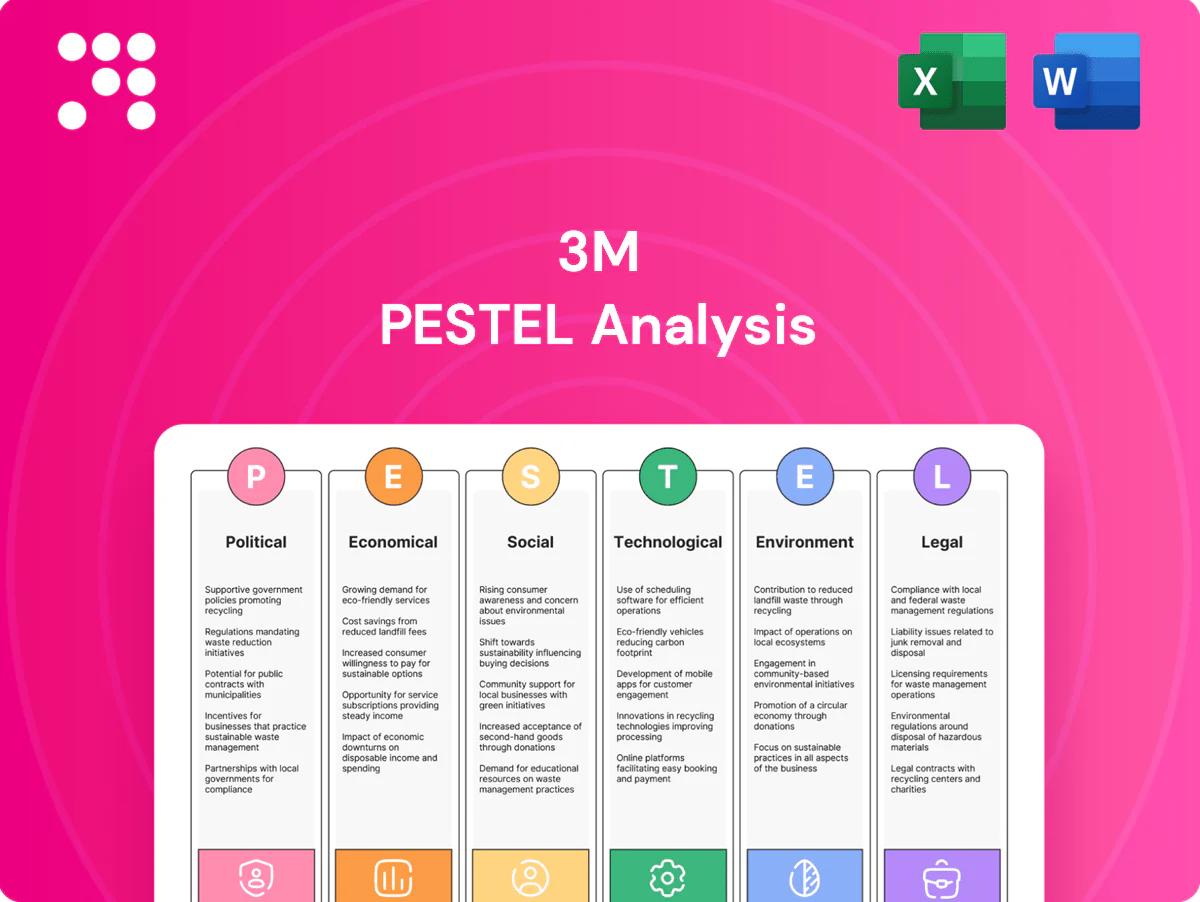
Description
Skip the Research. Get the Strategy.
Unlock the external forces impacting 3M's success with our comprehensive PESTLE analysis. Understand how political shifts, economic volatility, and technological advancements are shaping the company's trajectory. Gain the strategic foresight needed to navigate these complexities and identify emerging opportunities. Download the full PESTLE analysis now for actionable intelligence that empowers your decision-making.
Political factors
Government Regulatory Landscape
Government regulations are a huge deal for 3M, affecting everything from their environmental practices to how safe their products are, especially in healthcare. For instance, in 2023, 3M faced significant legal settlements related to PFAS "forever chemicals," totaling billions of dollars, highlighting the direct financial impact of environmental regulations.
Staying compliant with these rules in different countries is essential for 3M to even sell its products and operate smoothly. A prime example is the EU's REACH (Registration, Evaluation, Authorisation and Restriction of Chemicals) regulation, which requires extensive data on chemical substances and can impact product formulations and market availability.
Changes in how strict these regulations are or how they're enforced can really shake things up for 3M. For example, increased scrutiny on medical devices in the US by the FDA can lead to longer product approval times and higher R&D costs, directly influencing their go-to-market strategies.
International Trade Policies and Tariffs
As a global company, 3M is significantly impacted by international trade policies and tariffs. For instance, in 2023, the U.S. continued to maintain tariffs on goods from China, affecting the cost of certain imported components that 3M might utilize. These trade dynamics directly influence 3M's supply chain costs and the competitiveness of its products in international markets.
Geopolitical Stability and Regional Conflicts
Geopolitical stability is a major concern for 3M. For instance, the ongoing conflict in Eastern Europe, which began in early 2022, has continued to impact global supply chains and energy prices throughout 2024. This instability can directly affect 3M's manufacturing facilities and the sourcing of raw materials, potentially leading to increased costs and delivery delays.
Regional conflicts and political unrest in other key markets could also pose risks. In 2024, several regions experienced heightened tensions, which can disrupt market demand for 3M's diverse product portfolio, ranging from healthcare to industrial adhesives. Such disruptions necessitate robust risk management strategies to safeguard operations and maintain market access.
The financial implications of geopolitical instability are significant. Increased operational risks can translate into higher insurance premiums for 3M's global assets. Furthermore, potential loss of market access due to sanctions or trade restrictions in affected regions could impact revenue streams, underscoring the need for continuous geopolitical risk assessment and mitigation planning.
Government Spending and Infrastructure Initiatives
Government spending on infrastructure, like the Bipartisan Infrastructure Law enacted in the US, which allocates $1.2 trillion, directly impacts demand for 3M's materials in construction and transportation. This increased investment in public health and industrial development, such as semiconductor manufacturing incentives, creates new avenues for 3M's products in healthcare and electronics sectors. Conversely, shifts towards fiscal conservatism or reduced public investment can lead to a slowdown in these project-driven sales.
Healthcare Policy and Reimbursement Changes
Healthcare policy and reimbursement changes significantly influence 3M's Health Care segment. For instance, shifts in Medicare and Medicaid reimbursement rates directly affect the profitability of medical devices and supplies. In 2024, ongoing discussions around drug pricing and potential reforms to the Affordable Care Act could alter demand for 3M's diverse product portfolio, impacting revenue streams.
Policy changes can create both opportunities and challenges. For example, government initiatives promoting value-based care might favor innovative solutions that 3M offers, potentially boosting sales. Conversely, increased regulatory scrutiny on medical device approvals or stricter pricing controls could dampen market growth.
- 2024 Healthcare Spending Projections: Global healthcare spending is projected to continue its upward trend, with significant government investment in public health initiatives.
- Impact of Inflation Reduction Act: The IRA's provisions on drug pricing negotiations could indirectly influence the market for medical devices and supplies by altering overall healthcare cost structures.
- Reimbursement Rate Adjustments: Anticipated adjustments to reimbursement rates for various medical procedures in 2025 will be closely watched by 3M for their impact on device utilization.
Government Influence: Billions at Stake
Government regulations significantly shape 3M's operational landscape, impacting everything from product safety standards to environmental compliance. The company's substantial settlements in 2023, amounting to billions related to PFAS, underscore the financial weight of environmental rules. Navigating diverse international regulations, like the EU's REACH, is crucial for market access and product formulation.
Trade policies and geopolitical stability present ongoing challenges and opportunities for 3M. Tariffs on imported goods, as seen in 2023, affect supply chain costs. Geopolitical conflicts, like the one in Eastern Europe, continue to disrupt global supply chains and energy prices, impacting 3M's operations and raw material sourcing throughout 2024.
Government spending on infrastructure and healthcare policy directly influences demand for 3M's products. The US Bipartisan Infrastructure Law, with its $1.2 trillion allocation, boosts demand for materials in construction and transportation. Changes in healthcare reimbursement rates, particularly for Medicare and Medicaid, critically affect the profitability of 3M's Health Care segment.
| Political Factor | Impact on 3M | Relevant Data/Examples (2023-2025) |
| Regulatory Compliance | Affects product development, market entry, and operational costs. | 3M's ~$10.3 billion settlement in 2023 for PFAS litigation. EU REACH compliance impacts chemical use. |
| Trade Policies & Tariffs | Influences supply chain costs and product pricing in global markets. | Continued US tariffs on Chinese goods in 2023 affected component costs. |
| Geopolitical Instability | Disrupts supply chains, increases operational risks, and affects market demand. | Ongoing conflicts in Eastern Europe impacting energy prices and logistics in 2024. |
| Government Spending | Drives demand for materials in infrastructure, healthcare, and technology sectors. | US Bipartisan Infrastructure Law ($1.2 trillion) supports demand for construction materials. |
| Healthcare Policy | Impacts revenue and profitability of the Health Care segment through reimbursement and pricing. | 2024 projections show continued global healthcare spending growth; IRA drug pricing impacts considered. |
What is included in the product
Detailed Word Document
This PESTLE analysis provides a comprehensive examination of the external macro-environmental factors influencing 3M, categorized into Political, Economic, Social, Technological, Environmental, and Legal dimensions.
It offers actionable insights for strategic decision-making by identifying potential threats and opportunities arising from these dynamic global forces.
Customizable Excel Spreadsheet
The 3M PESTLE analysis offers a structured framework to identify and address external challenges, acting as a pain point reliever by providing clarity on potential disruptions and opportunities.
It simplifies complex external factors into actionable insights, enabling proactive strategy development and mitigating risks that could otherwise hinder business growth.
Economic factors
Global Economic Growth and Recession Risks
3M's revenue is significantly influenced by global economic growth trends. For instance, the International Monetary Fund (IMF) projected global growth to be 3.2% in 2024, a slight slowdown from 2023, indicating a mixed economic environment. This growth rate directly impacts demand for 3M's products in sectors like manufacturing and automotive.
Recessionary risks, however, pose a considerable threat. A potential economic slowdown in major markets like the US or Europe could dampen industrial production and consumer spending, directly affecting 3M's sales volumes. For example, if key markets experience a contraction, demand for 3M's adhesives, abrasives, and safety equipment would likely decrease.
Inflation and Raw Material Costs
Persistent inflationary pressures have a direct impact on 3M's operational costs. For example, the Producer Price Index for manufactured goods in the US saw a notable increase throughout 2023 and into early 2024, directly affecting the cost of chemicals, metals, and other essential inputs for 3M's diverse product lines. This surge in raw material and energy prices can squeeze profit margins if not effectively managed through pricing adjustments or enhanced operational efficiencies.
3M's extensive global supply chain, crucial for sourcing a wide array of components, is particularly vulnerable to these cost escalations. Managing these rising input costs requires sophisticated supply chain strategies, including long-term supplier contracts and exploring alternative material sourcing. Furthermore, 3M's ability to pass these increased costs onto consumers through pricing strategies is vital for maintaining its competitive edge and profitability in a dynamic market environment.
Currency Exchange Rate Fluctuations
As a global company, 3M is significantly influenced by currency exchange rate fluctuations. For instance, in the first quarter of 2024, 3M reported that unfavorable currency movements negatively impacted sales by 0.7%, highlighting the real-world effect of these shifts on their top line.
When foreign currencies weaken against the U.S. dollar, the value of 3M's overseas earnings and assets decreases when converted back into dollars. This can directly reduce reported profits and make their products more expensive in those local markets, potentially impacting sales volume.
Conversely, a stronger dollar can make imported materials cheaper for 3M, but it also diminishes the dollar value of earnings generated in countries with weaker currencies. Managing this volatility through hedging and diversification is crucial for maintaining stable financial performance.
Consumer Spending Patterns and Disposable Income
Consumer spending patterns significantly impact 3M's diverse product portfolio. In 2024, a notable trend is the continued consumer focus on value and durability, particularly in categories like home improvement and automotive aftermarket, where 3M has a strong presence. Disposable income levels, influenced by inflation and employment rates, directly correlate with demand for 3M's non-essential goods, such as certain consumer electronics accessories and craft supplies.
For instance, the U.S. Bureau of Economic Analysis reported that personal consumption expenditures increased by an annualized rate of 3.1% in the first quarter of 2024, indicating robust consumer activity. This suggests a favorable environment for 3M's consumer-facing segments. However, shifts towards sustainability and eco-friendly products are also shaping purchasing decisions, requiring 3M to adapt its product development and marketing to meet these evolving preferences.
- Increased discretionary spending in Q1 2024: Personal consumption expenditures rose by 3.1% annually in the US.
- Value-driven purchasing: Consumers are prioritizing durability and cost-effectiveness in home and automotive goods.
- Sustainability demand: Growing consumer preference for eco-friendly products influences buying choices across various categories.
- Impact on 3M's segments: Trends affect demand for DIY products, office supplies, and household items.
Interest Rates and Access to Capital
Fluctuations in interest rates directly impact 3M's cost of capital. For instance, the Federal Reserve's benchmark interest rate, which influences borrowing costs across the economy, saw increases through 2023 and early 2024, potentially raising the expense for 3M to secure loans for R&D or capital projects. This environment can temper investment in growth opportunities.
The broader credit market's health, influenced by interest rate policies, also plays a role. A tightening credit environment can make it harder for 3M's customers to access financing, potentially dampening demand for its products. Similarly, suppliers facing higher borrowing costs might see their own financial stability affected, creating ripple effects in 3M's supply chain.
- Impact on Borrowing Costs: Rising interest rates increase the cost of debt for 3M, affecting the feasibility of new investments.
- R&D and Capital Expenditure Financing: Higher borrowing costs can limit funding available for innovation and facility upgrades.
- Customer and Supplier Financial Health: The credit environment influences the ability of 3M's partners to conduct business, impacting demand and supply.
- Federal Reserve Policy: Actions by central banks, such as adjusting the federal funds rate, directly shape the interest rate landscape.
Navigating Economic Headwinds and Tailwinds
Global economic growth is a primary driver for 3M's revenue. The IMF projected 3.2% global growth for 2024, a slight dip from 2023, impacting demand across 3M's industrial and automotive sectors. Conversely, recessionary fears in major economies could significantly reduce sales volumes for adhesives, abrasives, and safety equipment.
Inflationary pressures directly increase 3M's input costs. The US Producer Price Index for manufactured goods saw considerable increases through early 2024, raising expenses for raw materials and energy, which can pressure profit margins if not offset by price increases or efficiency gains.
Currency exchange rates also affect 3M's financial performance. In Q1 2024, unfavorable currency movements negatively impacted 3M's sales by 0.7%, illustrating the tangible effect of currency fluctuations on the company's top line.
Consumer spending, particularly on durable and value-oriented goods, influences 3M's consumer segments. US personal consumption expenditures increased by 3.1% annually in Q1 2024, suggesting a positive environment for 3M's consumer products, though demand for eco-friendly options is also growing.
| Economic Factor | 2024 Projection/Trend | Impact on 3M | Example Data/Event |
|---|---|---|---|
| Global Economic Growth | Projected 3.2% (IMF) | Influences demand for industrial and automotive products. | IMF forecast for 2024. |
| Inflation | Persistent Pressure | Increases raw material and energy costs, potentially squeezing margins. | US Producer Price Index increases through early 2024. |
| Currency Exchange Rates | Volatile | Affects reported sales and profitability of international operations. | Q1 2024: 0.7% negative impact on sales due to currency. |
| Consumer Spending | Increased in Q1 2024 | Boosts demand for consumer-facing segments; sustainability is a growing factor. | US Personal Consumption Expenditures up 3.1% annually in Q1 2024. |
What You See Is What You Get
3M PESTLE Analysis
The preview shown here is the exact document you’ll receive after purchase—fully formatted and ready to use. This comprehensive 3M PESTLE analysis breaks down the Political, Economic, Social, Technological, Legal, and Environmental factors impacting the company. You'll gain a deep understanding of the external forces shaping 3M's strategic landscape.