Wharf (Holdings) PESTLE Analysis

Your Competitive Advantage Starts with This Report
Unlock strategic clarity with our PESTLE Analysis of Wharf (Holdings): evaluate how regulatory shifts, economic cycles, and technological disruption shape its property and logistics businesses. This concise briefing highlights immediate risks and opportunities. Purchase the full report for detailed, actionable insights and ready-to-use charts.
Political factors

HK–Mainland policy alignment
Beijing–Hong Kong policy alignment, anchored in the 14th Five-Year Plan and Greater Bay Area initiatives, directly affects planning approvals, land supply and cross-border project coordination for Wharf; policy shifts can accelerate or delay developments and retail recovery via tourism visa regimes. Wharf must track National Development priorities and Hong Kong policy address outcomes and run scenario planning for divergent policy paths to reduce approval and demand risk.
Land supply and housing directives
Government land tenders, rezoning and the 315,000-unit 10-year housing target announced by the Hong Kong government shape Wharf Holdings pipeline, pricing and margins by tightening available private plots and compressing plot ratios. Increased public housing quotas can crowd private supply or force downward pricing on residential launches. Transparent tender strategies and JV partnerships reduce bid concentration risk and preserve margins. Active advocacy aligns Wharf projects with community needs to access policy incentives and rezoning wins.

Trade and port governance
Logistics assets face evolving port policies, cabotage rules and customs efficiency that affect throughput and costs; Hong Kong handled about 16.8m TEU in 2023 while Shenzhen and Guangzhou processed roughly 27.7m and 23.3m TEU respectively, amplifying regional competition tied to local authority support and cross‑border facilitation. Wharf’s terminals gain from streamlined clearance and smart‑port programs, but policy friction could divert volumes or raise compliance costs.

Geopolitical tensions and sanctions
U.S.–China tensions constrain Wharf Holdings through tighter financing access, technology sourcing and weaker tenant sentiment; Hong Kong office transaction volumes fell 27% year-on-year in 2023, pressuring valuations and driving cap-rate normalization.
- Sanctions/export controls: impede procurement for logistics and ICT
- Investor risk: raises required yields, hits RE valuations
- Hedge: diversified funding and supplier bases
Public infrastructure and GBA integration
State-backed transport links (HK-Zhuhai-Macao Bridge, XRL) and GBA integration expand mall and office catchments across a GBA population ~86m and GDP ~US$2.0trn, boosting Wharf’s footfall and leasing demand; policy incentives for GBA services and talent mobility further lift office occupancy and premium retail spend. Coordination with municipal plans can unlock mixed-use conversions, while delays or policy reversals could stall absorption and cap rental growth.
- GBA population ~86m; GDP ~US$2.0trn
- Transport projects raise catchment and leasing demand
- Policy incentives support services/talent; municipal coordination enables mixed-use
- Delays/reversals risk slower absorption and capped rents
Beijing–Hong Kong alignment reshapes GBA logistics, real estate and financing
Beijing–Hong Kong alignment (14th Five‑Year Plan, GBA) shapes approvals, land supply and cross‑border demand; GBA pop ~86m, GDP ~US$2.0trn. HK container throughput 16.8m TEU (2023) vs Shenzhen 27.7m and Guangzhou 23.3m, affecting terminal competition. HK office volumes fell 27% YoY (2023), tightening valuations and financing access.
| Indicator | Value |
|---|---|
| GBA population | ~86m |
| GBA GDP | ~US$2.0trn |
| HK TEU (2023) | 16.8m |
| Shenzhen TEU (2023) | 27.7m |
| Guangzhou TEU (2023) | 23.3m |
| HK office vols change (2023) | -27% YoY |
What is included in the product
 Detailed Word Document
Explores how macro-environmental factors uniquely affect Wharf (Holdings) across Political, Economic, Social, Technological, Environmental and Legal dimensions, with data-driven examples and region-specific trends; designed to help executives, investors and strategists identify threats, opportunities and forward-looking scenarios for planning and funding decisions.

 Customizable Excel Spreadsheet
A concise, visually segmented PESTLE summary of Wharf (Holdings) highlighting key regulatory, economic, technological and market risks and opportunities for rapid decision‑making; editable notes and presentation‑ready format enable quick team alignment and action.
Economic factors

Interest rates and HKD–USD peg
Hong Kong interbank rates track the US federal funds path via the HKD–USD peg, with the Fed funds rate near 5.25–5.50% in mid‑2025, pushing HK base rates and 3‑month HIBOR above 4% and lifting commercial cap rates, pressuring mortgage affordability and new development feasibility.
Higher rates raise holding costs and compress valuations—Wharf faces lower yields and mark‑to‑market declines on investment properties—while upcoming refinancing (multi‑billion HKD maturities) demands active liability management.
Rate hedging and staggered maturities (swap locks, bullet vs amortizing schedules) preserve flexibility and reduce rollover risk for Wharf’s property and infrastructure portfolio.
Mainland property cycles
Mainland housing downturn in 2024–25 weakened residential pre-sales and raised counterparty risk, prompting Chinese authorities to roll out targeted easing measures that have been uneven across cities and tiers. Wharf should prioritize Tier‑1 and strong Tier‑2 exposure, tighten cash collection and covenant monitoring, and run stress tests for price cuts and extended sell‑through to gauge liquidity and NAV impact.

Retail and tourism recovery
Visitor arrivals rebounded to about 21.1 million in 2023 (HKTB), with mainland tourists the dominant segment—supporting flagship mall sales and mainland consumption patterns that drive luxury spend. Currency swings and consumer confidence influence both luxury and mass-market tenants, shifting basket sizes and footfall. Wharf’s turnover-rent model amplifies NOI volatility as receipts fluctuate. Curated experiential retail and tourism tie-ins (F&B, attractions) enhance resilience.

Logistics demand and trade flows
E-commerce expansion (global online retail sales >$5.5 trillion in 2023) and supply‑chain diversification sustain Wharf’s warehouse and terminal volumes; normalization of freight rates and post‑pandemic trade slowdowns since 2023 have compressed margins. Nearshoring and Greater Bay Area manufacturing upgrades shift cargo mix to higher‑value regional flows, while flexible leases and value‑added services (3PL, cold chain) capture upside.
- e-commerce >$5.5T (2023)
- freight-rate normalization since 2023 → margin pressure
- nearshoring & GBA upgrades → higher-value cargo
- flexible leases + 3PL/cold-chain = revenue upside
FX and capital market access
RMB volatility, trading around 7.2–7.3 per USD in mid-2025, directly affects mainland cash flows and timing of repatriation for Wharf’s China assets.
Tighter equity and bond markets since 2023 have raised development funding costs, making access to HK and offshore bond issuance and equity windows critical.
Maintaining multi-currency liquidity buffers and stable investment-grade ratings underpins competitive tendering and opportunistic acquisitions.
- FX: RMB ~7.2–7.3/USD (mid-2025)
- Funding: tighter bond/equity windows ↑ funding cost
- Liquidity: multi-currency buffers prudent
- Ratings: stability supports bids and timing
Beijing–Hong Kong alignment reshapes GBA logistics, real estate and financing
Higher US Fed funds (5.25–5.50% mid‑2025) lifts HK rates and 3‑month HIBOR >4%, raising holding costs and pressuring asset valuations and mortgage affordability.
Multi‑billion HKD refinancing needs increase rollover risk; maintaining swap hedges, staggered maturities and multi‑currency liquidity is critical to preserve ratings and bidding capacity.
Mainland demand mix, RMB ~7.2–7.3/USD (mid‑2025) and tourism rebound (21.1m arrivals in 2023) drive retail NOI volatility; e‑commerce >$5.5T (2023) supports logistics upside.
| Metric | Value |
|---|---|
| Fed funds (mid‑2025) | 5.25–5.50% |
| 3‑mo HIBOR | >4% |
| RMB/USD | ~7.2–7.3 |
| Visitor arrivals (2023) | 21.1m |
| Global e‑commerce (2023) | >$5.5T |
What You See Is What You Get
Wharf (Holdings) PESTLE Analysis
The Wharf (Holdings) PESTLE Analysis shown here is the exact document you’ll receive after purchase—fully formatted and ready to use. This preview is a true representation of the final file, with complete analysis, structure, and professional layout. No placeholders or edits are needed; you’ll download the same finished document immediately after payment.

Original: $10.00
-70%$10.00
$3.00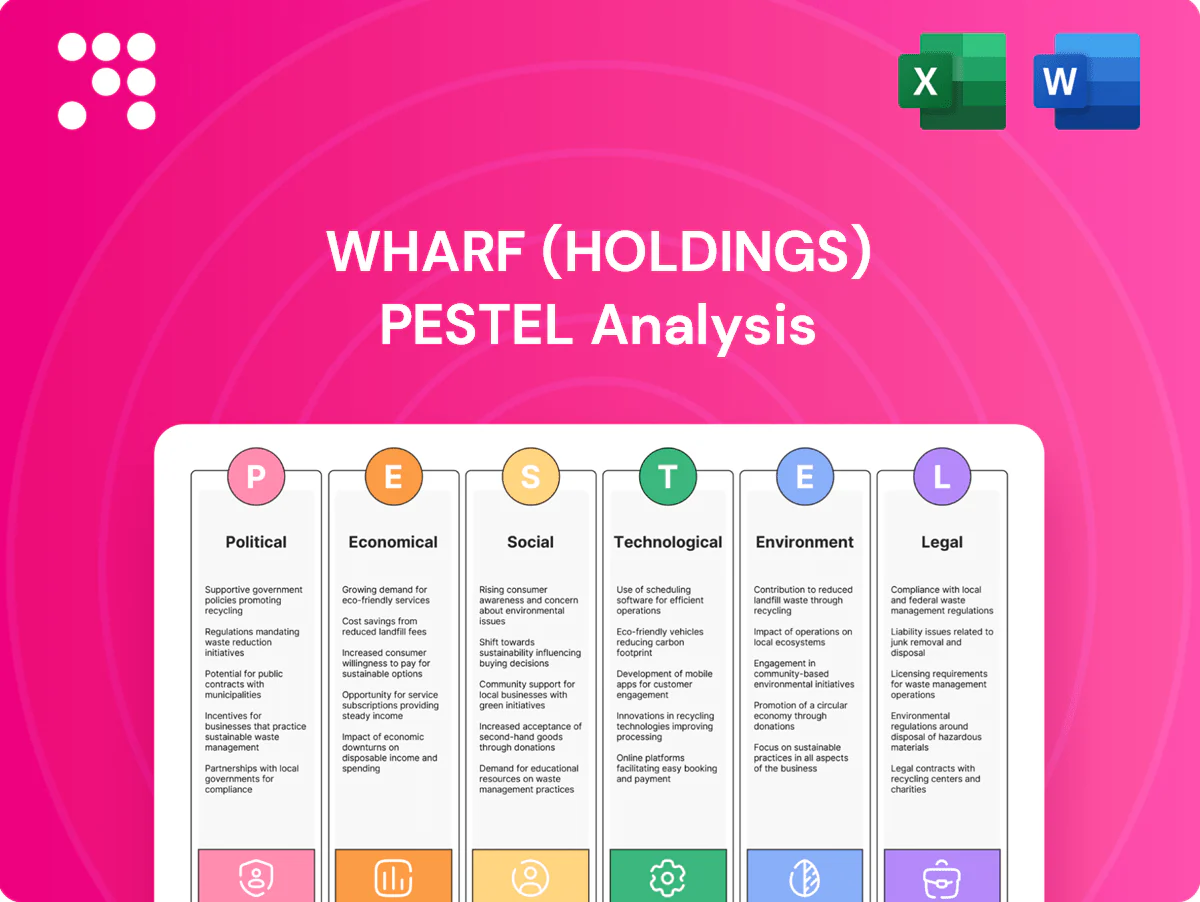
Description
Your Competitive Advantage Starts with This Report
Unlock strategic clarity with our PESTLE Analysis of Wharf (Holdings): evaluate how regulatory shifts, economic cycles, and technological disruption shape its property and logistics businesses. This concise briefing highlights immediate risks and opportunities. Purchase the full report for detailed, actionable insights and ready-to-use charts.
Political factors
HK–Mainland policy alignment
Beijing–Hong Kong policy alignment, anchored in the 14th Five-Year Plan and Greater Bay Area initiatives, directly affects planning approvals, land supply and cross-border project coordination for Wharf; policy shifts can accelerate or delay developments and retail recovery via tourism visa regimes. Wharf must track National Development priorities and Hong Kong policy address outcomes and run scenario planning for divergent policy paths to reduce approval and demand risk.
Land supply and housing directives
Government land tenders, rezoning and the 315,000-unit 10-year housing target announced by the Hong Kong government shape Wharf Holdings pipeline, pricing and margins by tightening available private plots and compressing plot ratios. Increased public housing quotas can crowd private supply or force downward pricing on residential launches. Transparent tender strategies and JV partnerships reduce bid concentration risk and preserve margins. Active advocacy aligns Wharf projects with community needs to access policy incentives and rezoning wins.
Trade and port governance
Logistics assets face evolving port policies, cabotage rules and customs efficiency that affect throughput and costs; Hong Kong handled about 16.8m TEU in 2023 while Shenzhen and Guangzhou processed roughly 27.7m and 23.3m TEU respectively, amplifying regional competition tied to local authority support and cross‑border facilitation. Wharf’s terminals gain from streamlined clearance and smart‑port programs, but policy friction could divert volumes or raise compliance costs.
Geopolitical tensions and sanctions
U.S.–China tensions constrain Wharf Holdings through tighter financing access, technology sourcing and weaker tenant sentiment; Hong Kong office transaction volumes fell 27% year-on-year in 2023, pressuring valuations and driving cap-rate normalization.
- Sanctions/export controls: impede procurement for logistics and ICT
- Investor risk: raises required yields, hits RE valuations
- Hedge: diversified funding and supplier bases
Public infrastructure and GBA integration
State-backed transport links (HK-Zhuhai-Macao Bridge, XRL) and GBA integration expand mall and office catchments across a GBA population ~86m and GDP ~US$2.0trn, boosting Wharf’s footfall and leasing demand; policy incentives for GBA services and talent mobility further lift office occupancy and premium retail spend. Coordination with municipal plans can unlock mixed-use conversions, while delays or policy reversals could stall absorption and cap rental growth.
- GBA population ~86m; GDP ~US$2.0trn
- Transport projects raise catchment and leasing demand
- Policy incentives support services/talent; municipal coordination enables mixed-use
- Delays/reversals risk slower absorption and capped rents
Beijing–Hong Kong alignment reshapes GBA logistics, real estate and financing
Beijing–Hong Kong alignment (14th Five‑Year Plan, GBA) shapes approvals, land supply and cross‑border demand; GBA pop ~86m, GDP ~US$2.0trn. HK container throughput 16.8m TEU (2023) vs Shenzhen 27.7m and Guangzhou 23.3m, affecting terminal competition. HK office volumes fell 27% YoY (2023), tightening valuations and financing access.
| Indicator | Value |
|---|---|
| GBA population | ~86m |
| GBA GDP | ~US$2.0trn |
| HK TEU (2023) | 16.8m |
| Shenzhen TEU (2023) | 27.7m |
| Guangzhou TEU (2023) | 23.3m |
| HK office vols change (2023) | -27% YoY |
What is included in the product
Detailed Word Document
Explores how macro-environmental factors uniquely affect Wharf (Holdings) across Political, Economic, Social, Technological, Environmental and Legal dimensions, with data-driven examples and region-specific trends; designed to help executives, investors and strategists identify threats, opportunities and forward-looking scenarios for planning and funding decisions.
Customizable Excel Spreadsheet
A concise, visually segmented PESTLE summary of Wharf (Holdings) highlighting key regulatory, economic, technological and market risks and opportunities for rapid decision‑making; editable notes and presentation‑ready format enable quick team alignment and action.
Economic factors
Interest rates and HKD–USD peg
Hong Kong interbank rates track the US federal funds path via the HKD–USD peg, with the Fed funds rate near 5.25–5.50% in mid‑2025, pushing HK base rates and 3‑month HIBOR above 4% and lifting commercial cap rates, pressuring mortgage affordability and new development feasibility.
Higher rates raise holding costs and compress valuations—Wharf faces lower yields and mark‑to‑market declines on investment properties—while upcoming refinancing (multi‑billion HKD maturities) demands active liability management.
Rate hedging and staggered maturities (swap locks, bullet vs amortizing schedules) preserve flexibility and reduce rollover risk for Wharf’s property and infrastructure portfolio.
Mainland property cycles
Mainland housing downturn in 2024–25 weakened residential pre-sales and raised counterparty risk, prompting Chinese authorities to roll out targeted easing measures that have been uneven across cities and tiers. Wharf should prioritize Tier‑1 and strong Tier‑2 exposure, tighten cash collection and covenant monitoring, and run stress tests for price cuts and extended sell‑through to gauge liquidity and NAV impact.
Retail and tourism recovery
Visitor arrivals rebounded to about 21.1 million in 2023 (HKTB), with mainland tourists the dominant segment—supporting flagship mall sales and mainland consumption patterns that drive luxury spend. Currency swings and consumer confidence influence both luxury and mass-market tenants, shifting basket sizes and footfall. Wharf’s turnover-rent model amplifies NOI volatility as receipts fluctuate. Curated experiential retail and tourism tie-ins (F&B, attractions) enhance resilience.
Logistics demand and trade flows
E-commerce expansion (global online retail sales >$5.5 trillion in 2023) and supply‑chain diversification sustain Wharf’s warehouse and terminal volumes; normalization of freight rates and post‑pandemic trade slowdowns since 2023 have compressed margins. Nearshoring and Greater Bay Area manufacturing upgrades shift cargo mix to higher‑value regional flows, while flexible leases and value‑added services (3PL, cold chain) capture upside.
- e-commerce >$5.5T (2023)
- freight-rate normalization since 2023 → margin pressure
- nearshoring & GBA upgrades → higher-value cargo
- flexible leases + 3PL/cold-chain = revenue upside
FX and capital market access
RMB volatility, trading around 7.2–7.3 per USD in mid-2025, directly affects mainland cash flows and timing of repatriation for Wharf’s China assets.
Tighter equity and bond markets since 2023 have raised development funding costs, making access to HK and offshore bond issuance and equity windows critical.
Maintaining multi-currency liquidity buffers and stable investment-grade ratings underpins competitive tendering and opportunistic acquisitions.
- FX: RMB ~7.2–7.3/USD (mid-2025)
- Funding: tighter bond/equity windows ↑ funding cost
- Liquidity: multi-currency buffers prudent
- Ratings: stability supports bids and timing
Beijing–Hong Kong alignment reshapes GBA logistics, real estate and financing
Higher US Fed funds (5.25–5.50% mid‑2025) lifts HK rates and 3‑month HIBOR >4%, raising holding costs and pressuring asset valuations and mortgage affordability.
Multi‑billion HKD refinancing needs increase rollover risk; maintaining swap hedges, staggered maturities and multi‑currency liquidity is critical to preserve ratings and bidding capacity.
Mainland demand mix, RMB ~7.2–7.3/USD (mid‑2025) and tourism rebound (21.1m arrivals in 2023) drive retail NOI volatility; e‑commerce >$5.5T (2023) supports logistics upside.
| Metric | Value |
|---|---|
| Fed funds (mid‑2025) | 5.25–5.50% |
| 3‑mo HIBOR | >4% |
| RMB/USD | ~7.2–7.3 |
| Visitor arrivals (2023) | 21.1m |
| Global e‑commerce (2023) | >$5.5T |
What You See Is What You Get
Wharf (Holdings) PESTLE Analysis
The Wharf (Holdings) PESTLE Analysis shown here is the exact document you’ll receive after purchase—fully formatted and ready to use. This preview is a true representation of the final file, with complete analysis, structure, and professional layout. No placeholders or edits are needed; you’ll download the same finished document immediately after payment.