Tokyo Century PESTLE Analysis

Your Shortcut to Market Insight Starts Here
Our PESTLE Analysis of Tokyo Century reveals how political shifts, economic cycles, and tech innovation are reshaping its growth prospects and risk profile. Ideal for investors and strategists, this concise briefing highlights actionable external trends. Purchase the full report to access detailed insights and ready-to-use recommendations.
Political factors

Regulatory stability in Japan
Japan’s pro-business stance and stable governance underpin long-term leasing and finance; GDP grew about 1.5% in 2024, supporting demand for credit. Predictable FSA supervision and Basel-aligned rules facilitate capital planning and product approvals. Shifts in financial modernization or industrial policy can redirect incentives, so close tracking of cabinet priorities and BOJ–government coordination (BOJ holds ~50% of JGBs) is essential.
Geopolitical trade lanes and sanctions risk
Aviation and shipping portfolios are highly exposed to geopolitical tensions, sanctions and export controls, as highlighted when roughly 500 Western-leased aircraft were stranded in Russia after 2022 sanctions. Route disruptions and restricted counterparties can sharply reduce asset utilization and resale values, pressuring lease yields. Sanctions compliance demands robust KYC and screening in cross-border leases, while diversification by region and flag mitigates concentration risk.

Public investment in energy transition
Government subsidies and auctions—driven by Japan’s 2030 renewables target of 36–38% and the 2050 carbon neutrality goal—feed specialty financing pipelines for Tokyo Century by creating predictable tender volumes. Policy support such as feed-in premiums or tax credits underpins project cash flows and debt serviceability. Changes in subsidy design or grid access rules materially alter project risk-return profiles, while active engagement with policymakers improves visibility on upcoming tender pipelines.

Infrastructure and industrial policy
Nation-level drives in Japan — including a roughly 2.2 trillion yen semiconductor support package and a FY2024 capital investment push near 16.3 trillion yen — boost demand for equipment financing and leasing across digital, logistics and chip supply chains; port and airport upgrades (Tokyo Bay container traffic ~2.2M TEU annually) pace aviation and maritime leasing cycles; policy-backed PPPs expand structured finance takeouts, while political delays or budget reprioritization can defer deployment.
- semiconductor: 2.2 trillion yen package
- public investment: ~16.3 trillion yen FY2024
- port throughput: ~2.2M TEU (Tokyo Bay)
- risk: political delays can defer asset deployment
International tax and treaty dynamics
Leasing structures for Tokyo Century depend on bilateral tax treaties and withholding rules; OECD BEPS 2.0 Pillar Two (adopted by 136 jurisdictions covering ~90% of global GDP) and interest limitation rules (often 30% EBITDA) can reduce cross-border profitability and shift asset location decisions. Changes to thin-cap rules or interest deductibility materially alter financing economics, so proactive structuring and jurisdictional diversification preserve after-tax returns.
- Tax treaties: affect withholding on lease payments
- Pillar Two: 15% minimum tax — 136 jurisdictions
- Interest limitation: commonly 30% EBITDA cap
- Strategy: proactive structuring, jurisdictional diversification
Leasing outlook: 1.5% GDP, BOJ policy, Pillar Two 15%
Stable pro-business governance (Japan GDP ~1.5% in 2024) and predictable FSA/Basel rules support leasing; BOJ holds ~50% of JGBs so BOJ–government coordination matters. Geopolitical risks (≈500 Western-leased aircraft stranded in Russia post‑2022) threaten aviation/shipping yields. Policy drives (2030 renewables 36–38%, 2050 carbon neutrality; 2.2 trillion yen semiconductor package; FY2024 capex ~16.3T yen) create financing pipelines. OECD Pillar Two (15% min tax; 136 jurisdictions) and 30% EBITDA interest limits reshape cross‑border structuring.
| Indicator | Value | Implication |
|---|---|---|
| GDP 2024 | ~1.5% | Credit demand support |
| BOJ JGB holdings | ~50% | policy linkage |
| Pillar Two | 15% / 136 juris. | tax on returns |
What is included in the product
 Detailed Word Document
Explores how macro-environmental factors uniquely affect Tokyo Century across Political, Economic, Social, Technological, Environmental, and Legal dimensions, with data-driven, region- and industry-specific examples. Designed for executives and investors, it delivers forward-looking insights to identify risks, opportunities, and strategic responses.

 Customizable Excel Spreadsheet
A concise, visually segmented PESTLE summary for Tokyo Century that relieves meeting prep pain by being drop‑in ready for presentations. Easily shared and editable so teams can align quickly on external risks and strategic positioning.
Economic factors

Interest rate and yield curve trends
Leasing margins at Tokyo Century hinge on funding costs and yield-curve shapes across JPY, USD and EUR; June 2025 10-year yields were about 0.9% (JGB), 4.3% (US) and 3.1% (Germany), compressing cross-currency spreads. Rising short-term rates can squeeze origination spreads while boosting reinvestment income. Fixed–floating mismatches demand strict hedging and liquidity buffers. Customer affordability and residual-value models must incorporate rate volatility and scenario stress.
Global trade and transport cycles
Global aviation RPKs recovered to about 92% of 2019 levels in 2024 (IATA) while seaborne trade rose ~1.6% to 11.3 billion tonnes in 2024 (UNCTAD), so demand tracks GDP, trade volumes and tourism recovery. Freight rates and passenger yields directly affect lessee credit quality and cashflows. Downcycles can push defaults higher and remarketing times to 12–24 months. Scenario planning across cargo and passenger segments is critical.

FX volatility and cross-currency exposure
Multi-currency leases expose Tokyo Century to translation and transaction risk; the yen's volatility is material — it fell to 151.94 per USD on October 24, 2022 — shifting reported earnings and equity when translated. Hedging programs need to match lease cash flows and residual values to avoid mismatches. Sudden yen moves can alter competitive pricing and increase counterparty risk if lessees suffer local-currency shocks.

Credit cycle and default rates
Economic slowdowns lift NPLs across SMEs and project finance, with sectoral tests for airlines, shipping lines and real estate tenants critical as airlines' RPKs recovered to about 94% of 2019 levels by 2023 (IATA), affecting lease recoveries.
Recovery rates hinge on secondary market depth for equipment; prudent provisioning and tighter collateral controls remain key buffers against shocks.
- Focus: SME and project finance NPLs
- Stress: airlines, shipping, real estate
- Data: airlines RPK ~94% of 2019 (IATA, 2023)
- Mitigation: provisioning + collateral controls
Capital market access and liquidity
Securitizations and asset-backed financing can cut Tokyo Century’s cost of capital by roughly 50–150 basis points, improving ROE and funding flexibility. During market risk-off episodes spreads can widen 100–300 bps and delay issuances, while reduced bank syndication appetite constrains large-ticket placements. Maintaining diversified funding (bonds, ABS, bank lines, commercial paper) stabilizes growth and lowers refinancing risk.
- Cost reduction: 50–150 bps via securitization
- Risk-off spread widening: 100–300 bps
- Key channels: bonds, ABS, bank syndication, CP
- Benefit: reduced refinancing concentration
Leasing outlook: 1.5% GDP, BOJ policy, Pillar Two 15%
Funding and yield-curve shifts (10y: JPY 0.9%, US 4.3%, GER 3.1% in Jun 2025) compress spreads and force hedging; short-term rate rises squeeze origination but lift reinvestment. Demand tied to trade and travel (aviation RPK ~92% of 2019 in 2024; seaborne trade 11.3bn t in 2024), affecting lessee cashflows. Multi-currency FX volatility (notably USD/JPY swings) raises translation and credit risk, stressing provisioning and liquidity.
| Metric | Value | Impact |
|---|---|---|
| 10y yields (Jun 2025) | JGB 0.9% / US 4.3% / GER 3.1% | Funding spread pressure |
| Aviation demand (2024) | RPK ~92% of 2019 | Lease cashflow recovery |
| Seaborne trade (2024) | 11.3bn tonnes | Freight/lessee credit |
Preview the Actual Deliverable
Tokyo Century PESTLE Analysis
The preview shown here is the exact document you’ll receive after purchase—fully formatted and ready to use. This Tokyo Century PESTLE Analysis provides comprehensive political, economic, social, technological, legal and environmental insights tailored for investors and strategists. No placeholders or teases—what you see is the final file available for immediate download.

Original: $10.00
-70%$10.00
$3.00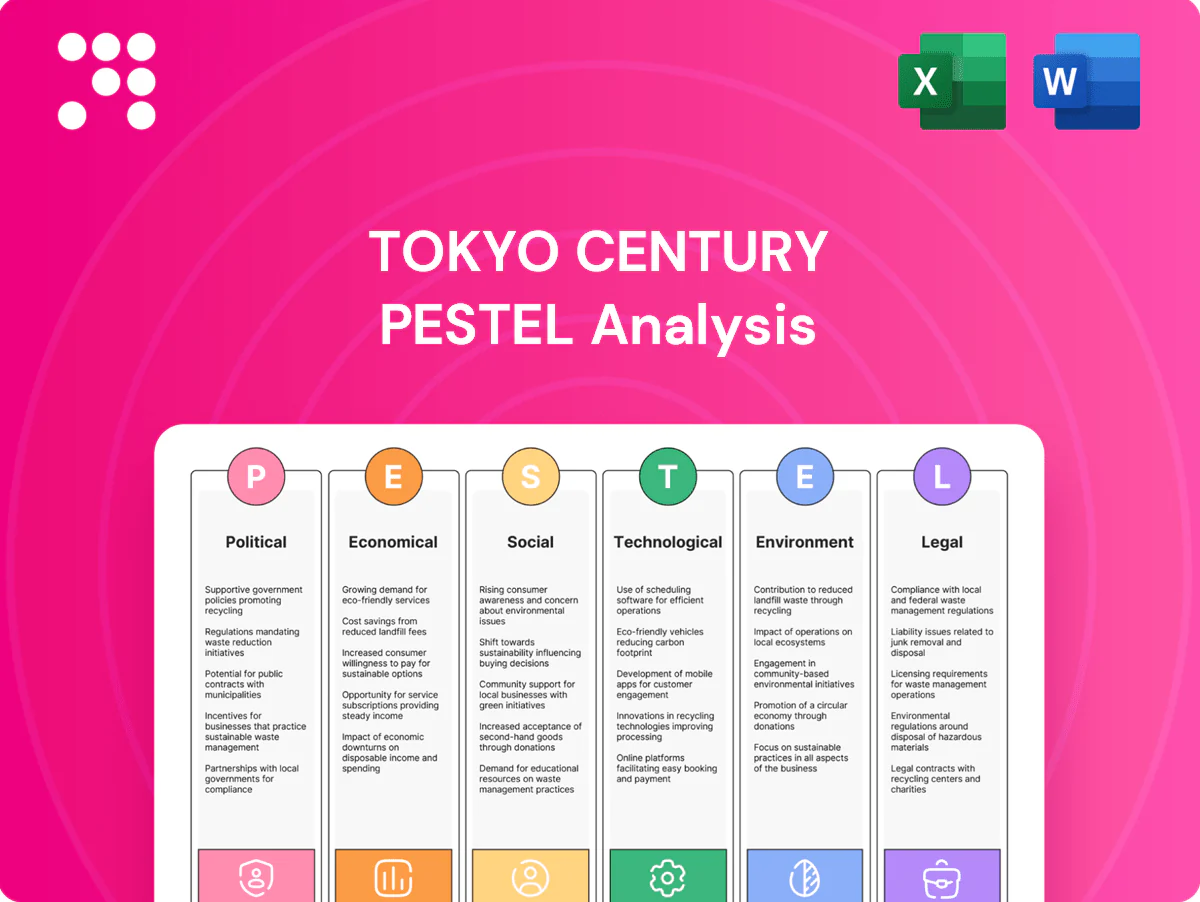
Description
Your Shortcut to Market Insight Starts Here
Our PESTLE Analysis of Tokyo Century reveals how political shifts, economic cycles, and tech innovation are reshaping its growth prospects and risk profile. Ideal for investors and strategists, this concise briefing highlights actionable external trends. Purchase the full report to access detailed insights and ready-to-use recommendations.
Political factors
Regulatory stability in Japan
Japan’s pro-business stance and stable governance underpin long-term leasing and finance; GDP grew about 1.5% in 2024, supporting demand for credit. Predictable FSA supervision and Basel-aligned rules facilitate capital planning and product approvals. Shifts in financial modernization or industrial policy can redirect incentives, so close tracking of cabinet priorities and BOJ–government coordination (BOJ holds ~50% of JGBs) is essential.
Geopolitical trade lanes and sanctions risk
Aviation and shipping portfolios are highly exposed to geopolitical tensions, sanctions and export controls, as highlighted when roughly 500 Western-leased aircraft were stranded in Russia after 2022 sanctions. Route disruptions and restricted counterparties can sharply reduce asset utilization and resale values, pressuring lease yields. Sanctions compliance demands robust KYC and screening in cross-border leases, while diversification by region and flag mitigates concentration risk.
Public investment in energy transition
Government subsidies and auctions—driven by Japan’s 2030 renewables target of 36–38% and the 2050 carbon neutrality goal—feed specialty financing pipelines for Tokyo Century by creating predictable tender volumes. Policy support such as feed-in premiums or tax credits underpins project cash flows and debt serviceability. Changes in subsidy design or grid access rules materially alter project risk-return profiles, while active engagement with policymakers improves visibility on upcoming tender pipelines.
Infrastructure and industrial policy
Nation-level drives in Japan — including a roughly 2.2 trillion yen semiconductor support package and a FY2024 capital investment push near 16.3 trillion yen — boost demand for equipment financing and leasing across digital, logistics and chip supply chains; port and airport upgrades (Tokyo Bay container traffic ~2.2M TEU annually) pace aviation and maritime leasing cycles; policy-backed PPPs expand structured finance takeouts, while political delays or budget reprioritization can defer deployment.
- semiconductor: 2.2 trillion yen package
- public investment: ~16.3 trillion yen FY2024
- port throughput: ~2.2M TEU (Tokyo Bay)
- risk: political delays can defer asset deployment
International tax and treaty dynamics
Leasing structures for Tokyo Century depend on bilateral tax treaties and withholding rules; OECD BEPS 2.0 Pillar Two (adopted by 136 jurisdictions covering ~90% of global GDP) and interest limitation rules (often 30% EBITDA) can reduce cross-border profitability and shift asset location decisions. Changes to thin-cap rules or interest deductibility materially alter financing economics, so proactive structuring and jurisdictional diversification preserve after-tax returns.
- Tax treaties: affect withholding on lease payments
- Pillar Two: 15% minimum tax — 136 jurisdictions
- Interest limitation: commonly 30% EBITDA cap
- Strategy: proactive structuring, jurisdictional diversification
Leasing outlook: 1.5% GDP, BOJ policy, Pillar Two 15%
Stable pro-business governance (Japan GDP ~1.5% in 2024) and predictable FSA/Basel rules support leasing; BOJ holds ~50% of JGBs so BOJ–government coordination matters. Geopolitical risks (≈500 Western-leased aircraft stranded in Russia post‑2022) threaten aviation/shipping yields. Policy drives (2030 renewables 36–38%, 2050 carbon neutrality; 2.2 trillion yen semiconductor package; FY2024 capex ~16.3T yen) create financing pipelines. OECD Pillar Two (15% min tax; 136 jurisdictions) and 30% EBITDA interest limits reshape cross‑border structuring.
| Indicator | Value | Implication |
|---|---|---|
| GDP 2024 | ~1.5% | Credit demand support |
| BOJ JGB holdings | ~50% | policy linkage |
| Pillar Two | 15% / 136 juris. | tax on returns |
What is included in the product
Detailed Word Document
Explores how macro-environmental factors uniquely affect Tokyo Century across Political, Economic, Social, Technological, Environmental, and Legal dimensions, with data-driven, region- and industry-specific examples. Designed for executives and investors, it delivers forward-looking insights to identify risks, opportunities, and strategic responses.
Customizable Excel Spreadsheet
A concise, visually segmented PESTLE summary for Tokyo Century that relieves meeting prep pain by being drop‑in ready for presentations. Easily shared and editable so teams can align quickly on external risks and strategic positioning.
Economic factors
Interest rate and yield curve trends
Leasing margins at Tokyo Century hinge on funding costs and yield-curve shapes across JPY, USD and EUR; June 2025 10-year yields were about 0.9% (JGB), 4.3% (US) and 3.1% (Germany), compressing cross-currency spreads. Rising short-term rates can squeeze origination spreads while boosting reinvestment income. Fixed–floating mismatches demand strict hedging and liquidity buffers. Customer affordability and residual-value models must incorporate rate volatility and scenario stress.
Global trade and transport cycles
Global aviation RPKs recovered to about 92% of 2019 levels in 2024 (IATA) while seaborne trade rose ~1.6% to 11.3 billion tonnes in 2024 (UNCTAD), so demand tracks GDP, trade volumes and tourism recovery. Freight rates and passenger yields directly affect lessee credit quality and cashflows. Downcycles can push defaults higher and remarketing times to 12–24 months. Scenario planning across cargo and passenger segments is critical.
FX volatility and cross-currency exposure
Multi-currency leases expose Tokyo Century to translation and transaction risk; the yen's volatility is material — it fell to 151.94 per USD on October 24, 2022 — shifting reported earnings and equity when translated. Hedging programs need to match lease cash flows and residual values to avoid mismatches. Sudden yen moves can alter competitive pricing and increase counterparty risk if lessees suffer local-currency shocks.
Credit cycle and default rates
Economic slowdowns lift NPLs across SMEs and project finance, with sectoral tests for airlines, shipping lines and real estate tenants critical as airlines' RPKs recovered to about 94% of 2019 levels by 2023 (IATA), affecting lease recoveries.
Recovery rates hinge on secondary market depth for equipment; prudent provisioning and tighter collateral controls remain key buffers against shocks.
- Focus: SME and project finance NPLs
- Stress: airlines, shipping, real estate
- Data: airlines RPK ~94% of 2019 (IATA, 2023)
- Mitigation: provisioning + collateral controls
Capital market access and liquidity
Securitizations and asset-backed financing can cut Tokyo Century’s cost of capital by roughly 50–150 basis points, improving ROE and funding flexibility. During market risk-off episodes spreads can widen 100–300 bps and delay issuances, while reduced bank syndication appetite constrains large-ticket placements. Maintaining diversified funding (bonds, ABS, bank lines, commercial paper) stabilizes growth and lowers refinancing risk.
- Cost reduction: 50–150 bps via securitization
- Risk-off spread widening: 100–300 bps
- Key channels: bonds, ABS, bank syndication, CP
- Benefit: reduced refinancing concentration
Leasing outlook: 1.5% GDP, BOJ policy, Pillar Two 15%
Funding and yield-curve shifts (10y: JPY 0.9%, US 4.3%, GER 3.1% in Jun 2025) compress spreads and force hedging; short-term rate rises squeeze origination but lift reinvestment. Demand tied to trade and travel (aviation RPK ~92% of 2019 in 2024; seaborne trade 11.3bn t in 2024), affecting lessee cashflows. Multi-currency FX volatility (notably USD/JPY swings) raises translation and credit risk, stressing provisioning and liquidity.
| Metric | Value | Impact |
|---|---|---|
| 10y yields (Jun 2025) | JGB 0.9% / US 4.3% / GER 3.1% | Funding spread pressure |
| Aviation demand (2024) | RPK ~92% of 2019 | Lease cashflow recovery |
| Seaborne trade (2024) | 11.3bn tonnes | Freight/lessee credit |
Preview the Actual Deliverable
Tokyo Century PESTLE Analysis
The preview shown here is the exact document you’ll receive after purchase—fully formatted and ready to use. This Tokyo Century PESTLE Analysis provides comprehensive political, economic, social, technological, legal and environmental insights tailored for investors and strategists. No placeholders or teases—what you see is the final file available for immediate download.