Summit Midstream PESTLE Analysis

Your Competitive Advantage Starts with This Report
Gain strategic clarity with our PESTLE Analysis of Summit Midstream—concise, data-driven insights on political, economic, social, technological, legal and environmental forces shaping performance. Ideal for investors and strategists, this report reveals risks and growth levers. Buy the full version for the complete, editable analysis and actionable recommendations.
Political factors

Federal energy policy direction
Shifts in U.S. administration priorities can rapidly reallocate support between fossil infrastructure and clean energy, affecting permitting and subsidies for midstream projects. Inflation Reduction Act credits and expanded DOE loan programs have improved bankability for low-carbon projects while natural gas still supplies ≈38% of U.S. electricity (EIA 2023). Pipeline approvals and incentive structures may accelerate or constrain Summit’s buildouts, so Summit must scenario-plan capital allocation under divergent regimes. Policy stability lowers stranded-asset risk and improves contract bankability.
Permitting and siting dynamics
Federal and state permitting timelines materially affect Summit Midstream project cycle time and cost: NEPA EIS reviews have a median duration around 4.5 years while agency reviews like FERC often run 12–18 months, extending schedules and capex. Industry studies show permitting delays can add roughly 10–20% to project costs and require extra mitigation. Proactive stakeholder engagement and route optimization de-risk approvals, and permit certainty directly underpins throughput growth forecasts and EBITDA visibility.

State-level regulatory patchwork
Operations across basins such as the Permian, Williston and Anadarko face differing Texas, New Mexico and North Dakota rules on gathering, flaring and produced-water disposal; the Permian alone accounted for about 50% of US crude production in 2024 (EIA). Regulatory tightening in one state can shift volumes and alter asset utilization across Summit’s footprint, so Summit must keep flexible commercial structures and contracts. Local political changes can rapidly change enforcement intensity, affecting throughput and margins.

Tribal and local governance
Projects crossing tribal lands or counties require separate tribal agreements and benefit-sharing; there are 574 federally recognized tribes in the US (BIA, 2024), so Summit Midstream must negotiate site-specific terms. Local ordinances on setbacks, road use, and noise directly shape construction methods and cost estimates. Building trust and delivering measurable community value shortens permitting and social license timelines; misalignment provokes opposition and legal challenges.
- Mandatory tribal agreements — site-by-site
- Local setbacks/road/noise rules — impact methods/costs
- Community trust reduces delays; misalignment risks litigation
Geopolitical impacts on markets
Geopolitical shocks and OPEC+ voluntary cuts (~3.66 million b/d) have tightened global supply, amplifying U.S. basis differentials and tempering production growth; U.S. crude output averaged about 13.0 million b/d in 2024. Export policy debates on LNG (U.S. liquefaction capacity ~13.7 Bcf/d in 2024) and crude shape upstream drilling and midstream flows. Summit’s basin-specific exposure links revenues indirectly to these shifts, while hedging programs and a diversified basin mix provide shock absorption.
Policy swings raise permitting/subsidy risk; NEPA ~4.5 yrs, gas ≈38% power
Federal policy swings alter permitting/subsidy risk for midstream; IRA and DOE loans improved low‑carbon bankability while gas ≈38% of US power (EIA 2023). NEPA median EIS ~4.5 years, FERC 12–18 months, adding ~10–20% capex risk. State/regional rules and 574 federally recognized tribes require site agreements; Permian ~50% of US crude (2024), OPEC+ cuts ~3.66M b/d.
| Metric | Value |
|---|---|
| US oil (2024) | 13.0M b/d |
| NEPA EIS | ~4.5 yrs |
| Tribes | 574 |
What is included in the product
 Detailed Word Document
Explores how macro-environmental factors uniquely affect Summit Midstream across Political, Economic, Social, Technological, Environmental, and Legal dimensions, with data-driven trends and region-specific regulatory context; includes forward-looking insights, detailed sub-points, and clear formatting for executive use in strategy, funding, or scenario planning.

 Customizable Excel Spreadsheet
A concise, visually segmented PESTLE summary for Summit Midstream that quickly clarifies external risks and market positioning, easily dropped into presentations or shared across teams to streamline decision-making and planning.
Economic factors

Throughput volume sensitivity
Summit Midstream revenues are highly sensitive to throughput volume because fee-based contracts tie cash flow to gathered and processed volumes; WTI averaged about 80 USD/bbl in 2024, a key driver of upstream activity and utilization. Upstream drilling cycles driven by commodity prices swing utilization; minimum volume commitments and take-or-pay provisions cushion downturns but naturally roll off over contract lives. Basin competitiveness—operators favoring low-basis basins—shapes long-term flow commitments and renewal economics.
Commodity price and basis dynamics
Gathering margins remain relatively insulated from commodity swings, but producer well activity and NGL residue marketing track price spreads; Henry Hub averaged roughly $3–4/MMBtu in 2024, keeping gathering throughput stable. Processing economics hinge on gas‑to‑liquid spreads and shrink, with Mont Belvieu NGL spreads driving margin volatility. Basis blowouts (Waha/Henry moves of ~$-2 to -3/MMBtu in recent stress periods) raise demand for takeaway capacity and recontracting leverage, while stable spreads enable capital recovery on expansions.

Interest rates and refinancing
As a capital-intensive MLP, Summit Midstream faces project hurdle rates and coverage ratios shaped by borrowing costs; with the Fed funds target at 5.25–5.50% and the 10-year Treasury near 4.1% (July 2025) rising rates compress valuations and distributable cash flow. Proactive liability management and a higher fixed-rate debt mix limit coupon volatility, while access to public debt/equity markets determines near-term growth optionality.

Inflation and supply chain costs
Steel, compression, and labor inflation raised Summit Midstream capex and opex, lifting project costs roughly 10–15% in 2024 while labor wage inflation ran about 5–7% year-on-year; indexation clauses in transportation and processing contracts enabled partial pass-through of material inflation but less so for labor.
- capex uplift: ~10–15% (2024)
- labor inflation: ~5–7% YoY (2024)
- indexation: partial pass-through for materials
- procurement/standardization: potential unit cost reduction 5–10%
- schedule discipline: limits overruns, preserves returns
Counterparty credit risk
Concentration of Summit Midstream revenue in a small number of E&P customers exposes cash flows to those producers’ balance-sheet stress; producer bankruptcies can force contract renegotiations or reduce delivered volumes, pressuring midstream cash receipts. Credit enhancements such as letters of credit and diversified take-or-pay contracts materially reduce counterparty risk. Ongoing counterparty monitoring enables early intervention and re-contracting to protect cash flow.
- Customer concentration risk
- Bankruptcy-driven renegotiation risk
- Use of credit enhancements
- Active monitoring and early intervention
Policy swings raise permitting/subsidy risk; NEPA ~4.5 yrs, gas ≈38% power
Summit revenues tied to throughput; WTI ~$80/bbl in 2024 drove upstream activity and utilization. Higher rates (Fed 5.25–5.50%, 10y ~4.1% Jul 2025) plus capex +10–15% and labor +5–7% (2024) raise hurdle rates and compress valuations. Customer concentration and rolling take‑or‑pay terms increase renegotiation and volume risk.
| Metric | Value |
|---|---|
| WTI 2024 | $~80/bbl |
| Fed / 10y (Jul 2025) | 5.25–5.50% / ~4.1% |
| Capex / Labor (2024) | +10–15% / +5–7% |
Preview Before You Purchase
Summit Midstream PESTLE Analysis
The preview shown here is the exact Summit Midstream PESTLE Analysis you’ll receive after purchase—fully formatted, professionally structured, and ready to use. What you see is the final file with complete content and layout, available for immediate download upon payment. No placeholders, no surprises.

Original: $10.00
-70%$10.00
$3.00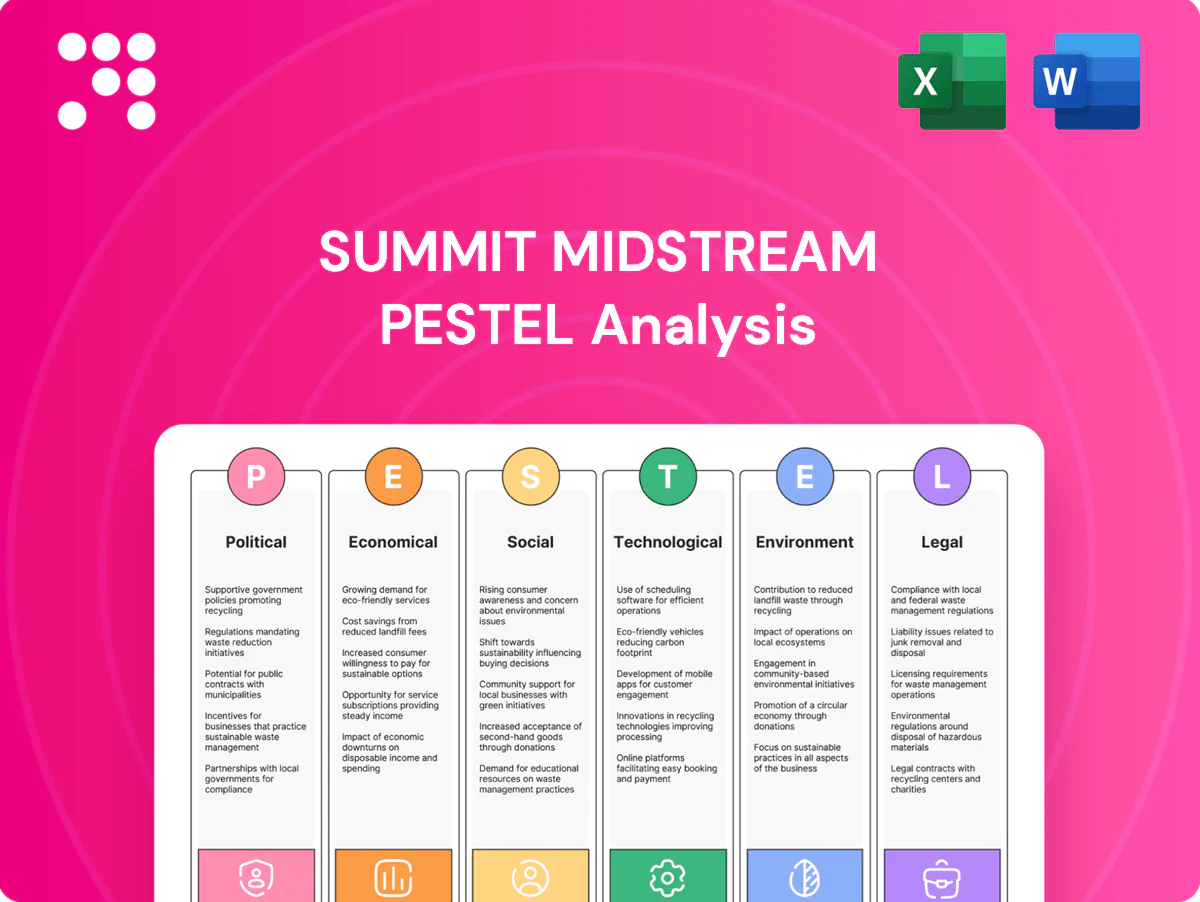
Description
Your Competitive Advantage Starts with This Report
Gain strategic clarity with our PESTLE Analysis of Summit Midstream—concise, data-driven insights on political, economic, social, technological, legal and environmental forces shaping performance. Ideal for investors and strategists, this report reveals risks and growth levers. Buy the full version for the complete, editable analysis and actionable recommendations.
Political factors
Federal energy policy direction
Shifts in U.S. administration priorities can rapidly reallocate support between fossil infrastructure and clean energy, affecting permitting and subsidies for midstream projects. Inflation Reduction Act credits and expanded DOE loan programs have improved bankability for low-carbon projects while natural gas still supplies ≈38% of U.S. electricity (EIA 2023). Pipeline approvals and incentive structures may accelerate or constrain Summit’s buildouts, so Summit must scenario-plan capital allocation under divergent regimes. Policy stability lowers stranded-asset risk and improves contract bankability.
Permitting and siting dynamics
Federal and state permitting timelines materially affect Summit Midstream project cycle time and cost: NEPA EIS reviews have a median duration around 4.5 years while agency reviews like FERC often run 12–18 months, extending schedules and capex. Industry studies show permitting delays can add roughly 10–20% to project costs and require extra mitigation. Proactive stakeholder engagement and route optimization de-risk approvals, and permit certainty directly underpins throughput growth forecasts and EBITDA visibility.
State-level regulatory patchwork
Operations across basins such as the Permian, Williston and Anadarko face differing Texas, New Mexico and North Dakota rules on gathering, flaring and produced-water disposal; the Permian alone accounted for about 50% of US crude production in 2024 (EIA). Regulatory tightening in one state can shift volumes and alter asset utilization across Summit’s footprint, so Summit must keep flexible commercial structures and contracts. Local political changes can rapidly change enforcement intensity, affecting throughput and margins.
Tribal and local governance
Projects crossing tribal lands or counties require separate tribal agreements and benefit-sharing; there are 574 federally recognized tribes in the US (BIA, 2024), so Summit Midstream must negotiate site-specific terms. Local ordinances on setbacks, road use, and noise directly shape construction methods and cost estimates. Building trust and delivering measurable community value shortens permitting and social license timelines; misalignment provokes opposition and legal challenges.
- Mandatory tribal agreements — site-by-site
- Local setbacks/road/noise rules — impact methods/costs
- Community trust reduces delays; misalignment risks litigation
Geopolitical impacts on markets
Geopolitical shocks and OPEC+ voluntary cuts (~3.66 million b/d) have tightened global supply, amplifying U.S. basis differentials and tempering production growth; U.S. crude output averaged about 13.0 million b/d in 2024. Export policy debates on LNG (U.S. liquefaction capacity ~13.7 Bcf/d in 2024) and crude shape upstream drilling and midstream flows. Summit’s basin-specific exposure links revenues indirectly to these shifts, while hedging programs and a diversified basin mix provide shock absorption.
Policy swings raise permitting/subsidy risk; NEPA ~4.5 yrs, gas ≈38% power
Federal policy swings alter permitting/subsidy risk for midstream; IRA and DOE loans improved low‑carbon bankability while gas ≈38% of US power (EIA 2023). NEPA median EIS ~4.5 years, FERC 12–18 months, adding ~10–20% capex risk. State/regional rules and 574 federally recognized tribes require site agreements; Permian ~50% of US crude (2024), OPEC+ cuts ~3.66M b/d.
| Metric | Value |
|---|---|
| US oil (2024) | 13.0M b/d |
| NEPA EIS | ~4.5 yrs |
| Tribes | 574 |
What is included in the product
Detailed Word Document
Explores how macro-environmental factors uniquely affect Summit Midstream across Political, Economic, Social, Technological, Environmental, and Legal dimensions, with data-driven trends and region-specific regulatory context; includes forward-looking insights, detailed sub-points, and clear formatting for executive use in strategy, funding, or scenario planning.
Customizable Excel Spreadsheet
A concise, visually segmented PESTLE summary for Summit Midstream that quickly clarifies external risks and market positioning, easily dropped into presentations or shared across teams to streamline decision-making and planning.
Economic factors
Throughput volume sensitivity
Summit Midstream revenues are highly sensitive to throughput volume because fee-based contracts tie cash flow to gathered and processed volumes; WTI averaged about 80 USD/bbl in 2024, a key driver of upstream activity and utilization. Upstream drilling cycles driven by commodity prices swing utilization; minimum volume commitments and take-or-pay provisions cushion downturns but naturally roll off over contract lives. Basin competitiveness—operators favoring low-basis basins—shapes long-term flow commitments and renewal economics.
Commodity price and basis dynamics
Gathering margins remain relatively insulated from commodity swings, but producer well activity and NGL residue marketing track price spreads; Henry Hub averaged roughly $3–4/MMBtu in 2024, keeping gathering throughput stable. Processing economics hinge on gas‑to‑liquid spreads and shrink, with Mont Belvieu NGL spreads driving margin volatility. Basis blowouts (Waha/Henry moves of ~$-2 to -3/MMBtu in recent stress periods) raise demand for takeaway capacity and recontracting leverage, while stable spreads enable capital recovery on expansions.
Interest rates and refinancing
As a capital-intensive MLP, Summit Midstream faces project hurdle rates and coverage ratios shaped by borrowing costs; with the Fed funds target at 5.25–5.50% and the 10-year Treasury near 4.1% (July 2025) rising rates compress valuations and distributable cash flow. Proactive liability management and a higher fixed-rate debt mix limit coupon volatility, while access to public debt/equity markets determines near-term growth optionality.
Inflation and supply chain costs
Steel, compression, and labor inflation raised Summit Midstream capex and opex, lifting project costs roughly 10–15% in 2024 while labor wage inflation ran about 5–7% year-on-year; indexation clauses in transportation and processing contracts enabled partial pass-through of material inflation but less so for labor.
- capex uplift: ~10–15% (2024)
- labor inflation: ~5–7% YoY (2024)
- indexation: partial pass-through for materials
- procurement/standardization: potential unit cost reduction 5–10%
- schedule discipline: limits overruns, preserves returns
Counterparty credit risk
Concentration of Summit Midstream revenue in a small number of E&P customers exposes cash flows to those producers’ balance-sheet stress; producer bankruptcies can force contract renegotiations or reduce delivered volumes, pressuring midstream cash receipts. Credit enhancements such as letters of credit and diversified take-or-pay contracts materially reduce counterparty risk. Ongoing counterparty monitoring enables early intervention and re-contracting to protect cash flow.
- Customer concentration risk
- Bankruptcy-driven renegotiation risk
- Use of credit enhancements
- Active monitoring and early intervention
Policy swings raise permitting/subsidy risk; NEPA ~4.5 yrs, gas ≈38% power
Summit revenues tied to throughput; WTI ~$80/bbl in 2024 drove upstream activity and utilization. Higher rates (Fed 5.25–5.50%, 10y ~4.1% Jul 2025) plus capex +10–15% and labor +5–7% (2024) raise hurdle rates and compress valuations. Customer concentration and rolling take‑or‑pay terms increase renegotiation and volume risk.
| Metric | Value |
|---|---|
| WTI 2024 | $~80/bbl |
| Fed / 10y (Jul 2025) | 5.25–5.50% / ~4.1% |
| Capex / Labor (2024) | +10–15% / +5–7% |
Preview Before You Purchase
Summit Midstream PESTLE Analysis
The preview shown here is the exact Summit Midstream PESTLE Analysis you’ll receive after purchase—fully formatted, professionally structured, and ready to use. What you see is the final file with complete content and layout, available for immediate download upon payment. No placeholders, no surprises.