Western Union PESTLE Analysis

Plan Smarter. Present Sharper. Compete Stronger.
Unlock strategic clarity with our PESTLE Analysis of Western Union — three to five expert-level insights into political, economic, social, technological, legal, and environmental forces shaping its future. Ideal for investors and strategists, this concise briefing highlights risks and growth levers. Purchase the full report to access the complete, actionable breakdown instantly.
Political factors

Geopolitical sanctions exposure
Sanctions regimes can abruptly close corridors, freeze funds, and force rapid compliance reconfiguration; Western Union operates in 200+ countries and territories and must screen senders, receivers and agents against daily-updated OFAC and EU lists. Heightened geopolitics raises false positives—often 5–10% in high-risk screening—adding operating friction, so geographic diversification mitigates corridor-specific shocks.
Regulatory diplomacy and policy shifts
Host-country changes to remittance rules, exchange controls or cash restrictions force Western Union to reprice corridors and adapt payout channels, impacting margins even as global remittances exceed $600B annually; Western Union operates in 200+ countries with ~500,000 agent locations. Engagement with central banks and ministries preserves access and payouts; sudden tightening can depress volumes and raise compliance costs, so proactive advocacy secures predictable rules.

Political stability in send and receive markets
Political instability disrupts Western Union agent networks, cash liquidity and physical security, forcing rerouting of flows and temporary branch closures. Conflict zones require heightened KYC, sanctions screening and contingency cash management to maintain corridors. Stable political environments underpin predictable corridor growth, while insurance and contingency planning reduce downtime and loss exposure.

Public-sector remittance initiatives
Public-sector remittance initiatives — such as government-sponsored low-cost programs or state-backed rails — can drive scale for Western Union but typically compress fee margins, especially as global remittances exceed 700 billion USD annually (World Bank, recent years).
Non-participation risks losing volume and share to subsidized alternatives; selective engagement and tiered pricing help balance access with profitability.
- Volume boost vs margin squeeze
- Risk: market share loss if excluded
- Mitigation: targeted participation, tiered fees
Foreign relations and migration policy
Migration flows drive remittance volumes: UN recorded 281 million international migrants in 2020 and World Bank reported remittances to low‑ and middle‑income countries at about 626 billion USD in 2022, so visa restrictions in sender markets can directly soften Western Union’s growth while regularization programs often expand formal flows; monitoring policy cycles guides corridor prioritization.
- UN migrants: 281 million (2020)
- World Bank remittances to LMICs: ~626B USD (2022)
- Visa tightening reduces corridor volume
- Regularization expands formal remittances
Sanctions and 5–10% screening false positives trigger rapid remittance corridor closures
Sanctions, sanctions screening false positives (5–10%) and geopolitical shifts force rapid corridor closures and compliance resets for Western Union, active in 200+ countries with ~500,000 agents. Host-country remittance rules, cash controls and public low‑cost rails compress fees but can boost volumes. Migration, visa policy and instability materially shift corridor volumes.
| Metric | Value |
|---|---|
| Countries | 200+ |
| Agent locations | ~500,000 |
| Screening false positives | 5–10% |
| UN migrants (2020) | 281M |
What is included in the product
 Detailed Word Document
Explores how Political, Economic, Social, Technological, Environmental and Legal forces uniquely shape Western Union’s cross-border payments business, with each section supported by data and current trends. Designed for executives and investors, the analysis highlights risks, opportunities and forward-looking implications to inform strategy, compliance and investor communications.

 Customizable Excel Spreadsheet
A clean, summarized Western Union PESTLE for easy reference in meetings and presentations, highlighting regulatory, technological and cross-border risks and opportunities to streamline decision-making.
Economic factors

Global remittance cycle sensitivity
Remittance volumes track employment and wages of migrant workers in developed markets; global remittances to low- and middle-income countries reached about $643 billion in 2023 and were forecast at $652 billion in 2024 (World Bank). Recessions in sender economies depress transfers, while resilience in essential sectors (healthcare, logistics) can stabilize flows. Recipient-country shocks can shift cash-out demand, and active corridor mix management helps Western Union cushion volatility.
FX volatility and corridor economics
Exchange-rate swings change send amounts, pricing and settlement risk, forcing Western Union to adjust margins so payout values remain predictable for recipients. Competitive pricing must reflect wider spreads in volatile corridors while staying marketable to retain flow share. Hedging and netting reduce FX exposure but add treasury costs, and transparent FX practices build trust and improve customer retention.

Interest rates and float income
Higher rate environments (Federal funds target 5.25–5.50% as of July 2025) raise yields on settlement float and customer-held funds, boosting ancillary income versus the low-rate 2020–2021 period. Rate declines compress this revenue stream as short-term yields fall. Treasury optimization—shifting into short-duration, higher-yield instruments while preserving liquidity—can lift net interest margins. Regulatory limits (Basel III/local investment rules) restrict some higher-yield allocations.

Cost inflation and operating leverage
Rising compliance, cybersecurity and labor costs squeeze margins as remittance volumes climb (global remittances $706B in 2023) and average data‑breach costs hit $4.45M in 2023, pushing Western Union to prioritize digitization and process automation to restore operating leverage while balancing growing agent commissions against digital channel adoption.
Competition and price compression
Fintechs and Big Tech wallets are compressing fees and speeding settlement, forcing Western Union to match speed benchmarks while defending margins; Western Union still operates in over 200 countries and territories with 500,000+ agent locations, giving it reach and cash-out ubiquity to differentiate.
- Pressure: fee compression from fintechs and Big Tech
- Expectation: instant rails raising real-time service demand
- Defence: coverage, reliability, cash-out ubiquity, bundled services
Sanctions and 5–10% screening false positives trigger rapid remittance corridor closures
Remittance volumes (LMICs $643B in 2023; $652B forecast 2024) track wages and recessions in sender markets, while FX swings and fee compression from fintechs pressure margins. Higher rates (Fed 5.25–5.50% Jul 2025) boost settlement yield but raise funding costs; compliance/cyber spend (avg breach cost $4.45M in 2023) raises operating expenses.
| Metric | Value |
|---|---|
| Remittances (LMICs) 2023 | $643B |
| Fed target Jul 2025 | 5.25–5.50% |
| Agent locations | 500,000+ |
Preview the Actual Deliverable
Western Union PESTLE Analysis
The preview shown here is the exact Western Union PESTLE Analysis you’ll receive after purchase—fully formatted, professionally structured, and ready to use. The content, layout, and insights visible in the preview are identical to the downloadable file. No placeholders, no edits needed—this is the final document you’ll own upon checkout.

Original: $10.00
-70%$10.00
$3.00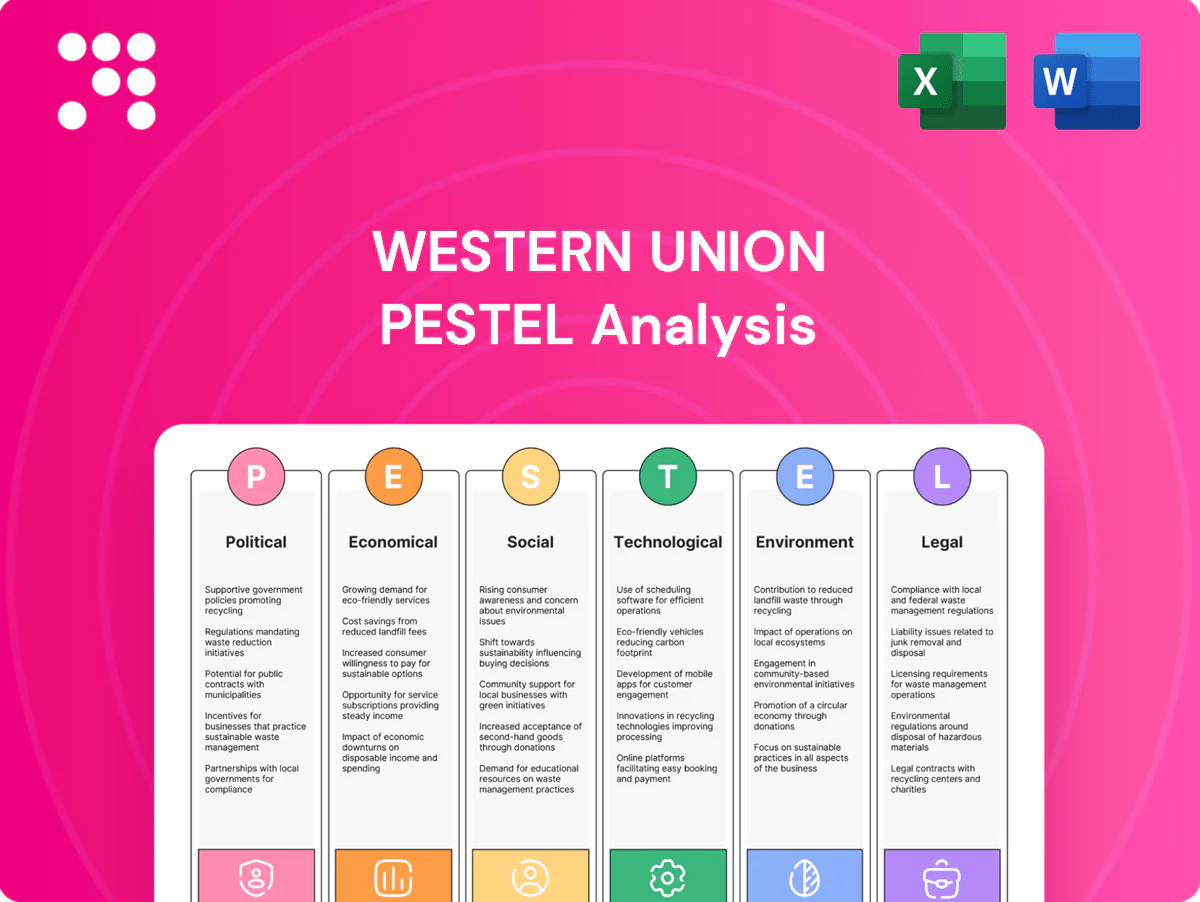
Description
Plan Smarter. Present Sharper. Compete Stronger.
Unlock strategic clarity with our PESTLE Analysis of Western Union — three to five expert-level insights into political, economic, social, technological, legal, and environmental forces shaping its future. Ideal for investors and strategists, this concise briefing highlights risks and growth levers. Purchase the full report to access the complete, actionable breakdown instantly.
Political factors
Geopolitical sanctions exposure
Sanctions regimes can abruptly close corridors, freeze funds, and force rapid compliance reconfiguration; Western Union operates in 200+ countries and territories and must screen senders, receivers and agents against daily-updated OFAC and EU lists. Heightened geopolitics raises false positives—often 5–10% in high-risk screening—adding operating friction, so geographic diversification mitigates corridor-specific shocks.
Regulatory diplomacy and policy shifts
Host-country changes to remittance rules, exchange controls or cash restrictions force Western Union to reprice corridors and adapt payout channels, impacting margins even as global remittances exceed $600B annually; Western Union operates in 200+ countries with ~500,000 agent locations. Engagement with central banks and ministries preserves access and payouts; sudden tightening can depress volumes and raise compliance costs, so proactive advocacy secures predictable rules.
Political stability in send and receive markets
Political instability disrupts Western Union agent networks, cash liquidity and physical security, forcing rerouting of flows and temporary branch closures. Conflict zones require heightened KYC, sanctions screening and contingency cash management to maintain corridors. Stable political environments underpin predictable corridor growth, while insurance and contingency planning reduce downtime and loss exposure.
Public-sector remittance initiatives
Public-sector remittance initiatives — such as government-sponsored low-cost programs or state-backed rails — can drive scale for Western Union but typically compress fee margins, especially as global remittances exceed 700 billion USD annually (World Bank, recent years).
Non-participation risks losing volume and share to subsidized alternatives; selective engagement and tiered pricing help balance access with profitability.
- Volume boost vs margin squeeze
- Risk: market share loss if excluded
- Mitigation: targeted participation, tiered fees
Foreign relations and migration policy
Migration flows drive remittance volumes: UN recorded 281 million international migrants in 2020 and World Bank reported remittances to low‑ and middle‑income countries at about 626 billion USD in 2022, so visa restrictions in sender markets can directly soften Western Union’s growth while regularization programs often expand formal flows; monitoring policy cycles guides corridor prioritization.
- UN migrants: 281 million (2020)
- World Bank remittances to LMICs: ~626B USD (2022)
- Visa tightening reduces corridor volume
- Regularization expands formal remittances
Sanctions and 5–10% screening false positives trigger rapid remittance corridor closures
Sanctions, sanctions screening false positives (5–10%) and geopolitical shifts force rapid corridor closures and compliance resets for Western Union, active in 200+ countries with ~500,000 agents. Host-country remittance rules, cash controls and public low‑cost rails compress fees but can boost volumes. Migration, visa policy and instability materially shift corridor volumes.
| Metric | Value |
|---|---|
| Countries | 200+ |
| Agent locations | ~500,000 |
| Screening false positives | 5–10% |
| UN migrants (2020) | 281M |
What is included in the product
Detailed Word Document
Explores how Political, Economic, Social, Technological, Environmental and Legal forces uniquely shape Western Union’s cross-border payments business, with each section supported by data and current trends. Designed for executives and investors, the analysis highlights risks, opportunities and forward-looking implications to inform strategy, compliance and investor communications.
Customizable Excel Spreadsheet
A clean, summarized Western Union PESTLE for easy reference in meetings and presentations, highlighting regulatory, technological and cross-border risks and opportunities to streamline decision-making.
Economic factors
Global remittance cycle sensitivity
Remittance volumes track employment and wages of migrant workers in developed markets; global remittances to low- and middle-income countries reached about $643 billion in 2023 and were forecast at $652 billion in 2024 (World Bank). Recessions in sender economies depress transfers, while resilience in essential sectors (healthcare, logistics) can stabilize flows. Recipient-country shocks can shift cash-out demand, and active corridor mix management helps Western Union cushion volatility.
FX volatility and corridor economics
Exchange-rate swings change send amounts, pricing and settlement risk, forcing Western Union to adjust margins so payout values remain predictable for recipients. Competitive pricing must reflect wider spreads in volatile corridors while staying marketable to retain flow share. Hedging and netting reduce FX exposure but add treasury costs, and transparent FX practices build trust and improve customer retention.
Interest rates and float income
Higher rate environments (Federal funds target 5.25–5.50% as of July 2025) raise yields on settlement float and customer-held funds, boosting ancillary income versus the low-rate 2020–2021 period. Rate declines compress this revenue stream as short-term yields fall. Treasury optimization—shifting into short-duration, higher-yield instruments while preserving liquidity—can lift net interest margins. Regulatory limits (Basel III/local investment rules) restrict some higher-yield allocations.
Cost inflation and operating leverage
Rising compliance, cybersecurity and labor costs squeeze margins as remittance volumes climb (global remittances $706B in 2023) and average data‑breach costs hit $4.45M in 2023, pushing Western Union to prioritize digitization and process automation to restore operating leverage while balancing growing agent commissions against digital channel adoption.
Competition and price compression
Fintechs and Big Tech wallets are compressing fees and speeding settlement, forcing Western Union to match speed benchmarks while defending margins; Western Union still operates in over 200 countries and territories with 500,000+ agent locations, giving it reach and cash-out ubiquity to differentiate.
- Pressure: fee compression from fintechs and Big Tech
- Expectation: instant rails raising real-time service demand
- Defence: coverage, reliability, cash-out ubiquity, bundled services
Sanctions and 5–10% screening false positives trigger rapid remittance corridor closures
Remittance volumes (LMICs $643B in 2023; $652B forecast 2024) track wages and recessions in sender markets, while FX swings and fee compression from fintechs pressure margins. Higher rates (Fed 5.25–5.50% Jul 2025) boost settlement yield but raise funding costs; compliance/cyber spend (avg breach cost $4.45M in 2023) raises operating expenses.
| Metric | Value |
|---|---|
| Remittances (LMICs) 2023 | $643B |
| Fed target Jul 2025 | 5.25–5.50% |
| Agent locations | 500,000+ |
Preview the Actual Deliverable
Western Union PESTLE Analysis
The preview shown here is the exact Western Union PESTLE Analysis you’ll receive after purchase—fully formatted, professionally structured, and ready to use. The content, layout, and insights visible in the preview are identical to the downloadable file. No placeholders, no edits needed—this is the final document you’ll own upon checkout.