Carl Zeiss Meditec PESTLE Analysis

Plan Smarter. Present Sharper. Compete Stronger.
Our Carl Zeiss Meditec PESTLE Analysis reveals how political, economic, social, technological, legal, and environmental forces shape the company’s prospects and risks. Ideal for investors, consultants, and strategists, it condenses critical external insights into actionable takeaways. Purchase the full report to access the complete, editable analysis and make smarter decisions.
Political factors

Healthcare reimbursement policy
Public payer rules across the EU, US and Asia—with Medicare covering ~3.7 million US cataract surgeries annually—drive uptake of Zeiss Meditec ophthalmic diagnostics and surgical systems by underwriting procedure volumes and device placements.
Favorable reimbursement for cataract and retinal procedures accelerates system installs and premium IOL mix upgrades in funded settings.
Shifts toward value-based care and outcome-linked payments (CMS and EU pilots) can reweight demand toward technologies with proven outcomes and lower total cost of care.
Monitoring HTA decisions (NICE, IQWiG) and country tender frameworks is critical for tailored go-to-market and pricing strategies.
Geopolitical trade dynamics
Tariffs, export controls and sanctions can disrupt Carl Zeiss Meditec’s component sourcing and sales to sensitive markets, risking delays in a business that generated about €1.9bn in revenue in FY 2024. Diversifying manufacturing footprints—Germany, US and Asia—reduces exposure to single-country risk and aligns with industry moves to shorten China-dependent supply chains. Political tensions can lengthen regulatory clearances or tender timelines, increasing time-to-market. Strengthening supply chain resilience and maintaining inventory buffers mitigates such shocks.

Public hospital procurement
Government-run tenders heavily shape equipment turnover cycles and pricing for Carl Zeiss Meditec, with public-sector contracts accounting for a significant portion of hospital device procurement; ZEISS Meditec reported group revenue of about 1.78 billion EUR in FY 2024, underscoring exposure to tender timing. Election cycles and delayed budget approvals create lumpiness in orders, compressing quarter-to-quarter visibility. Local content and preference policies in markets like India and Brazil can reduce win rates unless compliance is met. Strong key-account engagement and robust service SLAs materially improve tender outcomes and retention.

Industrial policy and incentives
Subsidies for medtech innovation, manufacturing and training reduce cost-to-serve; Germany’s medtech sector posts roughly €40bn turnover and ~200,000 jobs, attracting national grants and KfW loans. EU programmes (Horizon Europe 2021–27 budget €95.5bn) and APAC cluster funds channel billions to R&D and digital health. Policy-driven aging-care investment expands ophthalmology infrastructure, but eligibility often requires localization and workforce commitments.
- Germany: €40bn turnover, ~200,000 jobs
- Horizon Europe: €95.5bn (2021–27)
- APAC/EU grants: billions for R&D
- Eligibility: localization and workforce conditions
Pandemic and public health priorities
Government pandemic responses can reprioritize elective procedures and capital spending; an estimated 28.4 million elective operations were canceled worldwide in early COVID waves (Lancet 2020), creating rebound demand in surgical ophthalmology as backlogs clear. Increased infection‑control funding pushes specs toward single‑use disposables and sealed systems, while preparedness policies accelerate remote diagnostics and connected-device adoption (telemedicine market CAGR ~16% to 2027).
- Elective backlog: 28.4M canceled
- Rebound demand: higher surgical volumes
- Infection control: stronger specs, disposables
- Policy shift: remote diagnostics, connected devices (telemedicine CAGR ~16%)
Payer rules, ~3.7M cataracts & €1.9bn device market
Public payer rules (Medicare ~3.7M US cataracts/year) and favorable reimbursement underpin device uptake and ZEISS Meditec revenue (≈€1.9bn FY2024). Value‑based care, HTA/tenders and tariffs/sanctions can reweight procurement and delay access. Elective backlog (28.4M) and telemedicine growth (CAGR ~16% to 2027) reshape demand and specs.
| Metric | Value |
|---|---|
| US cataracts/year | ~3.7M |
| ZEISS Meditec rev FY2024 | ≈€1.9bn |
| Elective backlog (COVID) | 28.4M |
| Telemedicine CAGR | ~16% to 2027 |
What is included in the product
 Detailed Word Document
Provides a concise PESTLE overview of Carl Zeiss Meditec, examining Political, Economic, Social, Technological, Environmental and Legal forces with data-backed trends, tailored for executives and investors to identify risks, opportunities and actionable, forward-looking strategic implications.

 Customizable Excel Spreadsheet
Concise, visually segmented PESTLE summary of Carl Zeiss Meditec that can be dropped into presentations, annotated for regional or business-line specifics, and easily shared to streamline external risk discussions and align strategic planning across teams.
Economic factors

Healthcare budget cycles
Macro growth and fiscal space drive hospital capex for microscopes and diagnostic platforms, with OECD countries spending on average 8.8% of GDP on health in 2022, constraining discretionary equipment purchases in weaker economies. Tight budgets push hospitals toward refurbishment, leasing or service-based models—Zeiss and peers reported growing service contract mix as capital purchases softened. Inflation-adjusted budgets erode pricing power and shift mix to consumables and services, while long sales cycles (often 12–24 months) require robust pipeline visibility and order backlog management.
Currency volatility
Carl Zeiss Meditec reports revenue of about €2.2bn (FY2024) while booking significant sales in USD and other currencies, creating FX risk as costs are spread across Europe, Americas and APAC. Emerging market exposure—roughly 25–30% of sales—can swing reported growth and margins by several percentage points when local currencies devalue. Active hedging policies and natural currency offsets in sourcing have historically stabilized EBITDA impacts. Contractual pricing clauses in tenders also help mitigate sharp devaluations in key markets.

Procedure volumes and demographics
Aging populations boost cataract and retinal procedure volumes—UN projects one in six people will be 65+ by 2050—supporting steady demand; global cataract surgeries are ~20 million annually. Economic downturns can delay private-pay upgrades and premium IOL adoption, compressing ASPs. Insurance coverage depth shapes case mix and reimbursement levels. High installed-base utilization increases recurring services and consumables revenue.

Cost inflation and supply inputs
Semiconductors, optics and precision components face cyclical shortages and price spikes; the global semiconductor market was about US$600bn in 2023 and lead times for key parts often exceed 12–20 weeks. Rising logistics and energy costs have pushed COGS and extended delivery timelines. Vendor consolidation improves scale but increases supplier dependency; value engineering and dual‑sourcing protect gross margins.
- Lead times: 12–20+ weeks
- Global semi market ~US$600bn (2023)
- Higher logistics/energy → ↑COGS
- Consolidation → dependency risk
- Value engineering, dual‑sourcing → margin defense
Capital markets and M&A
Payer rules, ~3.7M cataracts & €1.9bn device market
Hospital capex drives device demand but OECD health spend was 8.8% of GDP (2022), limiting discretionary buys. CZM revenue ~€2.2bn (FY2024) with 25–30% sales in emerging markets, exposing FX and margin risk. Higher rates (Fed 5.25–5.50% in 2024–25) tighten financing, boosting services and leasing models.
| Metric | Value |
|---|---|
| OECD health spend | 8.8% GDP (2022) |
| CZM revenue | €2.2bn (FY2024) |
| EM share | 25–30% |
| Fed rate | 5.25–5.50% (2024–25) |
Preview Before You Purchase
Carl Zeiss Meditec PESTLE Analysis
The preview shown here is the exact Carl Zeiss Meditec PESTLE Analysis you’ll receive after purchase—fully formatted and ready to use. This real screenshot reflects the final document delivered exactly as shown. No placeholders or teasers; the content and structure are identical to the downloadable file.

Original: $10.00
-70%$10.00
$3.00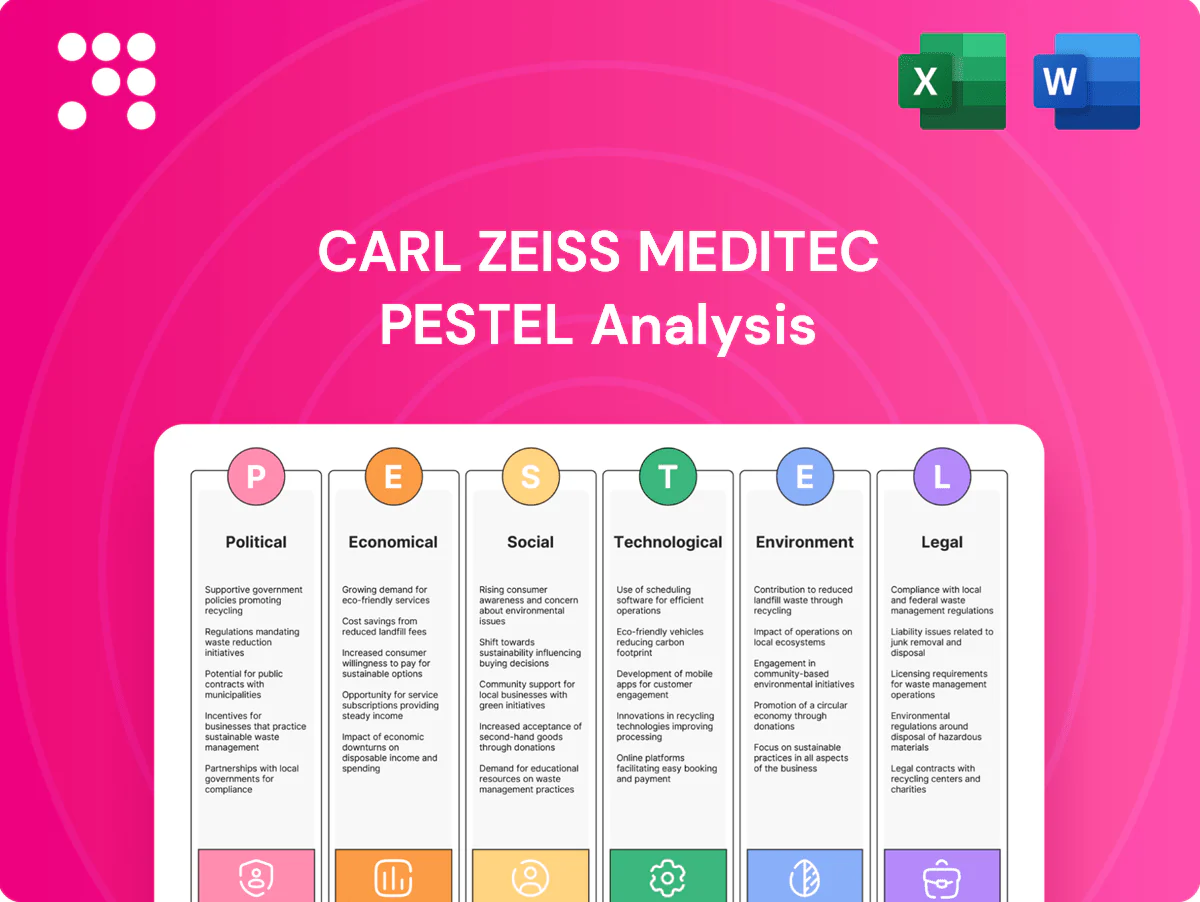
Description
Plan Smarter. Present Sharper. Compete Stronger.
Our Carl Zeiss Meditec PESTLE Analysis reveals how political, economic, social, technological, legal, and environmental forces shape the company’s prospects and risks. Ideal for investors, consultants, and strategists, it condenses critical external insights into actionable takeaways. Purchase the full report to access the complete, editable analysis and make smarter decisions.
Political factors
Healthcare reimbursement policy
Public payer rules across the EU, US and Asia—with Medicare covering ~3.7 million US cataract surgeries annually—drive uptake of Zeiss Meditec ophthalmic diagnostics and surgical systems by underwriting procedure volumes and device placements.
Favorable reimbursement for cataract and retinal procedures accelerates system installs and premium IOL mix upgrades in funded settings.
Shifts toward value-based care and outcome-linked payments (CMS and EU pilots) can reweight demand toward technologies with proven outcomes and lower total cost of care.
Monitoring HTA decisions (NICE, IQWiG) and country tender frameworks is critical for tailored go-to-market and pricing strategies.
Geopolitical trade dynamics
Tariffs, export controls and sanctions can disrupt Carl Zeiss Meditec’s component sourcing and sales to sensitive markets, risking delays in a business that generated about €1.9bn in revenue in FY 2024. Diversifying manufacturing footprints—Germany, US and Asia—reduces exposure to single-country risk and aligns with industry moves to shorten China-dependent supply chains. Political tensions can lengthen regulatory clearances or tender timelines, increasing time-to-market. Strengthening supply chain resilience and maintaining inventory buffers mitigates such shocks.
Public hospital procurement
Government-run tenders heavily shape equipment turnover cycles and pricing for Carl Zeiss Meditec, with public-sector contracts accounting for a significant portion of hospital device procurement; ZEISS Meditec reported group revenue of about 1.78 billion EUR in FY 2024, underscoring exposure to tender timing. Election cycles and delayed budget approvals create lumpiness in orders, compressing quarter-to-quarter visibility. Local content and preference policies in markets like India and Brazil can reduce win rates unless compliance is met. Strong key-account engagement and robust service SLAs materially improve tender outcomes and retention.
Industrial policy and incentives
Subsidies for medtech innovation, manufacturing and training reduce cost-to-serve; Germany’s medtech sector posts roughly €40bn turnover and ~200,000 jobs, attracting national grants and KfW loans. EU programmes (Horizon Europe 2021–27 budget €95.5bn) and APAC cluster funds channel billions to R&D and digital health. Policy-driven aging-care investment expands ophthalmology infrastructure, but eligibility often requires localization and workforce commitments.
- Germany: €40bn turnover, ~200,000 jobs
- Horizon Europe: €95.5bn (2021–27)
- APAC/EU grants: billions for R&D
- Eligibility: localization and workforce conditions
Pandemic and public health priorities
Government pandemic responses can reprioritize elective procedures and capital spending; an estimated 28.4 million elective operations were canceled worldwide in early COVID waves (Lancet 2020), creating rebound demand in surgical ophthalmology as backlogs clear. Increased infection‑control funding pushes specs toward single‑use disposables and sealed systems, while preparedness policies accelerate remote diagnostics and connected-device adoption (telemedicine market CAGR ~16% to 2027).
- Elective backlog: 28.4M canceled
- Rebound demand: higher surgical volumes
- Infection control: stronger specs, disposables
- Policy shift: remote diagnostics, connected devices (telemedicine CAGR ~16%)
Payer rules, ~3.7M cataracts & €1.9bn device market
Public payer rules (Medicare ~3.7M US cataracts/year) and favorable reimbursement underpin device uptake and ZEISS Meditec revenue (≈€1.9bn FY2024). Value‑based care, HTA/tenders and tariffs/sanctions can reweight procurement and delay access. Elective backlog (28.4M) and telemedicine growth (CAGR ~16% to 2027) reshape demand and specs.
| Metric | Value |
|---|---|
| US cataracts/year | ~3.7M |
| ZEISS Meditec rev FY2024 | ≈€1.9bn |
| Elective backlog (COVID) | 28.4M |
| Telemedicine CAGR | ~16% to 2027 |
What is included in the product
Detailed Word Document
Provides a concise PESTLE overview of Carl Zeiss Meditec, examining Political, Economic, Social, Technological, Environmental and Legal forces with data-backed trends, tailored for executives and investors to identify risks, opportunities and actionable, forward-looking strategic implications.
Customizable Excel Spreadsheet
Concise, visually segmented PESTLE summary of Carl Zeiss Meditec that can be dropped into presentations, annotated for regional or business-line specifics, and easily shared to streamline external risk discussions and align strategic planning across teams.
Economic factors
Healthcare budget cycles
Macro growth and fiscal space drive hospital capex for microscopes and diagnostic platforms, with OECD countries spending on average 8.8% of GDP on health in 2022, constraining discretionary equipment purchases in weaker economies. Tight budgets push hospitals toward refurbishment, leasing or service-based models—Zeiss and peers reported growing service contract mix as capital purchases softened. Inflation-adjusted budgets erode pricing power and shift mix to consumables and services, while long sales cycles (often 12–24 months) require robust pipeline visibility and order backlog management.
Currency volatility
Carl Zeiss Meditec reports revenue of about €2.2bn (FY2024) while booking significant sales in USD and other currencies, creating FX risk as costs are spread across Europe, Americas and APAC. Emerging market exposure—roughly 25–30% of sales—can swing reported growth and margins by several percentage points when local currencies devalue. Active hedging policies and natural currency offsets in sourcing have historically stabilized EBITDA impacts. Contractual pricing clauses in tenders also help mitigate sharp devaluations in key markets.
Procedure volumes and demographics
Aging populations boost cataract and retinal procedure volumes—UN projects one in six people will be 65+ by 2050—supporting steady demand; global cataract surgeries are ~20 million annually. Economic downturns can delay private-pay upgrades and premium IOL adoption, compressing ASPs. Insurance coverage depth shapes case mix and reimbursement levels. High installed-base utilization increases recurring services and consumables revenue.
Cost inflation and supply inputs
Semiconductors, optics and precision components face cyclical shortages and price spikes; the global semiconductor market was about US$600bn in 2023 and lead times for key parts often exceed 12–20 weeks. Rising logistics and energy costs have pushed COGS and extended delivery timelines. Vendor consolidation improves scale but increases supplier dependency; value engineering and dual‑sourcing protect gross margins.
- Lead times: 12–20+ weeks
- Global semi market ~US$600bn (2023)
- Higher logistics/energy → ↑COGS
- Consolidation → dependency risk
- Value engineering, dual‑sourcing → margin defense
Capital markets and M&A
Payer rules, ~3.7M cataracts & €1.9bn device market
Hospital capex drives device demand but OECD health spend was 8.8% of GDP (2022), limiting discretionary buys. CZM revenue ~€2.2bn (FY2024) with 25–30% sales in emerging markets, exposing FX and margin risk. Higher rates (Fed 5.25–5.50% in 2024–25) tighten financing, boosting services and leasing models.
| Metric | Value |
|---|---|
| OECD health spend | 8.8% GDP (2022) |
| CZM revenue | €2.2bn (FY2024) |
| EM share | 25–30% |
| Fed rate | 5.25–5.50% (2024–25) |
Preview Before You Purchase
Carl Zeiss Meditec PESTLE Analysis
The preview shown here is the exact Carl Zeiss Meditec PESTLE Analysis you’ll receive after purchase—fully formatted and ready to use. This real screenshot reflects the final document delivered exactly as shown. No placeholders or teasers; the content and structure are identical to the downloadable file.