TMX PESTLE Analysis

Skip the Research. Get the Strategy.
Unlock how political shifts, economic cycles, and tech trends are shaping TMX with our concise PESTLE Analysis—designed for investors and strategists who need actionable insight fast. Dive deeper: purchase the full report to access detailed risk assessments, growth drivers, and ready-to-use recommendations.
Political factors

Federal–provincial policy alignment
Canada’s split oversight across 13 provincial/territorial securities regulators shapes rules, approvals and supervision for TMX venues, affecting everything from trading rules to prospectus requirements. Policy divergence—notably Ontario (≈38% of national GDP) versus Québec (≈20%) priorities—can alter listing standards and market structure. Consistent intergovernmental coordination supports stability, while fragmentation raises compliance complexity, so TMX must engage multi‑jurisdictionally to mitigate rule conflicts.
U.S.–Canada relations and cross‑border capital
U.S.–Canada trade exceeds US$700 billion annually, and close diplomatic ties drive issuer pipelines, cross‑listings and investor participation that feed TMX liquidity. Harmonized policies and information‑sharing MOUs between Canadian regulators and the SEC/CFTC reduce frictions and ease access to U.S. markets. Geopolitical tensions or tariffs can rapidly suppress cross‑border issuance and trading activity. TMX competitiveness depends on seamless connectivity and regulatory reciprocity.

Resource and energy policy stance
Canada's net-zero by 2050 target and rising federal carbon pricing (policy pathway to C$170/t by 2030) directly affect TMX-listed energy and critical‑minerals issuers such as Suncor and Cenovus. Supportive permitting and infrastructure accelerate IPOs and secondary issuance for resource developers. Stricter environmental rules are redirecting capital toward transition assets and green metals. TMX benefits from policy clarity and predictability for market planning.

Government support for innovation and fintech
Public programs for fintech, AI and digital assets—including OSC LaunchPad (established 2019) and provincial sandbox pilots—shape TMX’s technology roadmap and new product timelines by enabling live testing with regulators.
Sandboxes and pilot regimes lower barriers to market innovation, while reduced government support or restrictive stances can delay launches and increase compliance costs.
Stable public funding and clear regulatory guidelines accelerate platform upgrades and integrations, improving time-to-market and operational resilience.
- OSC LaunchPad est. 2019
- Regulatory sandboxes enable live tests with regulators
- Reduced support raises compliance delays and costs
- Stable funding and clear rules facilitate upgrades
Geopolitical sanctions and global alignment
Canada’s sanctions and foreign policy positions affect listings, trading eligibility, and surveillance burdens for TMX, with allied alignment simplifying compliance while unilateral measures increase screening complexity. Market participants seek certainty on restricted securities and secondary trading; TMX oversees a CAD 3.4 trillion TSX market-cap footprint (2024). TMX must maintain robust controls to avoid enforcement risk.
- Impact: listings and trading eligibility
- Compliance: alignment vs unilateral complexity
- Market demand: certainty on restricted securities
- Control need: avoid enforcement and fines
Canada's 13 regulators fragment markets; cross-border trade > US$700bn
Canada's split securities oversight across 13 regulators and provincial policy divergence (Ontario ≈38% GDP, Québec ≈20%) raises compliance complexity for TMX. US–Canada trade >US$700bn and TSX market cap CAD3.4tn (2024) tie TMX to cross‑border flows; regulatory harmonization reduces frictions. Federal net‑zero by 2050 and carbon pricing pathway to C$170/t by 2030 shift capital toward transition assets.
| Factor | Metric | Impact |
|---|---|---|
| Jurisdictional split | 13 regulators | Higher compliance costs |
| Cross‑border | US$>700bn trade | Liquidity linkage |
| Climate policy | C$170/t by 2030 | Capital reallocation |
What is included in the product
 Detailed Word Document
Explores how Political, Economic, Social, Technological, Environmental and Legal forces uniquely affect the TMX, combining data-backed trends and forward-looking insights to identify threats and opportunities for executives, investors and strategists; delivered in clean, report-ready formatting for scenario planning and funding support.

 Customizable Excel Spreadsheet
A clean, summarized TMX PESTLE that’s visually segmented by category for quick interpretation at a glance, easily dropped into presentations or shared across teams to support fast, aligned decision-making.
Economic factors

Interest rates and liquidity cycles
Bank of Canada policy drives risk appetite, valuations and trading volumes: after a 5.00% peak in 2023 the policy rate eased to about 4.25% by July 2025, supporting renewed equity issuance and derivatives activity. Rate cuts historically lift IPO and secondary issuance and derivatives notional; hikes compress multiples and flows. Volatility spikes boost trading volumes but have mixed effects on listings, and TMX revenues closely track these liquidity swings.
Commodity price exposure
Canada’s market is heavily weighted to energy and materials, which comprise roughly 35% of the S&P/TSX Composite by market cap, linking TMX revenue and volumes to commodity cycles. Higher commodity prices historically boost equity capital raising and hedging demand, while downturns cut IPO activity and shift trading toward defensive sectors. TMX’s derivatives and data products—with derivatives ADV rising double digits in 2024—help offset cash‑equity cyclicality.

CAD FX swings and foreign investor flows
CAD FX swings alter international buying power and hedging needs; CAD traded near US0.75 in mid‑2025, making Canadian assets cheaper for foreign buyers and supporting higher turnover. A weaker CAD helped attract roughly C$30bn in foreign portfolio inflows to Canadian equities in 2024, boosting TMX volumes. FX volatility has increased derivatives usage and market data demand, while FX stability underpins steady valuation benchmarks.

Global growth and capital formation
Global risk sentiment and GDP trends shape issuance windows for Canadian and international issuers; IMF projected global GDP growth of 3.2% in 2024 and 3.0% in 2025, supporting broader issuance when momentum holds. Strong growth expands sector participation beyond resources into technology and renewables, while slowdowns compress pipelines and depress listing fees. TMX’s diversified venues (TSX, TSXV, Montreal Exchange) cushion but cannot eliminate cyclical issuance swings.
- IMF global GDP: 3.2% (2024), 3.0% (2025)
- Growth expands non-resource issuers (tech, renewables)
- Slowdowns compress pipelines and fees
- TMX diversification reduces but does not remove cyclicality
Competition from global exchanges
Rival U.S. and European exchanges vie for listings, liquidity and data clients, with U.S. ETF assets exceeding 8 trillion USD in 2024, concentrating issuer attention and order flow. Fee pressure and incentive programs continue to reallocate execution; superior liquidity pools attract marquee issuers and deepen market quality. TMX must differentiate through sector depth, execution quality and technology to retain and grow listings.
- Competition: U.S./EU venues target listings and data
- Liquidity: deeper pools draw marquee issuers
- Fees: incentive programs shift order flow
- TMX focus: sector depth, market quality, technology
Canada's 13 regulators fragment markets; cross-border trade > US$700bn
BoC rate ~4.25% (Jul 2025) moderates risk appetite and issuance; volatility lifts trading volumes. Energy+materials ~35% of S&P/TSX ties TMX to commodity cycles; derivatives growth offsets cash cyclicality. CAD ~0.75 (mid‑2025) and C$30bn foreign inflows (2024) boosted turnover; IMF GDP 3.2% (2024)/3.0% (2025) supports issuance.
| Metric | Value |
|---|---|
| BoC rate (Jul 2025) | 4.25% |
| Energy+Materials (TSX) | ~35% |
| CAD vs USD (mid‑2025) | ~0.75 |
| Foreign inflows (2024) | C$30bn |
| IMF global GDP | 3.2% (2024) / 3.0% (2025) |
| US ETF assets (2024) | >$8tn |
Same Document Delivered
TMX PESTLE Analysis
The preview of the TMX PESTLE Analysis shown here is the exact document you’ll receive after purchase—fully formatted, professionally structured, and ready to use. This is the real file, not a teaser or placeholder, so the layout, content, and structure match the download you’ll get at checkout. After payment you’ll instantly receive this same final document.

Original: $10.00
-70%$10.00
$3.00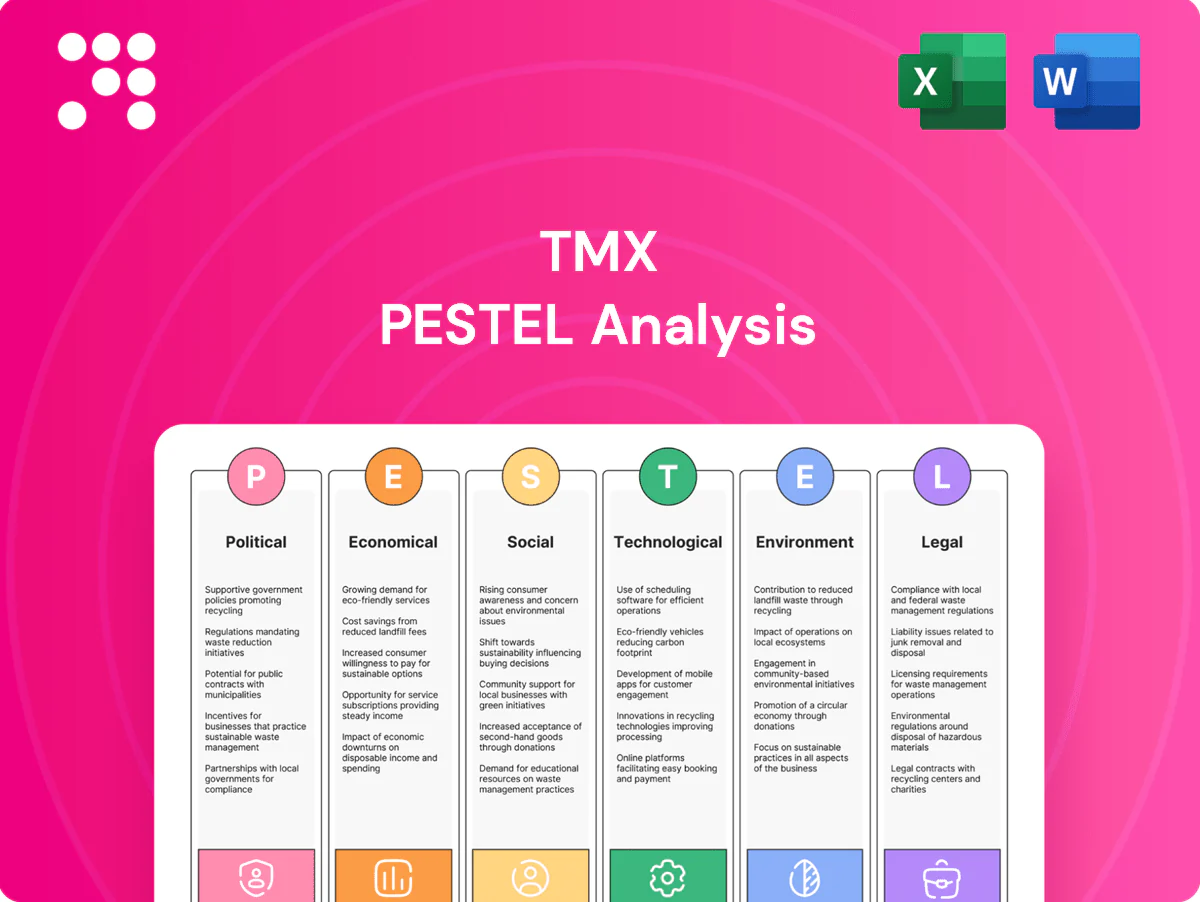
Description
Skip the Research. Get the Strategy.
Unlock how political shifts, economic cycles, and tech trends are shaping TMX with our concise PESTLE Analysis—designed for investors and strategists who need actionable insight fast. Dive deeper: purchase the full report to access detailed risk assessments, growth drivers, and ready-to-use recommendations.
Political factors
Federal–provincial policy alignment
Canada’s split oversight across 13 provincial/territorial securities regulators shapes rules, approvals and supervision for TMX venues, affecting everything from trading rules to prospectus requirements. Policy divergence—notably Ontario (≈38% of national GDP) versus Québec (≈20%) priorities—can alter listing standards and market structure. Consistent intergovernmental coordination supports stability, while fragmentation raises compliance complexity, so TMX must engage multi‑jurisdictionally to mitigate rule conflicts.
U.S.–Canada relations and cross‑border capital
U.S.–Canada trade exceeds US$700 billion annually, and close diplomatic ties drive issuer pipelines, cross‑listings and investor participation that feed TMX liquidity. Harmonized policies and information‑sharing MOUs between Canadian regulators and the SEC/CFTC reduce frictions and ease access to U.S. markets. Geopolitical tensions or tariffs can rapidly suppress cross‑border issuance and trading activity. TMX competitiveness depends on seamless connectivity and regulatory reciprocity.
Resource and energy policy stance
Canada's net-zero by 2050 target and rising federal carbon pricing (policy pathway to C$170/t by 2030) directly affect TMX-listed energy and critical‑minerals issuers such as Suncor and Cenovus. Supportive permitting and infrastructure accelerate IPOs and secondary issuance for resource developers. Stricter environmental rules are redirecting capital toward transition assets and green metals. TMX benefits from policy clarity and predictability for market planning.
Government support for innovation and fintech
Public programs for fintech, AI and digital assets—including OSC LaunchPad (established 2019) and provincial sandbox pilots—shape TMX’s technology roadmap and new product timelines by enabling live testing with regulators.
Sandboxes and pilot regimes lower barriers to market innovation, while reduced government support or restrictive stances can delay launches and increase compliance costs.
Stable public funding and clear regulatory guidelines accelerate platform upgrades and integrations, improving time-to-market and operational resilience.
- OSC LaunchPad est. 2019
- Regulatory sandboxes enable live tests with regulators
- Reduced support raises compliance delays and costs
- Stable funding and clear rules facilitate upgrades
Geopolitical sanctions and global alignment
Canada’s sanctions and foreign policy positions affect listings, trading eligibility, and surveillance burdens for TMX, with allied alignment simplifying compliance while unilateral measures increase screening complexity. Market participants seek certainty on restricted securities and secondary trading; TMX oversees a CAD 3.4 trillion TSX market-cap footprint (2024). TMX must maintain robust controls to avoid enforcement risk.
- Impact: listings and trading eligibility
- Compliance: alignment vs unilateral complexity
- Market demand: certainty on restricted securities
- Control need: avoid enforcement and fines
Canada's 13 regulators fragment markets; cross-border trade > US$700bn
Canada's split securities oversight across 13 regulators and provincial policy divergence (Ontario ≈38% GDP, Québec ≈20%) raises compliance complexity for TMX. US–Canada trade >US$700bn and TSX market cap CAD3.4tn (2024) tie TMX to cross‑border flows; regulatory harmonization reduces frictions. Federal net‑zero by 2050 and carbon pricing pathway to C$170/t by 2030 shift capital toward transition assets.
| Factor | Metric | Impact |
|---|---|---|
| Jurisdictional split | 13 regulators | Higher compliance costs |
| Cross‑border | US$>700bn trade | Liquidity linkage |
| Climate policy | C$170/t by 2030 | Capital reallocation |
What is included in the product
Detailed Word Document
Explores how Political, Economic, Social, Technological, Environmental and Legal forces uniquely affect the TMX, combining data-backed trends and forward-looking insights to identify threats and opportunities for executives, investors and strategists; delivered in clean, report-ready formatting for scenario planning and funding support.
Customizable Excel Spreadsheet
A clean, summarized TMX PESTLE that’s visually segmented by category for quick interpretation at a glance, easily dropped into presentations or shared across teams to support fast, aligned decision-making.
Economic factors
Interest rates and liquidity cycles
Bank of Canada policy drives risk appetite, valuations and trading volumes: after a 5.00% peak in 2023 the policy rate eased to about 4.25% by July 2025, supporting renewed equity issuance and derivatives activity. Rate cuts historically lift IPO and secondary issuance and derivatives notional; hikes compress multiples and flows. Volatility spikes boost trading volumes but have mixed effects on listings, and TMX revenues closely track these liquidity swings.
Commodity price exposure
Canada’s market is heavily weighted to energy and materials, which comprise roughly 35% of the S&P/TSX Composite by market cap, linking TMX revenue and volumes to commodity cycles. Higher commodity prices historically boost equity capital raising and hedging demand, while downturns cut IPO activity and shift trading toward defensive sectors. TMX’s derivatives and data products—with derivatives ADV rising double digits in 2024—help offset cash‑equity cyclicality.
CAD FX swings and foreign investor flows
CAD FX swings alter international buying power and hedging needs; CAD traded near US0.75 in mid‑2025, making Canadian assets cheaper for foreign buyers and supporting higher turnover. A weaker CAD helped attract roughly C$30bn in foreign portfolio inflows to Canadian equities in 2024, boosting TMX volumes. FX volatility has increased derivatives usage and market data demand, while FX stability underpins steady valuation benchmarks.
Global growth and capital formation
Global risk sentiment and GDP trends shape issuance windows for Canadian and international issuers; IMF projected global GDP growth of 3.2% in 2024 and 3.0% in 2025, supporting broader issuance when momentum holds. Strong growth expands sector participation beyond resources into technology and renewables, while slowdowns compress pipelines and depress listing fees. TMX’s diversified venues (TSX, TSXV, Montreal Exchange) cushion but cannot eliminate cyclical issuance swings.
- IMF global GDP: 3.2% (2024), 3.0% (2025)
- Growth expands non-resource issuers (tech, renewables)
- Slowdowns compress pipelines and fees
- TMX diversification reduces but does not remove cyclicality
Competition from global exchanges
Rival U.S. and European exchanges vie for listings, liquidity and data clients, with U.S. ETF assets exceeding 8 trillion USD in 2024, concentrating issuer attention and order flow. Fee pressure and incentive programs continue to reallocate execution; superior liquidity pools attract marquee issuers and deepen market quality. TMX must differentiate through sector depth, execution quality and technology to retain and grow listings.
- Competition: U.S./EU venues target listings and data
- Liquidity: deeper pools draw marquee issuers
- Fees: incentive programs shift order flow
- TMX focus: sector depth, market quality, technology
Canada's 13 regulators fragment markets; cross-border trade > US$700bn
BoC rate ~4.25% (Jul 2025) moderates risk appetite and issuance; volatility lifts trading volumes. Energy+materials ~35% of S&P/TSX ties TMX to commodity cycles; derivatives growth offsets cash cyclicality. CAD ~0.75 (mid‑2025) and C$30bn foreign inflows (2024) boosted turnover; IMF GDP 3.2% (2024)/3.0% (2025) supports issuance.
| Metric | Value |
|---|---|
| BoC rate (Jul 2025) | 4.25% |
| Energy+Materials (TSX) | ~35% |
| CAD vs USD (mid‑2025) | ~0.75 |
| Foreign inflows (2024) | C$30bn |
| IMF global GDP | 3.2% (2024) / 3.0% (2025) |
| US ETF assets (2024) | >$8tn |
Same Document Delivered
TMX PESTLE Analysis
The preview of the TMX PESTLE Analysis shown here is the exact document you’ll receive after purchase—fully formatted, professionally structured, and ready to use. This is the real file, not a teaser or placeholder, so the layout, content, and structure match the download you’ll get at checkout. After payment you’ll instantly receive this same final document.