WidePoint PESTLE Analysis

Your Shortcut to Market Insight Starts Here
Gain a strategic edge with our PESTLE Analysis of WidePoint—concise, expert-driven insights into political, economic, social, technological, legal, and environmental forces shaping the firm. Use this to spot risks and growth areas for investment or strategy. Purchase the full, downloadable report for the complete breakdown.
Political factors

Federal cyber priorities
Executive Order 14028 (May 12, 2021) and CISA directives have elevated Zero Trust, incident reporting, and secure software standards, driving steady demand for trusted mobility and identity solutions across agencies. Alignment with NIST SP 800-207 (2020) and TIC 3.0 (2020–21) can be a bid differentiator. Changes in administration may recalibrate timelines and funding priorities.
Budget dynamics
Continuing resolutions and shutdown risks have repeatedly delayed federal awards and onboarding, lengthening procurement timelines for contractors; the FY2024 DoD topline was about $858 billion, underscoring scale and sensitivity to funding timing. Multi-year contract vehicles increase stability but typically extend sales cycles across multiple fiscal years. Earmarks for cyber modernization—growing into the low billions Congress-wide—can trigger surges in task orders, while clearer appropriations materially improve revenue visibility for TM2 deployments.

Procurement policy
Procurement policy—driven by Buy American rules and supply-chain risk requirements—forces WidePoint to prefer compliance-ready partners; the micro-purchase threshold remains $10,000 and Section 889 (implemented Aug 13, 2019) bans certain CNCI vendors, narrowing supplier pools. Eligible, compliant chains increase federal contract access, while vehicle access (GWACs/BPAs) materially boosts win rates and margins. Socioeconomic set-asides and small-business status shift competitive dynamics and bid eligibility.

Geopolitical risk
Geopolitical risk forces WidePoint to adapt device sourcing and software stacks as US and allied export controls since the early 2020s restrict advanced components and AI-capable chips, while sanctions steer procurement away from targeted suppliers. Government bans—over 30 US states had restricted TikTok or similar apps on official devices by 2024—disrupt mobile-fleet policies. Rising nation-state activity and supply-chain threats through 2023–24 heighten cybersecurity urgency and complicate international expansion amid localization laws in over 60 countries.
- export-controls: US/allied chip and software curbs since 2020s
- app/device-bans: 30+ US states (2024)
- cyber-threats: increased nation-state targeting 2023–24
- localization: data sovereignty rules in 60+ countries
State and local agendas
State and local agendas force WidePoint to adapt TM2 to rising privacy and cyber standards: five US states had enacted comprehensive privacy laws by 2024 (CA, VA, CO, CT, UT), while procurement rules increasingly incorporate cyberclauses, driving demand and complexity across jurisdictions.
- Grants: federal/state cybersecurity funding and CISA programs boost municipal demand
- Fragmentation: multi-jurisdiction rules increase delivery costs
- Strategy: harmonize offerings for layered government needs
Zero Trust drives secure mobility demand amid procurement cycles, bans and data-localization
EO 14028/NIST Zero Trust and CISA directives raise demand for secure mobility; procurement timing tied to FY cycles (DoD FY2024 ~$858B) and CR risks. Section 889, Buy American and export controls narrow suppliers; 30+ states had app/device bans (2024). Five states had privacy laws (2024); 60+ countries enforce data-localization.
| Item | 2024/25 Data |
|---|---|
| DoD topline | $858B |
| State app bans | 30+ |
| US privacy laws | 5 states |
| Data-localization | 60+ countries |
What is included in the product
 Detailed Word Document
Explores how macro-environmental factors affect WidePoint across Political, Economic, Social, Technological, Environmental and Legal dimensions, with data-backed, region- and industry-specific insights, forward-looking scenario guidance, and formatted findings to support executives, investors and strategists.

 Customizable Excel Spreadsheet
Condenses WidePoint's PESTLE into a clear, actionable summary that highlights external risks and opportunities, streamlines decision-making across teams, and is easily shareable for quick alignment during planning or client presentations.
Economic factors

Cyber spend resilience
Cybersecurity remains a protected budget line even in downturns, with Gartner reporting security and risk management spending topping $200 billion in 2024, supporting steady demand for WidePoint TM2 recurring services. Agencies and enterprises are prioritizing asset visibility and mobile risk reduction, driving subscription and managed-service adoption that strengthens recurring revenue profiles. Persistent price sensitivity, however, continues to compress professional services rates and margins.
Inflation and labor costs
Wage inflation for cleared cyber talent — often 20–30% higher than non-cleared peers per ClearanceJobs data — is elevating delivery costs against a US CPI of about 3.4% in 2024.
Passing through labor-cost increases to fixed contracts frequently lags 12–18 months, compressing near-term margins for WidePoint.
Automation and AI-driven analytics, which McKinsey finds can cut operating costs up to ~30%, are being deployed to defend margins.
Carrier and device price moves (smartphone ASPs declined roughly 5% in 2024 per IDC) reshape TEM savings narratives and vendor negotiations.

Interest rates
Higher interest rates—policy rates near 5.25% mid‑2025—compress valuation multiples and raise cost of capital, increasing WidePoint's funding costs and lowering acquisition multiples. Customers favor SaaS opex over large upfront transforms, delaying capex. Strong cash conversion from managed services (often >70%) is advantageous. Rate cuts could revive longer‑term modernization programs.

Carrier market dynamics
Enterprise digitization
Enterprise digitization drives a 30% rise in mobile/edge endpoints year-over-year, stressing TEM for lifecycle management and security; the global edge computing market reached about $54.2 billion in 2024, underscoring demand for edge-enabled TEM.
- Hybrid work: ~30% endpoint growth
- Edge market: $54.2B (2024)
- Buyers favor <12-month payback
- Cross-sell security + TEM boosts wallet share
Zero Trust drives secure mobility demand amid procurement cycles, bans and data-localization
Security spend topped $200B in 2024, sustaining TM2 recurring demand while wage inflation for cleared cyber talent (20–30% premium) and a ~3.4% US CPI in 2024 squeeze margins. Policy rates ~5.25% mid‑2025 raise cost of capital and favor SaaS opex; edge market $54.2B (2024) and ~40% eSIM activation growth reshape TEM value. Automation targeting ~30% ops cost cuts is key to margin defense.
| Metric | Value |
|---|---|
| Security spend (2024) | $200B |
| Cleared wage premium | 20–30% |
| US CPI (2024) | 3.4% |
| Policy rate (mid‑2025) | ~5.25% |
| Edge market (2024) | $54.2B |
| eSIM growth (2024) | ~40% |
Same Document Delivered
WidePoint PESTLE Analysis
The WidePoint PESTLE Analysis preview shown here is the exact, fully formatted document you’ll receive after purchase. It contains the same content, structure, and professional layout—no placeholders or teasers. After checkout you’ll be able to download this finished file immediately and use it as shown.

Original: $10.00
-70%$10.00
$3.00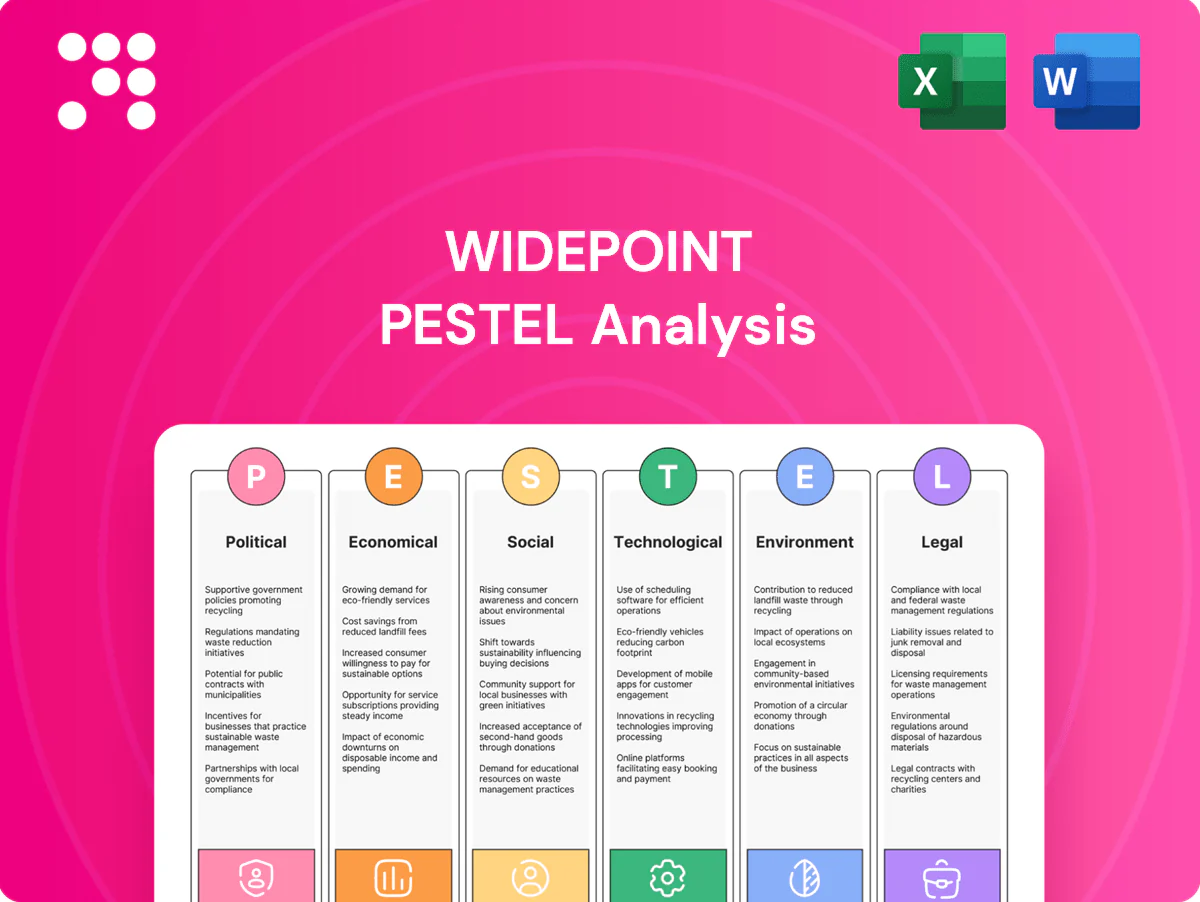
Description
Your Shortcut to Market Insight Starts Here
Gain a strategic edge with our PESTLE Analysis of WidePoint—concise, expert-driven insights into political, economic, social, technological, legal, and environmental forces shaping the firm. Use this to spot risks and growth areas for investment or strategy. Purchase the full, downloadable report for the complete breakdown.
Political factors
Federal cyber priorities
Executive Order 14028 (May 12, 2021) and CISA directives have elevated Zero Trust, incident reporting, and secure software standards, driving steady demand for trusted mobility and identity solutions across agencies. Alignment with NIST SP 800-207 (2020) and TIC 3.0 (2020–21) can be a bid differentiator. Changes in administration may recalibrate timelines and funding priorities.
Budget dynamics
Continuing resolutions and shutdown risks have repeatedly delayed federal awards and onboarding, lengthening procurement timelines for contractors; the FY2024 DoD topline was about $858 billion, underscoring scale and sensitivity to funding timing. Multi-year contract vehicles increase stability but typically extend sales cycles across multiple fiscal years. Earmarks for cyber modernization—growing into the low billions Congress-wide—can trigger surges in task orders, while clearer appropriations materially improve revenue visibility for TM2 deployments.
Procurement policy
Procurement policy—driven by Buy American rules and supply-chain risk requirements—forces WidePoint to prefer compliance-ready partners; the micro-purchase threshold remains $10,000 and Section 889 (implemented Aug 13, 2019) bans certain CNCI vendors, narrowing supplier pools. Eligible, compliant chains increase federal contract access, while vehicle access (GWACs/BPAs) materially boosts win rates and margins. Socioeconomic set-asides and small-business status shift competitive dynamics and bid eligibility.
Geopolitical risk
Geopolitical risk forces WidePoint to adapt device sourcing and software stacks as US and allied export controls since the early 2020s restrict advanced components and AI-capable chips, while sanctions steer procurement away from targeted suppliers. Government bans—over 30 US states had restricted TikTok or similar apps on official devices by 2024—disrupt mobile-fleet policies. Rising nation-state activity and supply-chain threats through 2023–24 heighten cybersecurity urgency and complicate international expansion amid localization laws in over 60 countries.
- export-controls: US/allied chip and software curbs since 2020s
- app/device-bans: 30+ US states (2024)
- cyber-threats: increased nation-state targeting 2023–24
- localization: data sovereignty rules in 60+ countries
State and local agendas
State and local agendas force WidePoint to adapt TM2 to rising privacy and cyber standards: five US states had enacted comprehensive privacy laws by 2024 (CA, VA, CO, CT, UT), while procurement rules increasingly incorporate cyberclauses, driving demand and complexity across jurisdictions.
- Grants: federal/state cybersecurity funding and CISA programs boost municipal demand
- Fragmentation: multi-jurisdiction rules increase delivery costs
- Strategy: harmonize offerings for layered government needs
Zero Trust drives secure mobility demand amid procurement cycles, bans and data-localization
EO 14028/NIST Zero Trust and CISA directives raise demand for secure mobility; procurement timing tied to FY cycles (DoD FY2024 ~$858B) and CR risks. Section 889, Buy American and export controls narrow suppliers; 30+ states had app/device bans (2024). Five states had privacy laws (2024); 60+ countries enforce data-localization.
| Item | 2024/25 Data |
|---|---|
| DoD topline | $858B |
| State app bans | 30+ |
| US privacy laws | 5 states |
| Data-localization | 60+ countries |
What is included in the product
Detailed Word Document
Explores how macro-environmental factors affect WidePoint across Political, Economic, Social, Technological, Environmental and Legal dimensions, with data-backed, region- and industry-specific insights, forward-looking scenario guidance, and formatted findings to support executives, investors and strategists.
Customizable Excel Spreadsheet
Condenses WidePoint's PESTLE into a clear, actionable summary that highlights external risks and opportunities, streamlines decision-making across teams, and is easily shareable for quick alignment during planning or client presentations.
Economic factors
Cyber spend resilience
Cybersecurity remains a protected budget line even in downturns, with Gartner reporting security and risk management spending topping $200 billion in 2024, supporting steady demand for WidePoint TM2 recurring services. Agencies and enterprises are prioritizing asset visibility and mobile risk reduction, driving subscription and managed-service adoption that strengthens recurring revenue profiles. Persistent price sensitivity, however, continues to compress professional services rates and margins.
Inflation and labor costs
Wage inflation for cleared cyber talent — often 20–30% higher than non-cleared peers per ClearanceJobs data — is elevating delivery costs against a US CPI of about 3.4% in 2024.
Passing through labor-cost increases to fixed contracts frequently lags 12–18 months, compressing near-term margins for WidePoint.
Automation and AI-driven analytics, which McKinsey finds can cut operating costs up to ~30%, are being deployed to defend margins.
Carrier and device price moves (smartphone ASPs declined roughly 5% in 2024 per IDC) reshape TEM savings narratives and vendor negotiations.
Interest rates
Higher interest rates—policy rates near 5.25% mid‑2025—compress valuation multiples and raise cost of capital, increasing WidePoint's funding costs and lowering acquisition multiples. Customers favor SaaS opex over large upfront transforms, delaying capex. Strong cash conversion from managed services (often >70%) is advantageous. Rate cuts could revive longer‑term modernization programs.
Carrier market dynamics
Enterprise digitization
Enterprise digitization drives a 30% rise in mobile/edge endpoints year-over-year, stressing TEM for lifecycle management and security; the global edge computing market reached about $54.2 billion in 2024, underscoring demand for edge-enabled TEM.
- Hybrid work: ~30% endpoint growth
- Edge market: $54.2B (2024)
- Buyers favor <12-month payback
- Cross-sell security + TEM boosts wallet share
Zero Trust drives secure mobility demand amid procurement cycles, bans and data-localization
Security spend topped $200B in 2024, sustaining TM2 recurring demand while wage inflation for cleared cyber talent (20–30% premium) and a ~3.4% US CPI in 2024 squeeze margins. Policy rates ~5.25% mid‑2025 raise cost of capital and favor SaaS opex; edge market $54.2B (2024) and ~40% eSIM activation growth reshape TEM value. Automation targeting ~30% ops cost cuts is key to margin defense.
| Metric | Value |
|---|---|
| Security spend (2024) | $200B |
| Cleared wage premium | 20–30% |
| US CPI (2024) | 3.4% |
| Policy rate (mid‑2025) | ~5.25% |
| Edge market (2024) | $54.2B |
| eSIM growth (2024) | ~40% |
Same Document Delivered
WidePoint PESTLE Analysis
The WidePoint PESTLE Analysis preview shown here is the exact, fully formatted document you’ll receive after purchase. It contains the same content, structure, and professional layout—no placeholders or teasers. After checkout you’ll be able to download this finished file immediately and use it as shown.