Waste Connections PESTLE Analysis

Skip the Research. Get the Strategy.
Navigate the complex external forces shaping Waste Connections's future with our comprehensive PESTLE analysis. Understand the political, economic, social, technological, legal, and environmental factors that present both challenges and opportunities. Download the full report to gain actionable insights and refine your strategic planning.
Political factors

Government Regulatory Landscape
Waste Connections navigates a complex web of government regulations impacting waste management practices across North America. These rules, which differ significantly between U.S. states and Canadian provinces, govern everything from landfill operations and material bans to recycling mandates, directly influencing the company's operational costs and service scope. For instance, state-level landfill regulations can impose strict operational standards and require substantial capital investment for compliance.
The evolving regulatory landscape presents both challenges and opportunities. Potential new federal regulations, such as those targeting per- and polyfluoroalkyl substances (PFAS) in landfills or stricter rules on landfill gas emissions, could necessitate significant adjustments to Waste Connections' infrastructure and operational strategies. In 2024, the U.S. Environmental Protection Agency continued to advance its PFAS Strategic Roadmap, indicating a growing focus on these persistent chemicals within the waste sector.
Extended Producer Responsibility (EPR) Laws
Extended Producer Responsibility (EPR) laws are gaining traction across North America, placing the onus for product end-of-life management squarely on manufacturers. This regulatory shift presents Waste Connections with a dual opportunity: to forge new revenue streams by offering collection and recycling services to these producers, and to innovate their operational processes. For instance, states like California, with its ambitious recycling goals under SB 54 (the Plastic Pollution Prevention and Packaging Producer Responsibility Act), are driving demand for specialized sorting and processing solutions.

Climate Policy and Emissions Regulations
Government climate policies, especially those focused on greenhouse gas emissions, directly impact Waste Connections. This includes regulations on landfill methane capture and the emissions from their vehicle fleets. For instance, the Biden administration's ongoing updates to the Clean Air Act require constant attention and investment in greener technologies.
Potential shifts in federal rules, whether accelerations or delays, mean Waste Connections must remain adaptable. The company's stated goal to reduce its Scope 1 and 2 emissions is a direct response to these evolving regulatory landscapes, ensuring compliance and operational efficiency.

Government Funding and Infrastructure Investments
Government funding and infrastructure investments are pivotal for Waste Connections’ expansion in recycling and waste management. For instance, the U.S. Environmental Protection Agency (EPA) has allocated significant resources through programs like the Solid Waste Infrastructure for Recycling (SWIFR) grants. In 2024, the EPA announced over $40 million in grants to improve recycling infrastructure across the nation, directly benefiting companies like Waste Connections that invest in advanced sorting and processing technologies.
These government initiatives provide substantial opportunities for Waste Connections to modernize its operations and develop new revenue streams. Investments in renewable natural gas (RNG) facilities, for example, are often supported by federal tax credits and state-level grants aimed at promoting clean energy. Such support can accelerate the deployment of technologies that convert landfill gas into a valuable commodity, enhancing the company's sustainability profile and financial performance.
- EPA's SWIFR Grants: In 2024, the EPA awarded over $40 million to bolster recycling infrastructure, creating avenues for Waste Connections to upgrade its facilities and adopt advanced sorting technologies.
- Renewable Natural Gas (RNG) Investments: Federal tax credits and state grants encourage the development of RNG plants, aligning with Waste Connections' strategic growth in resource recovery and clean energy production.
- Infrastructure Modernization: Government funding supports the adoption of cutting-edge technologies in waste processing and recycling, enabling Waste Connections to improve efficiency and expand its service offerings.
Trade Policies and Tariffs
Broader trade policies and the potential for tariffs can significantly impact Waste Connections' operational costs, especially when acquiring new fleet vehicles and essential equipment. For instance, anticipated tariff increases on truck bodies and chassis, as seen in past trade disputes, necessitate careful strategic planning for fleet acquisitions and robust supply chain management to mitigate rising purchase prices.
These external economic shifts directly influence capital expenditure decisions and can ultimately affect overall profitability. For example, a 10% tariff on imported heavy-duty truck components could add millions to Waste Connections' annual capital spending, requiring adjustments to budgeting and potentially delaying fleet modernization.
- Tariff Impact on Fleet Procurement: Potential tariffs on imported vehicle components can increase the cost of new trucks and equipment, affecting capital budgets.
- Supply Chain Vulnerability: Trade policy shifts can disrupt the supply chain for critical parts, leading to delays and higher prices.
- Strategic Financial Planning: Companies like Waste Connections must factor potential tariff increases into their long-term financial planning and investment strategies.
Government Policies: Shaping Waste Management's Future
Government policies and regulations remain a dominant force shaping Waste Connections' operations and strategic direction. Stricter environmental standards, particularly concerning landfill emissions and waste diversion, require continuous investment in compliant technologies. For example, the U.S. Environmental Protection Agency's (EPA) ongoing focus on PFAS in landfills, highlighted by its 2024 PFAS Strategic Roadmap, necessitates adaptation in waste containment and treatment processes.
The push for Extended Producer Responsibility (EPR) laws across various U.S. states and Canadian provinces, such as California's SB 54, directly impacts how waste is managed and processed, creating opportunities for specialized services. Furthermore, government incentives and grants, like the EPA's 2024 Solid Waste Infrastructure for Recycling (SWIFR) program which awarded over $40 million, support Waste Connections' efforts to modernize recycling infrastructure and invest in renewable natural gas (RNG) projects.
Trade policies, including potential tariffs on imported vehicle components, also present financial considerations for fleet acquisition and maintenance. These political factors underscore the need for Waste Connections to maintain regulatory compliance, adapt to evolving environmental mandates, and strategically leverage government support for infrastructure development and sustainable practices.
What is included in the product
 Detailed Word Document
This PESTLE analysis provides a comprehensive examination of the external macro-environmental factors impacting Waste Connections across Political, Economic, Social, Technological, Environmental, and Legal dimensions.
It offers forward-looking insights and actionable strategies to navigate industry dynamics and capitalize on emerging opportunities.

 Customizable Excel Spreadsheet
This PESTLE analysis offers a clean, summarized version of Waste Connections' external environment, providing easy referencing for strategic discussions and decision-making.
Visually segmented by PESTEL categories, this analysis allows for quick interpretation of external factors impacting Waste Connections, aiding in proactive risk management and market positioning.
Economic factors

Overall Economic Conditions and Waste Generation
Waste Connections' financial performance is intrinsically linked to overall economic health. During periods of economic slowdown, commercial and industrial sectors often reduce their output, directly impacting the volume of waste generated. For instance, a projected 2% GDP growth for the US in 2024, while positive, could still see some sectors experiencing slower waste generation compared to peak economic periods.
While the company's core solid waste business demonstrates pricing resilience, certain waste streams are more susceptible to economic fluctuations. Reduced construction and demolition (C&D) activity, a common feature of economic downturns, can significantly decrease volumes in this specific segment. The company's 2025 guidance, anticipating no major shifts in the current economic climate, underscores its sensitivity to these macroeconomic trends.
Recycled Commodity Market Fluctuations
Waste Connections' recycling segment faces significant profit volatility due to fluctuating prices for key commodities like old corrugated containers (OCC). For instance, during 2024, OCC prices saw considerable swings, impacting the profitability of the company's higher-margin recycling activities and creating headwinds for overall financial results.
The company's financial performance in 2024 was demonstrably affected by these commodity price movements, with lower-than-anticipated recycling revenues contributing to challenges in meeting profit targets. This highlights the direct correlation between external market forces and the success of Waste Connections' resource recovery initiatives.
Waste Connections continues to adapt its strategy by investing in resource recovery and beneficial reuse technologies, aiming to mitigate the impact of commodity price fluctuations. This proactive approach seeks to build resilience and ensure the long-term viability of its recycling operations despite market uncertainties.

Acquisition and Consolidation Strategy
Waste Connections' acquisition strategy is a cornerstone of its growth, significantly boosting revenue and market presence. In 2024 alone, the company successfully integrated acquisitions contributing roughly $750 million in annualized revenue.
Looking ahead to 2025, Waste Connections expects ongoing contributions from its acquisition pipeline, underscoring its commitment to aggressive market consolidation. This strategic approach enhances market share and operational efficiencies, supported by a strong financial position.

Inflationary Pressures and Operating Costs
Persistent inflationary pressures, particularly on fuel, labor, and equipment, continue to impact Waste Connections' operating costs. For instance, the Producer Price Index for trucking services saw a notable increase in early 2024, directly affecting transportation expenses.
While Waste Connections has shown resilience, achieving strong margin expansion through price-led organic growth, effectively managing these rising input costs remains paramount for sustained profitability. The company's ability to pass on increased costs through pricing adjustments is a key factor in its financial performance.
Strategic initiatives, such as enhancing employee retention, are vital in mitigating some of these cost pressures by improving operational efficiency and reducing recruitment expenses. A stable workforce contributes to smoother operations and can help offset the impact of wage inflation.
- Fuel Costs: Fluctuations in diesel prices directly influence Waste Connections' transportation expenses, a significant component of operating costs.
- Labor Costs: Wage inflation and competition for skilled labor, particularly drivers and technicians, put upward pressure on payroll.
- Equipment and Maintenance: The cost of new vehicles, machinery, and replacement parts has also seen increases, impacting capital expenditures and ongoing maintenance budgets.
- Pricing Power: Waste Connections' capacity to implement price increases to offset these rising costs is a critical determinant of its margin stability.
Capital Expenditures and Investment in Sustainable Infrastructure
Waste Connections is strategically channeling significant capital into sustainable infrastructure, notably expanding its renewable natural gas (RNG) initiatives. The company's capital expenditure forecast for 2025 is robust, projected to be between $1.200 billion and $1.225 billion. A key component of this spending is directed towards developing and enhancing RNG facilities at its landfills, underscoring a commitment to resource recovery and environmental stewardship.
These substantial capital expenditures are foundational for Waste Connections' long-term growth trajectory and its ambitious sustainability goals. By investing in RNG, the company is not only meeting current market demands for cleaner energy solutions but also positioning itself to capitalize on future opportunities in the circular economy. This focus on sustainable infrastructure directly supports enhanced resource recovery capabilities.
- 2025 Capital Expenditure Guidance: $1.200 billion - $1.225 billion.
- Investment Focus: Significant allocation towards renewable natural gas (RNG) facilities.
- Strategic Rationale: Driving long-term growth, achieving sustainability objectives, and improving resource recovery.
- Market Alignment: Responding to increasing demand for environmentally conscious waste management and energy solutions.
Economic Factors Impact Waste Management's Bottom Line
Economic growth directly influences waste generation volumes, with a projected 2% US GDP growth in 2024 suggesting moderate activity. However, downturns can reduce commercial and industrial waste, as well as construction and demolition debris, impacting Waste Connections' revenue streams. The company's 2025 outlook reflects sensitivity to these macroeconomic shifts.
Commodity price volatility, particularly for recyclables like old corrugated containers (OCC), significantly affects the profitability of Waste Connections' recycling segment. For example, 2024 saw considerable swings in OCC prices, creating headwinds for the company's resource recovery operations and impacting overall financial results.
Persistent inflation, especially in fuel and labor, continues to pressure operating costs for Waste Connections. While the company has demonstrated pricing power to offset some of these increases, managing rising input expenses remains crucial for sustained margin performance. Strategic initiatives like employee retention are key to mitigating these cost pressures.
| Economic Indicator | 2024 Projection/Observation | Impact on Waste Connections |
| US GDP Growth | ~2% | Moderate waste generation, potential for slower growth in some sectors. |
| Commodity Prices (OCC) | Volatile | Profitability fluctuations in recycling segment. |
| Inflation (Fuel, Labor) | Persistent pressure | Increased operating costs, reliance on pricing power. |
What You See Is What You Get
Waste Connections PESTLE Analysis
The preview shown here is the exact document you’ll receive after purchase—fully formatted and ready to use. This comprehensive PESTLE analysis of Waste Connections delves into the Political, Economic, Social, Technological, Legal, and Environmental factors impacting the company's operations and strategic decisions.
This is a real screenshot of the product you’re buying—delivered exactly as shown, no surprises. You'll gain a deep understanding of the external forces shaping Waste Connections' future, enabling informed strategic planning.
The content and structure shown in the preview is the same document you’ll download after payment. This detailed PESTLE analysis provides actionable insights into the opportunities and threats facing Waste Connections in the waste management industry.

Original: $10.00
-70%$10.00
$3.00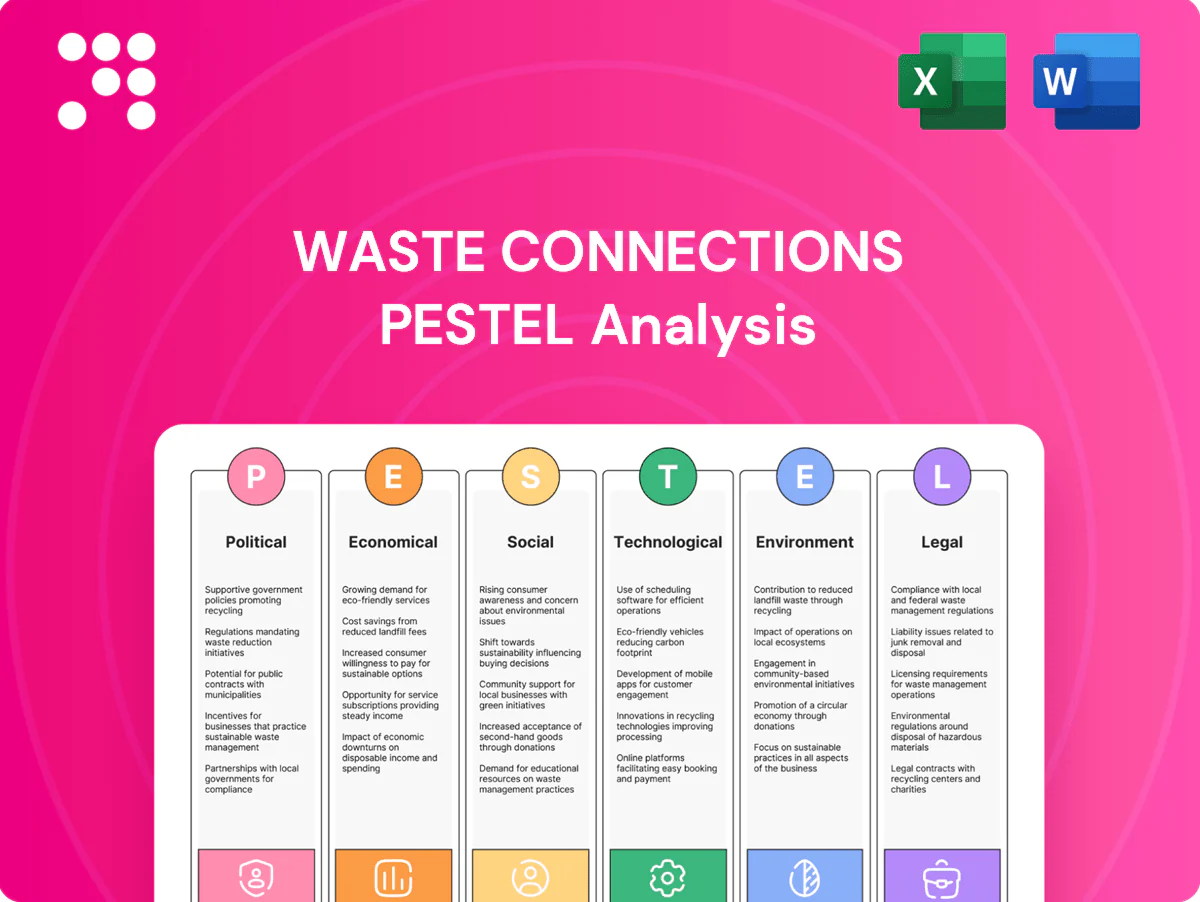
Description
Skip the Research. Get the Strategy.
Navigate the complex external forces shaping Waste Connections's future with our comprehensive PESTLE analysis. Understand the political, economic, social, technological, legal, and environmental factors that present both challenges and opportunities. Download the full report to gain actionable insights and refine your strategic planning.
Political factors
Government Regulatory Landscape
Waste Connections navigates a complex web of government regulations impacting waste management practices across North America. These rules, which differ significantly between U.S. states and Canadian provinces, govern everything from landfill operations and material bans to recycling mandates, directly influencing the company's operational costs and service scope. For instance, state-level landfill regulations can impose strict operational standards and require substantial capital investment for compliance.
The evolving regulatory landscape presents both challenges and opportunities. Potential new federal regulations, such as those targeting per- and polyfluoroalkyl substances (PFAS) in landfills or stricter rules on landfill gas emissions, could necessitate significant adjustments to Waste Connections' infrastructure and operational strategies. In 2024, the U.S. Environmental Protection Agency continued to advance its PFAS Strategic Roadmap, indicating a growing focus on these persistent chemicals within the waste sector.
Extended Producer Responsibility (EPR) Laws
Extended Producer Responsibility (EPR) laws are gaining traction across North America, placing the onus for product end-of-life management squarely on manufacturers. This regulatory shift presents Waste Connections with a dual opportunity: to forge new revenue streams by offering collection and recycling services to these producers, and to innovate their operational processes. For instance, states like California, with its ambitious recycling goals under SB 54 (the Plastic Pollution Prevention and Packaging Producer Responsibility Act), are driving demand for specialized sorting and processing solutions.
Climate Policy and Emissions Regulations
Government climate policies, especially those focused on greenhouse gas emissions, directly impact Waste Connections. This includes regulations on landfill methane capture and the emissions from their vehicle fleets. For instance, the Biden administration's ongoing updates to the Clean Air Act require constant attention and investment in greener technologies.
Potential shifts in federal rules, whether accelerations or delays, mean Waste Connections must remain adaptable. The company's stated goal to reduce its Scope 1 and 2 emissions is a direct response to these evolving regulatory landscapes, ensuring compliance and operational efficiency.
Government Funding and Infrastructure Investments
Government funding and infrastructure investments are pivotal for Waste Connections’ expansion in recycling and waste management. For instance, the U.S. Environmental Protection Agency (EPA) has allocated significant resources through programs like the Solid Waste Infrastructure for Recycling (SWIFR) grants. In 2024, the EPA announced over $40 million in grants to improve recycling infrastructure across the nation, directly benefiting companies like Waste Connections that invest in advanced sorting and processing technologies.
These government initiatives provide substantial opportunities for Waste Connections to modernize its operations and develop new revenue streams. Investments in renewable natural gas (RNG) facilities, for example, are often supported by federal tax credits and state-level grants aimed at promoting clean energy. Such support can accelerate the deployment of technologies that convert landfill gas into a valuable commodity, enhancing the company's sustainability profile and financial performance.
- EPA's SWIFR Grants: In 2024, the EPA awarded over $40 million to bolster recycling infrastructure, creating avenues for Waste Connections to upgrade its facilities and adopt advanced sorting technologies.
- Renewable Natural Gas (RNG) Investments: Federal tax credits and state grants encourage the development of RNG plants, aligning with Waste Connections' strategic growth in resource recovery and clean energy production.
- Infrastructure Modernization: Government funding supports the adoption of cutting-edge technologies in waste processing and recycling, enabling Waste Connections to improve efficiency and expand its service offerings.
Trade Policies and Tariffs
Broader trade policies and the potential for tariffs can significantly impact Waste Connections' operational costs, especially when acquiring new fleet vehicles and essential equipment. For instance, anticipated tariff increases on truck bodies and chassis, as seen in past trade disputes, necessitate careful strategic planning for fleet acquisitions and robust supply chain management to mitigate rising purchase prices.
These external economic shifts directly influence capital expenditure decisions and can ultimately affect overall profitability. For example, a 10% tariff on imported heavy-duty truck components could add millions to Waste Connections' annual capital spending, requiring adjustments to budgeting and potentially delaying fleet modernization.
- Tariff Impact on Fleet Procurement: Potential tariffs on imported vehicle components can increase the cost of new trucks and equipment, affecting capital budgets.
- Supply Chain Vulnerability: Trade policy shifts can disrupt the supply chain for critical parts, leading to delays and higher prices.
- Strategic Financial Planning: Companies like Waste Connections must factor potential tariff increases into their long-term financial planning and investment strategies.
Government Policies: Shaping Waste Management's Future
Government policies and regulations remain a dominant force shaping Waste Connections' operations and strategic direction. Stricter environmental standards, particularly concerning landfill emissions and waste diversion, require continuous investment in compliant technologies. For example, the U.S. Environmental Protection Agency's (EPA) ongoing focus on PFAS in landfills, highlighted by its 2024 PFAS Strategic Roadmap, necessitates adaptation in waste containment and treatment processes.
The push for Extended Producer Responsibility (EPR) laws across various U.S. states and Canadian provinces, such as California's SB 54, directly impacts how waste is managed and processed, creating opportunities for specialized services. Furthermore, government incentives and grants, like the EPA's 2024 Solid Waste Infrastructure for Recycling (SWIFR) program which awarded over $40 million, support Waste Connections' efforts to modernize recycling infrastructure and invest in renewable natural gas (RNG) projects.
Trade policies, including potential tariffs on imported vehicle components, also present financial considerations for fleet acquisition and maintenance. These political factors underscore the need for Waste Connections to maintain regulatory compliance, adapt to evolving environmental mandates, and strategically leverage government support for infrastructure development and sustainable practices.
What is included in the product
Detailed Word Document
This PESTLE analysis provides a comprehensive examination of the external macro-environmental factors impacting Waste Connections across Political, Economic, Social, Technological, Environmental, and Legal dimensions.
It offers forward-looking insights and actionable strategies to navigate industry dynamics and capitalize on emerging opportunities.
Customizable Excel Spreadsheet
This PESTLE analysis offers a clean, summarized version of Waste Connections' external environment, providing easy referencing for strategic discussions and decision-making.
Visually segmented by PESTEL categories, this analysis allows for quick interpretation of external factors impacting Waste Connections, aiding in proactive risk management and market positioning.
Economic factors
Overall Economic Conditions and Waste Generation
Waste Connections' financial performance is intrinsically linked to overall economic health. During periods of economic slowdown, commercial and industrial sectors often reduce their output, directly impacting the volume of waste generated. For instance, a projected 2% GDP growth for the US in 2024, while positive, could still see some sectors experiencing slower waste generation compared to peak economic periods.
While the company's core solid waste business demonstrates pricing resilience, certain waste streams are more susceptible to economic fluctuations. Reduced construction and demolition (C&D) activity, a common feature of economic downturns, can significantly decrease volumes in this specific segment. The company's 2025 guidance, anticipating no major shifts in the current economic climate, underscores its sensitivity to these macroeconomic trends.
Recycled Commodity Market Fluctuations
Waste Connections' recycling segment faces significant profit volatility due to fluctuating prices for key commodities like old corrugated containers (OCC). For instance, during 2024, OCC prices saw considerable swings, impacting the profitability of the company's higher-margin recycling activities and creating headwinds for overall financial results.
The company's financial performance in 2024 was demonstrably affected by these commodity price movements, with lower-than-anticipated recycling revenues contributing to challenges in meeting profit targets. This highlights the direct correlation between external market forces and the success of Waste Connections' resource recovery initiatives.
Waste Connections continues to adapt its strategy by investing in resource recovery and beneficial reuse technologies, aiming to mitigate the impact of commodity price fluctuations. This proactive approach seeks to build resilience and ensure the long-term viability of its recycling operations despite market uncertainties.
Acquisition and Consolidation Strategy
Waste Connections' acquisition strategy is a cornerstone of its growth, significantly boosting revenue and market presence. In 2024 alone, the company successfully integrated acquisitions contributing roughly $750 million in annualized revenue.
Looking ahead to 2025, Waste Connections expects ongoing contributions from its acquisition pipeline, underscoring its commitment to aggressive market consolidation. This strategic approach enhances market share and operational efficiencies, supported by a strong financial position.
Inflationary Pressures and Operating Costs
Persistent inflationary pressures, particularly on fuel, labor, and equipment, continue to impact Waste Connections' operating costs. For instance, the Producer Price Index for trucking services saw a notable increase in early 2024, directly affecting transportation expenses.
While Waste Connections has shown resilience, achieving strong margin expansion through price-led organic growth, effectively managing these rising input costs remains paramount for sustained profitability. The company's ability to pass on increased costs through pricing adjustments is a key factor in its financial performance.
Strategic initiatives, such as enhancing employee retention, are vital in mitigating some of these cost pressures by improving operational efficiency and reducing recruitment expenses. A stable workforce contributes to smoother operations and can help offset the impact of wage inflation.
- Fuel Costs: Fluctuations in diesel prices directly influence Waste Connections' transportation expenses, a significant component of operating costs.
- Labor Costs: Wage inflation and competition for skilled labor, particularly drivers and technicians, put upward pressure on payroll.
- Equipment and Maintenance: The cost of new vehicles, machinery, and replacement parts has also seen increases, impacting capital expenditures and ongoing maintenance budgets.
- Pricing Power: Waste Connections' capacity to implement price increases to offset these rising costs is a critical determinant of its margin stability.
Capital Expenditures and Investment in Sustainable Infrastructure
Waste Connections is strategically channeling significant capital into sustainable infrastructure, notably expanding its renewable natural gas (RNG) initiatives. The company's capital expenditure forecast for 2025 is robust, projected to be between $1.200 billion and $1.225 billion. A key component of this spending is directed towards developing and enhancing RNG facilities at its landfills, underscoring a commitment to resource recovery and environmental stewardship.
These substantial capital expenditures are foundational for Waste Connections' long-term growth trajectory and its ambitious sustainability goals. By investing in RNG, the company is not only meeting current market demands for cleaner energy solutions but also positioning itself to capitalize on future opportunities in the circular economy. This focus on sustainable infrastructure directly supports enhanced resource recovery capabilities.
- 2025 Capital Expenditure Guidance: $1.200 billion - $1.225 billion.
- Investment Focus: Significant allocation towards renewable natural gas (RNG) facilities.
- Strategic Rationale: Driving long-term growth, achieving sustainability objectives, and improving resource recovery.
- Market Alignment: Responding to increasing demand for environmentally conscious waste management and energy solutions.
Economic Factors Impact Waste Management's Bottom Line
Economic growth directly influences waste generation volumes, with a projected 2% US GDP growth in 2024 suggesting moderate activity. However, downturns can reduce commercial and industrial waste, as well as construction and demolition debris, impacting Waste Connections' revenue streams. The company's 2025 outlook reflects sensitivity to these macroeconomic shifts.
Commodity price volatility, particularly for recyclables like old corrugated containers (OCC), significantly affects the profitability of Waste Connections' recycling segment. For example, 2024 saw considerable swings in OCC prices, creating headwinds for the company's resource recovery operations and impacting overall financial results.
Persistent inflation, especially in fuel and labor, continues to pressure operating costs for Waste Connections. While the company has demonstrated pricing power to offset some of these increases, managing rising input expenses remains crucial for sustained margin performance. Strategic initiatives like employee retention are key to mitigating these cost pressures.
| Economic Indicator | 2024 Projection/Observation | Impact on Waste Connections |
| US GDP Growth | ~2% | Moderate waste generation, potential for slower growth in some sectors. |
| Commodity Prices (OCC) | Volatile | Profitability fluctuations in recycling segment. |
| Inflation (Fuel, Labor) | Persistent pressure | Increased operating costs, reliance on pricing power. |
What You See Is What You Get
Waste Connections PESTLE Analysis
The preview shown here is the exact document you’ll receive after purchase—fully formatted and ready to use. This comprehensive PESTLE analysis of Waste Connections delves into the Political, Economic, Social, Technological, Legal, and Environmental factors impacting the company's operations and strategic decisions.
This is a real screenshot of the product you’re buying—delivered exactly as shown, no surprises. You'll gain a deep understanding of the external forces shaping Waste Connections' future, enabling informed strategic planning.
The content and structure shown in the preview is the same document you’ll download after payment. This detailed PESTLE analysis provides actionable insights into the opportunities and threats facing Waste Connections in the waste management industry.