Univest Financial PESTLE Analysis

Your Competitive Advantage Starts with This Report
Discover how political, economic, social, technological, legal and environmental forces are reshaping Univest Financial’s strategic landscape in our concise PESTLE snapshot. This expert analysis highlights regulatory risks, interest-rate sensitivities, digital banking trends and ESG pressures that could affect performance. Ideal for investors and strategists—buy the full PESTLE to unlock detailed insights and actionable recommendations.
Political factors

Regulatory priorities
Shifts in federal and state banking policy can raise Univest's compliance costs and reshape product lines; FDIC, Federal Reserve, OCC and CFPB priorities after the 2023–25 regional bank stress episodes have increased supervisory intensity. With the federal funds rate near 5.25% and a $250,000 FDIC insurance cap, Univest must adapt governance and capital planning and engage proactively to mitigate policy risk.
Government lending programs
Programs such as SBA 7(a), which guarantees up to $5 million and covers up to 85% on loans ≤$150,000 (75% above), drive small-business demand and margins for Univest. Policy expansions or contractions directly shift pipeline and fee income, as seen during PPP (≈11.8 million loans, ~$800 billion). Maintaining approved-lender status sustains access and credibility, while process agility is needed to capture episodic program surges.

Community development agendas
The June 5, 2023 CRA final rule by OCC/FDIC/FRB reshaped branch placement, lending targets and partnerships, with new public-file data collection beginning in 2024 increasing transparency. Political emphasis on financial inclusion raises scrutiny of service to LMI areas and ties CRA performance to supervisory outcomes. Strategic CRA investments and measurable metrics (dollars, loan counts) can strengthen brand and reduce examination risk.

Fiscal policy and public spending
Infrastructure and municipal spending directly shape regional deposits and loan pipelines; the 2021 Bipartisan Infrastructure Law commits roughly 550 billion dollars in new spending, boosting project lending and contractor cash flow.
US municipal bond market outstanding is about 4 trillion dollars, so Univest’s exposure to local governments and contractors ties performance to appropriations cycles and tax-policy shifts; close monitoring informs sectoral credit strategy.
- Infrastructure funding: 550B (Bipartisan Infrastructure Law)
- Municipal market size: ~4T outstanding
- Impacts: deposits, project loans, contractor exposures
- Action: monitor appropriations and tax changes
Geopolitical risk spillovers
Geopolitical tensions in 2024 drove rate and liquidity shifts—Fed funds peaked near 5.25–5.50%, tightening funding conditions and trimming risk appetite; CBOE VIX spiked above 30 during major shocks, pressuring wealth-management flows. Sanctions regimes intensified due diligence and correspondent-banking oversight. Robust contingency planning preserved client confidence and limited outflows.
- Rates: Fed funds ~5.25–5.50% (2024)
- Volatility: VIX >30 at spikes
- Compliance: increased sanctions screening
- Risk mgmt: contingency planning stabilizes flows
Rates at ~5.25% and CRA tightening raise bank costs; infrastructure boosts lending
Federal and state regulatory tightening post‑2023 regional bank stress raises compliance and capital-planning costs for Univest; Fed funds ~5.25% (2024) compresses margins. SBA and federal programs (SBA 7(a) up to $5M) drive small‑business lending volume. CRA final rule (June 5, 2023) increases LMI reporting and exam risk. Infrastructure and muni spending (BIL $550B; muni market ~$4T) boost project lending pipelines.
| Factor | 2024/25 datapoint | Impact | Action |
|---|---|---|---|
| Rates | Fed funds ~5.25% | Margin pressure | Adjust pricing |
| FDIC | $250,000 cap | Deposit behavior | Liquidity planning |
| Infrastructure | $550B BIL | Loan pipeline | Targeted origination |
| Muni market | ~$4T | Credit exposure | Monitor appropriations |
What is included in the product
 Detailed Word Document
Provides a data‑backed PESTLE assessment of Univest Financial across Political, Economic, Social, Technological, Environmental and Legal dimensions, linking regional market and regulatory dynamics to concrete risks and opportunities; designed for executives and investors to support scenario planning, strategy and funding decisions.

 Customizable Excel Spreadsheet
A concise, visually segmented Univest Financial PESTLE summary that fits into presentations and strategy packs, easing cross-team alignment and planning. Editable notes and export-friendly formatting make it ideal for consultants, advisors, and on-the-go review on Excel or tablets.
Economic factors

Interest rate cycle
Net interest margin for Univest hinges on Fed policy, deposit betas and asset repricing; the Fed tightened to a peak of 5.25–5.50% in 2023, lifting NIMs across regional banks. Rapid hikes force higher funding costs and shift mix to pricier deposits, while eventual easing compresses yields but often revives loan demand. Active ALM and hedging are critical to stabilize earnings and duration risk.
Credit cycle and delinquencies
Regional employment staying near 3.7% (mid-2025) shapes charge-off trends as local business health drives consumer and commercial losses. Commercial real estate delinquencies, roughly 2% nationally in 2024-25, and concentrated small-business exposures require vigilant monitoring. Strong underwriting discipline, sector diversification and early-warning analytics have helped limit downside and reduce projected loss severity for regional banks like Univest.

Yield curve dynamics
Curve inversions (2s-10s inverted by roughly -100 to -120 bps in late 2022–early 2023) compress spread income and complicate loan and deposit pricing for Univest, especially as the 10-year Treasury settled near 4.2% in mid-2025. Term premium swings drive mark-to-market AOCI volatility and can erode regulatory capital through unrealized losses. Balance sheet duration management becomes central to limit interest rate risk. Sizable liquidity buffers and LCR compliance counteract episodic market stress.

Housing and CRE markets
Real estate valuations directly affect Univest's collateral strength and origination volumes; U.S. home prices rose modestly ~3–6% YoY into 2024, supporting loan-to-value cushions but tightening underwriting.
Rising cap rates (up roughly 100–150 bp vs 2021) and elevated office vacancies (~15–18% in 2024) heighten CRE credit risk and mark-to-market losses.
Residential affordability erosion from higher rates cut mortgage pipelines; overall origination activity remained subdued below pre-pandemic peaks in 2024.
Concentration limits and regulatory stress tests bolster resilience by capping sector exposure and forcing higher capital buffers.
- tags: collateral-strength, origination-volume, cap-rates, vacancies, affordability, concentration-limits, stress-tests
Deposit competition
Fintechs and large banks bidding up deposit rates have tightened funding; the federal funds target sits at 5.25–5.50% (July 2025), keeping deposit pricing elevated. Deeper relationships and bundled services raise retention, pricing analytics optimize segment mix, and brand trust plus convenience remain key differentiators.
- Higher market rates: fed funds 5.25–5.50%
- Retention: bundled services boost stickiness
- Analytics: price-to-segment optimization
- Differentiators: trust and convenience
Rates at ~5.25% and CRA tightening raise bank costs; infrastructure boosts lending
Univest NIMs remain tied to Fed funds at 5.25–5.50% (Jul 2025), funding costs and deposit betas stay elevated while easing would compress yields but boost loan demand. Local unemployment ~3.7% (mid‑2025) supports asset quality though CRE stress (vacancies 15–18% in 2024) and higher cap rates (+100–150bp vs 2021) increase credit risk. Active ALM, hedging and concentration limits are essential.
| Metric | Value |
|---|---|
| Fed funds (Jul 2025) | 5.25–5.50% |
| Unemployment (mid‑2025) | ~3.7% |
| 10y Treasury (mid‑2025) | ~4.2% |
| Home prices YoY (2024) | +3–6% |
| CRE vacancies (2024) | 15–18% |
| Cap rates vs 2021 | +100–150bp |
Preview the Actual Deliverable
Univest Financial PESTLE Analysis
The preview shown here is the exact document you'll receive after purchase—fully formatted and ready to use. This Univest Financial PESTLE Analysis includes complete content, structure, and professional formatting with no placeholders or teasers. After checkout you'll instantly download the same finished file shown here, ready for immediate use.

Original: $10.00
-70%$10.00
$3.00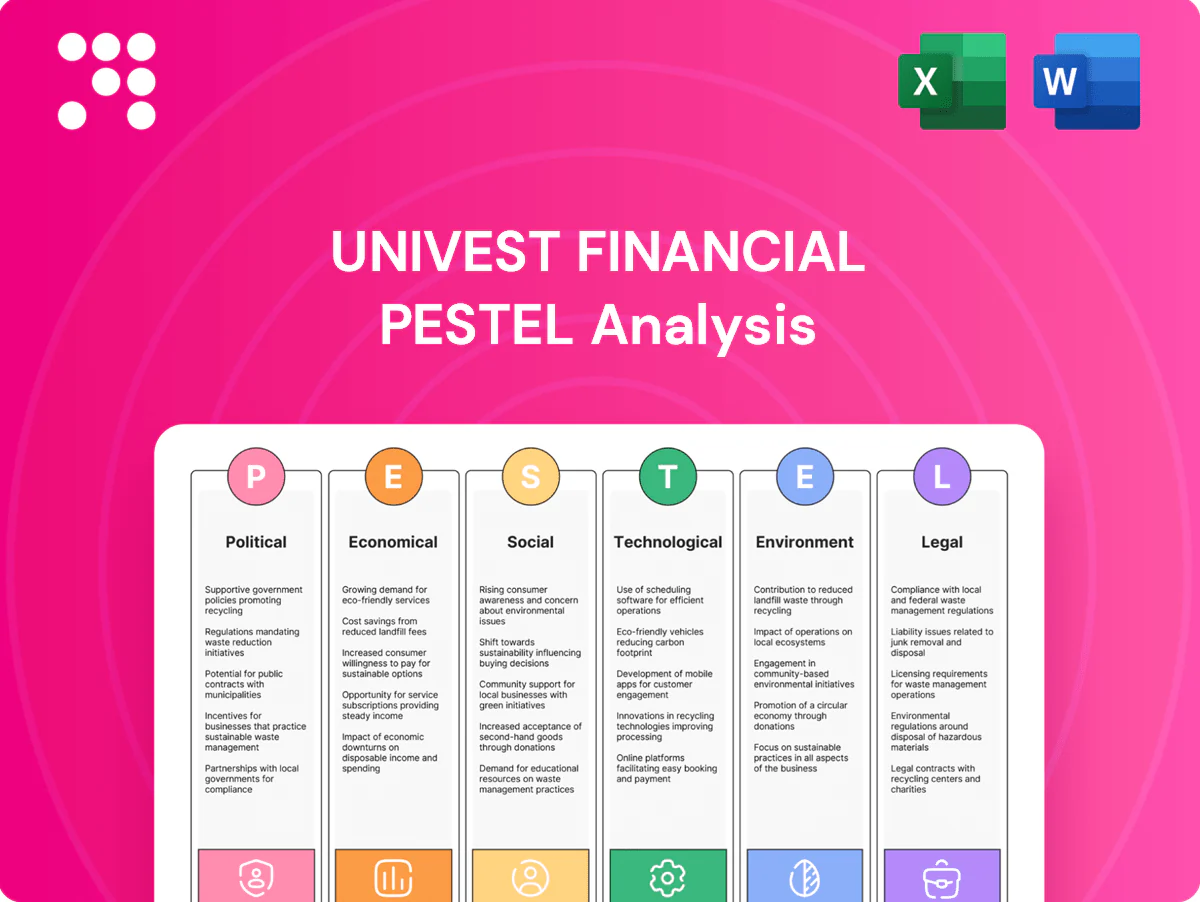
Description
Your Competitive Advantage Starts with This Report
Discover how political, economic, social, technological, legal and environmental forces are reshaping Univest Financial’s strategic landscape in our concise PESTLE snapshot. This expert analysis highlights regulatory risks, interest-rate sensitivities, digital banking trends and ESG pressures that could affect performance. Ideal for investors and strategists—buy the full PESTLE to unlock detailed insights and actionable recommendations.
Political factors
Regulatory priorities
Shifts in federal and state banking policy can raise Univest's compliance costs and reshape product lines; FDIC, Federal Reserve, OCC and CFPB priorities after the 2023–25 regional bank stress episodes have increased supervisory intensity. With the federal funds rate near 5.25% and a $250,000 FDIC insurance cap, Univest must adapt governance and capital planning and engage proactively to mitigate policy risk.
Government lending programs
Programs such as SBA 7(a), which guarantees up to $5 million and covers up to 85% on loans ≤$150,000 (75% above), drive small-business demand and margins for Univest. Policy expansions or contractions directly shift pipeline and fee income, as seen during PPP (≈11.8 million loans, ~$800 billion). Maintaining approved-lender status sustains access and credibility, while process agility is needed to capture episodic program surges.
Community development agendas
The June 5, 2023 CRA final rule by OCC/FDIC/FRB reshaped branch placement, lending targets and partnerships, with new public-file data collection beginning in 2024 increasing transparency. Political emphasis on financial inclusion raises scrutiny of service to LMI areas and ties CRA performance to supervisory outcomes. Strategic CRA investments and measurable metrics (dollars, loan counts) can strengthen brand and reduce examination risk.
Fiscal policy and public spending
Infrastructure and municipal spending directly shape regional deposits and loan pipelines; the 2021 Bipartisan Infrastructure Law commits roughly 550 billion dollars in new spending, boosting project lending and contractor cash flow.
US municipal bond market outstanding is about 4 trillion dollars, so Univest’s exposure to local governments and contractors ties performance to appropriations cycles and tax-policy shifts; close monitoring informs sectoral credit strategy.
- Infrastructure funding: 550B (Bipartisan Infrastructure Law)
- Municipal market size: ~4T outstanding
- Impacts: deposits, project loans, contractor exposures
- Action: monitor appropriations and tax changes
Geopolitical risk spillovers
Geopolitical tensions in 2024 drove rate and liquidity shifts—Fed funds peaked near 5.25–5.50%, tightening funding conditions and trimming risk appetite; CBOE VIX spiked above 30 during major shocks, pressuring wealth-management flows. Sanctions regimes intensified due diligence and correspondent-banking oversight. Robust contingency planning preserved client confidence and limited outflows.
- Rates: Fed funds ~5.25–5.50% (2024)
- Volatility: VIX >30 at spikes
- Compliance: increased sanctions screening
- Risk mgmt: contingency planning stabilizes flows
Rates at ~5.25% and CRA tightening raise bank costs; infrastructure boosts lending
Federal and state regulatory tightening post‑2023 regional bank stress raises compliance and capital-planning costs for Univest; Fed funds ~5.25% (2024) compresses margins. SBA and federal programs (SBA 7(a) up to $5M) drive small‑business lending volume. CRA final rule (June 5, 2023) increases LMI reporting and exam risk. Infrastructure and muni spending (BIL $550B; muni market ~$4T) boost project lending pipelines.
| Factor | 2024/25 datapoint | Impact | Action |
|---|---|---|---|
| Rates | Fed funds ~5.25% | Margin pressure | Adjust pricing |
| FDIC | $250,000 cap | Deposit behavior | Liquidity planning |
| Infrastructure | $550B BIL | Loan pipeline | Targeted origination |
| Muni market | ~$4T | Credit exposure | Monitor appropriations |
What is included in the product
Detailed Word Document
Provides a data‑backed PESTLE assessment of Univest Financial across Political, Economic, Social, Technological, Environmental and Legal dimensions, linking regional market and regulatory dynamics to concrete risks and opportunities; designed for executives and investors to support scenario planning, strategy and funding decisions.
Customizable Excel Spreadsheet
A concise, visually segmented Univest Financial PESTLE summary that fits into presentations and strategy packs, easing cross-team alignment and planning. Editable notes and export-friendly formatting make it ideal for consultants, advisors, and on-the-go review on Excel or tablets.
Economic factors
Interest rate cycle
Net interest margin for Univest hinges on Fed policy, deposit betas and asset repricing; the Fed tightened to a peak of 5.25–5.50% in 2023, lifting NIMs across regional banks. Rapid hikes force higher funding costs and shift mix to pricier deposits, while eventual easing compresses yields but often revives loan demand. Active ALM and hedging are critical to stabilize earnings and duration risk.
Credit cycle and delinquencies
Regional employment staying near 3.7% (mid-2025) shapes charge-off trends as local business health drives consumer and commercial losses. Commercial real estate delinquencies, roughly 2% nationally in 2024-25, and concentrated small-business exposures require vigilant monitoring. Strong underwriting discipline, sector diversification and early-warning analytics have helped limit downside and reduce projected loss severity for regional banks like Univest.
Yield curve dynamics
Curve inversions (2s-10s inverted by roughly -100 to -120 bps in late 2022–early 2023) compress spread income and complicate loan and deposit pricing for Univest, especially as the 10-year Treasury settled near 4.2% in mid-2025. Term premium swings drive mark-to-market AOCI volatility and can erode regulatory capital through unrealized losses. Balance sheet duration management becomes central to limit interest rate risk. Sizable liquidity buffers and LCR compliance counteract episodic market stress.
Housing and CRE markets
Real estate valuations directly affect Univest's collateral strength and origination volumes; U.S. home prices rose modestly ~3–6% YoY into 2024, supporting loan-to-value cushions but tightening underwriting.
Rising cap rates (up roughly 100–150 bp vs 2021) and elevated office vacancies (~15–18% in 2024) heighten CRE credit risk and mark-to-market losses.
Residential affordability erosion from higher rates cut mortgage pipelines; overall origination activity remained subdued below pre-pandemic peaks in 2024.
Concentration limits and regulatory stress tests bolster resilience by capping sector exposure and forcing higher capital buffers.
- tags: collateral-strength, origination-volume, cap-rates, vacancies, affordability, concentration-limits, stress-tests
Deposit competition
Fintechs and large banks bidding up deposit rates have tightened funding; the federal funds target sits at 5.25–5.50% (July 2025), keeping deposit pricing elevated. Deeper relationships and bundled services raise retention, pricing analytics optimize segment mix, and brand trust plus convenience remain key differentiators.
- Higher market rates: fed funds 5.25–5.50%
- Retention: bundled services boost stickiness
- Analytics: price-to-segment optimization
- Differentiators: trust and convenience
Rates at ~5.25% and CRA tightening raise bank costs; infrastructure boosts lending
Univest NIMs remain tied to Fed funds at 5.25–5.50% (Jul 2025), funding costs and deposit betas stay elevated while easing would compress yields but boost loan demand. Local unemployment ~3.7% (mid‑2025) supports asset quality though CRE stress (vacancies 15–18% in 2024) and higher cap rates (+100–150bp vs 2021) increase credit risk. Active ALM, hedging and concentration limits are essential.
| Metric | Value |
|---|---|
| Fed funds (Jul 2025) | 5.25–5.50% |
| Unemployment (mid‑2025) | ~3.7% |
| 10y Treasury (mid‑2025) | ~4.2% |
| Home prices YoY (2024) | +3–6% |
| CRE vacancies (2024) | 15–18% |
| Cap rates vs 2021 | +100–150bp |
Preview the Actual Deliverable
Univest Financial PESTLE Analysis
The preview shown here is the exact document you'll receive after purchase—fully formatted and ready to use. This Univest Financial PESTLE Analysis includes complete content, structure, and professional formatting with no placeholders or teasers. After checkout you'll instantly download the same finished file shown here, ready for immediate use.