ASMedia Porter's Five Forces Analysis

Go Beyond the Preview—Access the Full Strategic Report
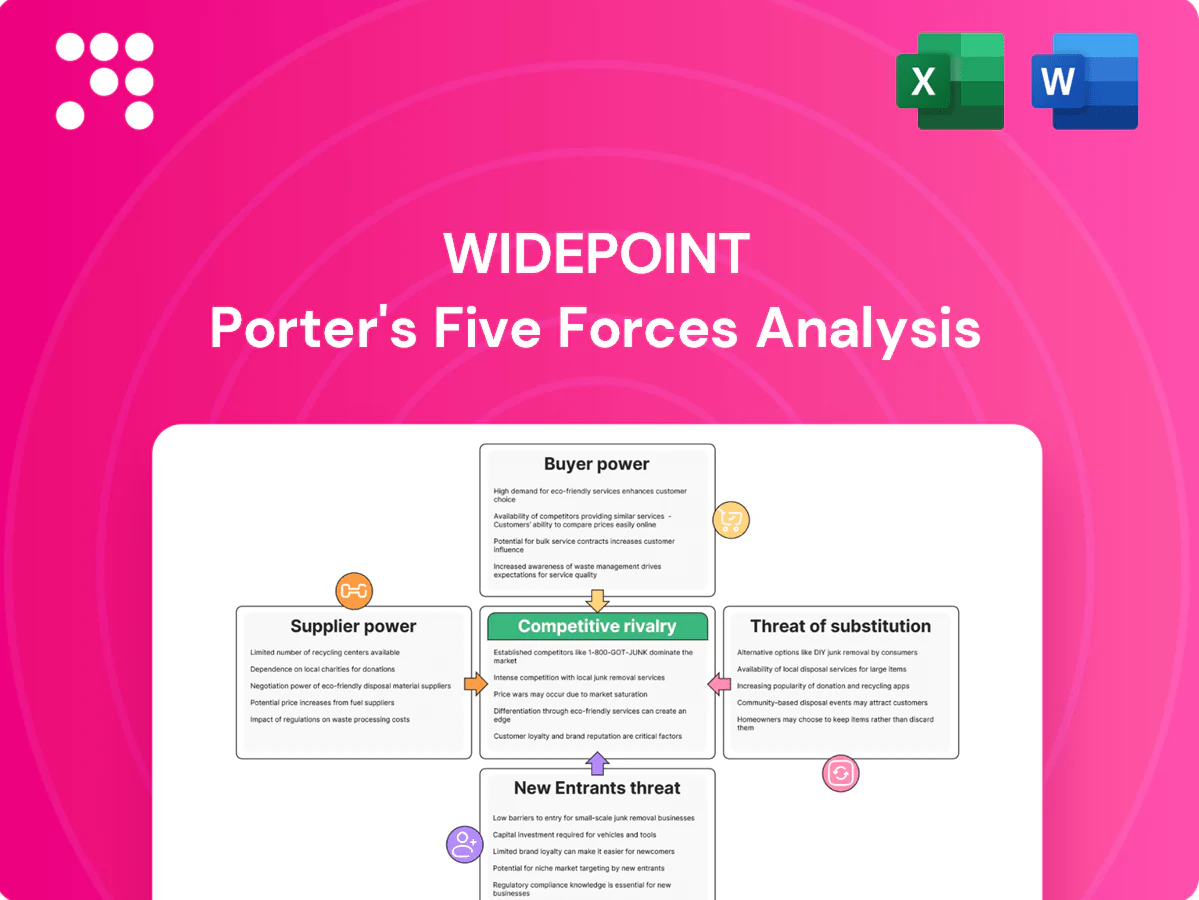
ASMedia's competitive landscape is shaped by the interplay of five key forces, revealing both opportunities and challenges within its semiconductor industry. Understanding the intensity of rivalry, the bargaining power of buyers and suppliers, and the threats of new entrants and substitutes is crucial for strategic planning.
This snapshot only scratches the surface. Unlock the full Porter's Five Forces Analysis to explore ASMedia’s competitive dynamics, market pressures, and strategic advantages in detail.
Suppliers Bargaining Power

Concentration of Suppliers
The semiconductor industry, particularly for fabless companies like ASMedia, faces supplier concentration for specialized equipment and raw materials. If a few dominant suppliers control essential inputs, they can dictate terms and prices, impacting ASMedia's costs and production schedules. For instance, companies like ASML hold a near-monopoly on extreme ultraviolet (EUV) lithography machines, critical for advanced chip manufacturing, giving them substantial leverage.
Uniqueness of Inputs
ASMedia's reliance on specialized inputs for its high-speed interface ICs, such as those for PCIe Gen5/6 and USB4, significantly influences supplier bargaining power. These advanced technologies often necessitate proprietary processes or unique materials from suppliers, limiting readily available alternatives.
For instance, the development of cutting-edge chipsets requires specialized foundries and advanced packaging solutions that may only be offered by a select few global manufacturers. If ASMedia faces a situation where only a handful of suppliers can meet the stringent technical specifications for these critical components, those suppliers gain considerable leverage in price negotiations and supply terms.

Switching Costs
Switching semiconductor foundry partners or key material suppliers for companies like ASMedia involves significant expenses and time. This is largely due to the rigorous qualification processes required for new suppliers, the need for product re-design to accommodate different manufacturing specifications, and the potential for disruptions to the entire supply chain during the transition. For instance, in 2024, the lead time for qualifying a new semiconductor supplier can easily extend to 6-12 months, impacting product development schedules.
These high switching costs create a substantial barrier for ASMedia, effectively empowering its existing suppliers. This leverage allows suppliers to negotiate more favorable terms, potentially increasing prices or dictating contract conditions, thereby strengthening their bargaining power within the industry.

Threat of Forward Integration
The threat of forward integration by suppliers, while generally low for specialized IC design firms like ASMedia, remains a consideration. Should a major foundry or advanced materials supplier invest heavily in chip design capabilities, they could theoretically enter ASMedia's market, directly competing and reducing ASMedia's bargaining power. This scenario would transform a supplier into a rival, potentially impacting ASMedia's pricing and market share.
While ASMedia operates in a highly specialized niche, the broader semiconductor industry has seen consolidation and vertical integration. For instance, some large foundries are exploring design services, and material science companies are investing in advanced process development that could edge into design. For example, in 2024, TSMC, a leading foundry, continued to expand its advanced packaging and design enablement services, demonstrating a trend towards closer integration with the design process.
- Forward Integration Threat: Suppliers could develop their own chip designs, becoming direct competitors to ASMedia.
- Industry Trends: Consolidation and vertical integration in the semiconductor sector could empower suppliers to pursue design services.
- Example: Foundries like TSMC are increasingly offering advanced design enablement services, blurring the lines between manufacturing and design.
Importance of ASMedia to Supplier
ASMedia's significance to its suppliers plays a crucial role in determining their bargaining power. If ASMedia constitutes a substantial portion of a supplier's sales, that supplier has less leverage, as losing ASMedia as a client would significantly impact their revenue. For instance, if a key component supplier derives over 15% of its total revenue from ASMedia, its ability to dictate terms or raise prices would be considerably weaker.
Conversely, if ASMedia is a minor customer for a supplier, the supplier might prioritize larger, more lucrative clients. This could mean ASMedia faces challenges in securing critical resources or obtaining preferential pricing, especially if demand in the semiconductor market, projected to grow by approximately 8-10% in 2024-2025, intensifies competition for supply.
- Revenue Dependence: A supplier heavily reliant on ASMedia will have reduced bargaining power.
- Customer Size: ASMedia's status as a small customer can lead suppliers to prioritize larger clients.
- Market Conditions: Broader semiconductor market growth can shift the balance of power between ASMedia and its suppliers.
Supplier Power: ASMedia's Critical Supply Chain Challenge
The bargaining power of suppliers for ASMedia is significantly influenced by industry concentration and the availability of substitutes for critical inputs. High supplier concentration, especially for specialized equipment like advanced lithography machines, grants dominant players considerable pricing and negotiation leverage. For instance, ASML's near-monopoly on EUV lithography machines underscores this power, impacting the entire semiconductor manufacturing chain.
| Factor | Impact on ASMedia | Example/Data (2024) |
|---|---|---|
| Supplier Concentration | High leverage for dominant suppliers | ASML's dominance in EUV lithography |
| Availability of Substitutes | Limited substitutes increase supplier power | Proprietary materials for advanced ICs |
| Switching Costs | High costs empower existing suppliers | 6-12 months to qualify new semiconductor suppliers |
| Supplier Dependence on ASMedia | Low dependence empowers suppliers | Suppliers prioritizing clients contributing >15% revenue |
What is included in the product
 Detailed Word Document
This analysis dissects ASMedia's competitive environment by examining the intensity of rivalry, the bargaining power of buyers and suppliers, the threat of new entrants, and the availability of substitutes.

 Customizable Excel Spreadsheet
Effortlessly visualize competitive intensity with a dynamic, interactive spider chart, instantly highlighting ASMedia's strategic positioning and potential vulnerabilities.
Customers Bargaining Power

Customer Concentration
ASMedia's customer concentration is a key factor in understanding its bargaining power. Its client roster features prominent names in personal computers, storage, and other electronics sectors.
When a few major customers represent a substantial chunk of ASMedia's revenue, these large clients gain significant leverage. This can translate into intense pressure on pricing and more demanding contract conditions, directly impacting ASMedia's profitability and flexibility.
Switching Costs for Customers
For customers looking to switch away from ASMedia's high-speed interface ICs, the process isn't a simple plug-and-play. It often necessitates a complete redesign of their existing systems, which can be a time-consuming and expensive undertaking. This involves re-evaluating circuit layouts and ensuring compatibility with new components.
Beyond the initial redesign, customers must also go through a rigorous re-qualification process for the new components. This ensures that the alternative ICs meet ASMedia's established performance standards and reliability. Failure to do so could lead to product failures or even market delays, impacting their own revenue streams.
These significant hurdles, including system redesign and component re-qualification, directly translate into high switching costs for ASMedia's clientele. Consequently, this elevated barrier effectively diminishes the bargaining power of these customers, as the effort and expense involved in changing suppliers are substantial.

Customer Information and Price Sensitivity
Customers in the electronics sector, especially those ASMedia serves, are typically quite knowledgeable about the costs of components and the other options available to them. This awareness, amplified by the intense competition within their own industries, often translates into significant price sensitivity for ASMedia's clientele.
For instance, in 2024, the average semiconductor component cost can fluctuate significantly, and ASMedia's clients are adept at comparing these prices across various suppliers. This makes them less likely to accept premium pricing without strong justification, thereby enhancing their leverage in negotiations.

Threat of Backward Integration by Customers
Large customers, particularly those with substantial research and development resources, may explore the possibility of developing their own high-speed interface integrated circuits internally. This potential for backward integration, while requiring significant capital investment, grants these customers considerable leverage when negotiating with ASMedia.
For instance, major players in the consumer electronics or data center industries, who are ASMedia's key clients, often possess the technical expertise and financial capacity to undertake such vertical integration. This capability acts as a constant pressure point, influencing ASMedia's pricing strategies and product development roadmap.
- Customer Leverage: The ability of large customers to consider in-house chip design provides them with significant bargaining power.
- R&D Investment: Customers with strong R&D departments are more likely to pose a threat of backward integration.
- Capital Intensity: While costly, the pursuit of backward integration by customers can be a strategic move to control supply chains and costs.
- Market Dynamics: This threat influences ASMedia's competitive positioning and its approach to customer relationships.
Product Differentiation and Importance to Customer
ASMedia's capacity to provide unique, high-performance solutions, such as its USB4 and PCIe Gen5/6 offerings, significantly diminishes customer bargaining power. When customers rely on ASMedia for critical, hard-to-replicate technology, their ability to demand lower prices or more favorable terms is curtailed. This differentiation makes ASMedia's products less substitutable, strengthening the company's position.
Recent accolades and certifications serve as tangible proof of ASMedia's product differentiation. For instance, achieving certifications for advanced standards like USB4 Version 2.0, which offers speeds up to 80 Gbps, showcases the company's technological leadership. This advanced performance and validation reduce the likelihood of customers switching to competitors offering less sophisticated or unproven alternatives.
- Product Differentiation: ASMedia's focus on high-performance, certified solutions like USB4 and PCIe Gen5/6 limits customer options.
- Reduced Substitutability: The advanced nature of ASMedia's technology makes it difficult for customers to find comparable alternatives, thereby reducing their bargaining leverage.
- Importance to Customer: By providing critical components for next-generation connectivity, ASMedia embeds itself deeply into customer product roadmaps, increasing its value and reducing customer power.
- Recent Certifications: Achieving certifications for cutting-edge standards, such as PCIe Gen6, underscores ASMedia's technological edge and reinforces its value proposition to customers.
Customer Power: Innovation Limits Leverage
ASMedia's customers possess moderate bargaining power, primarily influenced by the high switching costs associated with redesigning systems and re-qualifying components. Their price sensitivity is also a factor, especially given the competitive landscape of the electronics industry. However, ASMedia's unique, high-performance offerings, like USB4 and PCIe Gen5/6, create differentiation that significantly limits customer leverage.
| Factor | ASMedia's Position | Impact on Customer Bargaining Power |
|---|---|---|
| Switching Costs | High (System redesign, re-qualification) | Lowers customer power |
| Price Sensitivity | Moderate (Awareness of component costs) | Increases customer power |
| Product Differentiation | High (USB4, PCIe Gen5/6) | Lowers customer power |
| Threat of Backward Integration | Moderate (For large R&D-focused customers) | Increases customer power |
Same Document Delivered
ASMedia Porter's Five Forces Analysis
This preview showcases the complete ASMedia Porter's Five Forces Analysis, offering a detailed examination of competitive forces within its industry. The document you see here is precisely what you will receive immediately after purchase, ensuring a transparent and accurate transaction. This professionally formatted analysis is ready for your immediate use, providing valuable insights without any hidden surprises or placeholder content.

Original: $10.00
-70%$10.00
$3.00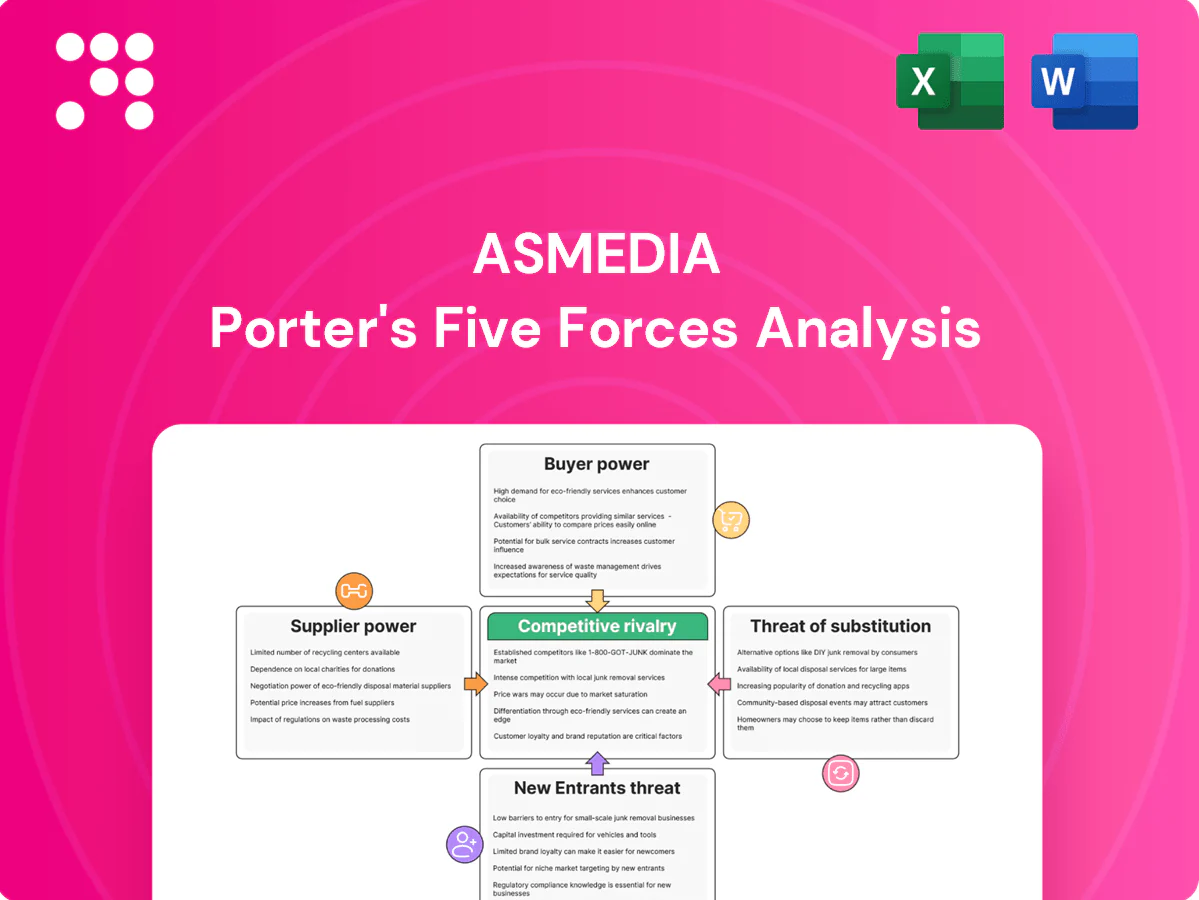
Description
Go Beyond the Preview—Access the Full Strategic Report
ASMedia's competitive landscape is shaped by the interplay of five key forces, revealing both opportunities and challenges within its semiconductor industry. Understanding the intensity of rivalry, the bargaining power of buyers and suppliers, and the threats of new entrants and substitutes is crucial for strategic planning.
This snapshot only scratches the surface. Unlock the full Porter's Five Forces Analysis to explore ASMedia’s competitive dynamics, market pressures, and strategic advantages in detail.
Suppliers Bargaining Power
Concentration of Suppliers
The semiconductor industry, particularly for fabless companies like ASMedia, faces supplier concentration for specialized equipment and raw materials. If a few dominant suppliers control essential inputs, they can dictate terms and prices, impacting ASMedia's costs and production schedules. For instance, companies like ASML hold a near-monopoly on extreme ultraviolet (EUV) lithography machines, critical for advanced chip manufacturing, giving them substantial leverage.
Uniqueness of Inputs
ASMedia's reliance on specialized inputs for its high-speed interface ICs, such as those for PCIe Gen5/6 and USB4, significantly influences supplier bargaining power. These advanced technologies often necessitate proprietary processes or unique materials from suppliers, limiting readily available alternatives.
For instance, the development of cutting-edge chipsets requires specialized foundries and advanced packaging solutions that may only be offered by a select few global manufacturers. If ASMedia faces a situation where only a handful of suppliers can meet the stringent technical specifications for these critical components, those suppliers gain considerable leverage in price negotiations and supply terms.
Switching Costs
Switching semiconductor foundry partners or key material suppliers for companies like ASMedia involves significant expenses and time. This is largely due to the rigorous qualification processes required for new suppliers, the need for product re-design to accommodate different manufacturing specifications, and the potential for disruptions to the entire supply chain during the transition. For instance, in 2024, the lead time for qualifying a new semiconductor supplier can easily extend to 6-12 months, impacting product development schedules.
These high switching costs create a substantial barrier for ASMedia, effectively empowering its existing suppliers. This leverage allows suppliers to negotiate more favorable terms, potentially increasing prices or dictating contract conditions, thereby strengthening their bargaining power within the industry.
Threat of Forward Integration
The threat of forward integration by suppliers, while generally low for specialized IC design firms like ASMedia, remains a consideration. Should a major foundry or advanced materials supplier invest heavily in chip design capabilities, they could theoretically enter ASMedia's market, directly competing and reducing ASMedia's bargaining power. This scenario would transform a supplier into a rival, potentially impacting ASMedia's pricing and market share.
While ASMedia operates in a highly specialized niche, the broader semiconductor industry has seen consolidation and vertical integration. For instance, some large foundries are exploring design services, and material science companies are investing in advanced process development that could edge into design. For example, in 2024, TSMC, a leading foundry, continued to expand its advanced packaging and design enablement services, demonstrating a trend towards closer integration with the design process.
- Forward Integration Threat: Suppliers could develop their own chip designs, becoming direct competitors to ASMedia.
- Industry Trends: Consolidation and vertical integration in the semiconductor sector could empower suppliers to pursue design services.
- Example: Foundries like TSMC are increasingly offering advanced design enablement services, blurring the lines between manufacturing and design.
Importance of ASMedia to Supplier
ASMedia's significance to its suppliers plays a crucial role in determining their bargaining power. If ASMedia constitutes a substantial portion of a supplier's sales, that supplier has less leverage, as losing ASMedia as a client would significantly impact their revenue. For instance, if a key component supplier derives over 15% of its total revenue from ASMedia, its ability to dictate terms or raise prices would be considerably weaker.
Conversely, if ASMedia is a minor customer for a supplier, the supplier might prioritize larger, more lucrative clients. This could mean ASMedia faces challenges in securing critical resources or obtaining preferential pricing, especially if demand in the semiconductor market, projected to grow by approximately 8-10% in 2024-2025, intensifies competition for supply.
- Revenue Dependence: A supplier heavily reliant on ASMedia will have reduced bargaining power.
- Customer Size: ASMedia's status as a small customer can lead suppliers to prioritize larger clients.
- Market Conditions: Broader semiconductor market growth can shift the balance of power between ASMedia and its suppliers.
Supplier Power: ASMedia's Critical Supply Chain Challenge
The bargaining power of suppliers for ASMedia is significantly influenced by industry concentration and the availability of substitutes for critical inputs. High supplier concentration, especially for specialized equipment like advanced lithography machines, grants dominant players considerable pricing and negotiation leverage. For instance, ASML's near-monopoly on EUV lithography machines underscores this power, impacting the entire semiconductor manufacturing chain.
| Factor | Impact on ASMedia | Example/Data (2024) |
|---|---|---|
| Supplier Concentration | High leverage for dominant suppliers | ASML's dominance in EUV lithography |
| Availability of Substitutes | Limited substitutes increase supplier power | Proprietary materials for advanced ICs |
| Switching Costs | High costs empower existing suppliers | 6-12 months to qualify new semiconductor suppliers |
| Supplier Dependence on ASMedia | Low dependence empowers suppliers | Suppliers prioritizing clients contributing >15% revenue |
What is included in the product
Detailed Word Document
This analysis dissects ASMedia's competitive environment by examining the intensity of rivalry, the bargaining power of buyers and suppliers, the threat of new entrants, and the availability of substitutes.
Customizable Excel Spreadsheet
Effortlessly visualize competitive intensity with a dynamic, interactive spider chart, instantly highlighting ASMedia's strategic positioning and potential vulnerabilities.
Customers Bargaining Power
Customer Concentration
ASMedia's customer concentration is a key factor in understanding its bargaining power. Its client roster features prominent names in personal computers, storage, and other electronics sectors.
When a few major customers represent a substantial chunk of ASMedia's revenue, these large clients gain significant leverage. This can translate into intense pressure on pricing and more demanding contract conditions, directly impacting ASMedia's profitability and flexibility.
Switching Costs for Customers
For customers looking to switch away from ASMedia's high-speed interface ICs, the process isn't a simple plug-and-play. It often necessitates a complete redesign of their existing systems, which can be a time-consuming and expensive undertaking. This involves re-evaluating circuit layouts and ensuring compatibility with new components.
Beyond the initial redesign, customers must also go through a rigorous re-qualification process for the new components. This ensures that the alternative ICs meet ASMedia's established performance standards and reliability. Failure to do so could lead to product failures or even market delays, impacting their own revenue streams.
These significant hurdles, including system redesign and component re-qualification, directly translate into high switching costs for ASMedia's clientele. Consequently, this elevated barrier effectively diminishes the bargaining power of these customers, as the effort and expense involved in changing suppliers are substantial.
Customer Information and Price Sensitivity
Customers in the electronics sector, especially those ASMedia serves, are typically quite knowledgeable about the costs of components and the other options available to them. This awareness, amplified by the intense competition within their own industries, often translates into significant price sensitivity for ASMedia's clientele.
For instance, in 2024, the average semiconductor component cost can fluctuate significantly, and ASMedia's clients are adept at comparing these prices across various suppliers. This makes them less likely to accept premium pricing without strong justification, thereby enhancing their leverage in negotiations.
Threat of Backward Integration by Customers
Large customers, particularly those with substantial research and development resources, may explore the possibility of developing their own high-speed interface integrated circuits internally. This potential for backward integration, while requiring significant capital investment, grants these customers considerable leverage when negotiating with ASMedia.
For instance, major players in the consumer electronics or data center industries, who are ASMedia's key clients, often possess the technical expertise and financial capacity to undertake such vertical integration. This capability acts as a constant pressure point, influencing ASMedia's pricing strategies and product development roadmap.
- Customer Leverage: The ability of large customers to consider in-house chip design provides them with significant bargaining power.
- R&D Investment: Customers with strong R&D departments are more likely to pose a threat of backward integration.
- Capital Intensity: While costly, the pursuit of backward integration by customers can be a strategic move to control supply chains and costs.
- Market Dynamics: This threat influences ASMedia's competitive positioning and its approach to customer relationships.
Product Differentiation and Importance to Customer
ASMedia's capacity to provide unique, high-performance solutions, such as its USB4 and PCIe Gen5/6 offerings, significantly diminishes customer bargaining power. When customers rely on ASMedia for critical, hard-to-replicate technology, their ability to demand lower prices or more favorable terms is curtailed. This differentiation makes ASMedia's products less substitutable, strengthening the company's position.
Recent accolades and certifications serve as tangible proof of ASMedia's product differentiation. For instance, achieving certifications for advanced standards like USB4 Version 2.0, which offers speeds up to 80 Gbps, showcases the company's technological leadership. This advanced performance and validation reduce the likelihood of customers switching to competitors offering less sophisticated or unproven alternatives.
- Product Differentiation: ASMedia's focus on high-performance, certified solutions like USB4 and PCIe Gen5/6 limits customer options.
- Reduced Substitutability: The advanced nature of ASMedia's technology makes it difficult for customers to find comparable alternatives, thereby reducing their bargaining leverage.
- Importance to Customer: By providing critical components for next-generation connectivity, ASMedia embeds itself deeply into customer product roadmaps, increasing its value and reducing customer power.
- Recent Certifications: Achieving certifications for cutting-edge standards, such as PCIe Gen6, underscores ASMedia's technological edge and reinforces its value proposition to customers.
Customer Power: Innovation Limits Leverage
ASMedia's customers possess moderate bargaining power, primarily influenced by the high switching costs associated with redesigning systems and re-qualifying components. Their price sensitivity is also a factor, especially given the competitive landscape of the electronics industry. However, ASMedia's unique, high-performance offerings, like USB4 and PCIe Gen5/6, create differentiation that significantly limits customer leverage.
| Factor | ASMedia's Position | Impact on Customer Bargaining Power |
|---|---|---|
| Switching Costs | High (System redesign, re-qualification) | Lowers customer power |
| Price Sensitivity | Moderate (Awareness of component costs) | Increases customer power |
| Product Differentiation | High (USB4, PCIe Gen5/6) | Lowers customer power |
| Threat of Backward Integration | Moderate (For large R&D-focused customers) | Increases customer power |
Same Document Delivered
ASMedia Porter's Five Forces Analysis
This preview showcases the complete ASMedia Porter's Five Forces Analysis, offering a detailed examination of competitive forces within its industry. The document you see here is precisely what you will receive immediately after purchase, ensuring a transparent and accurate transaction. This professionally formatted analysis is ready for your immediate use, providing valuable insights without any hidden surprises or placeholder content.