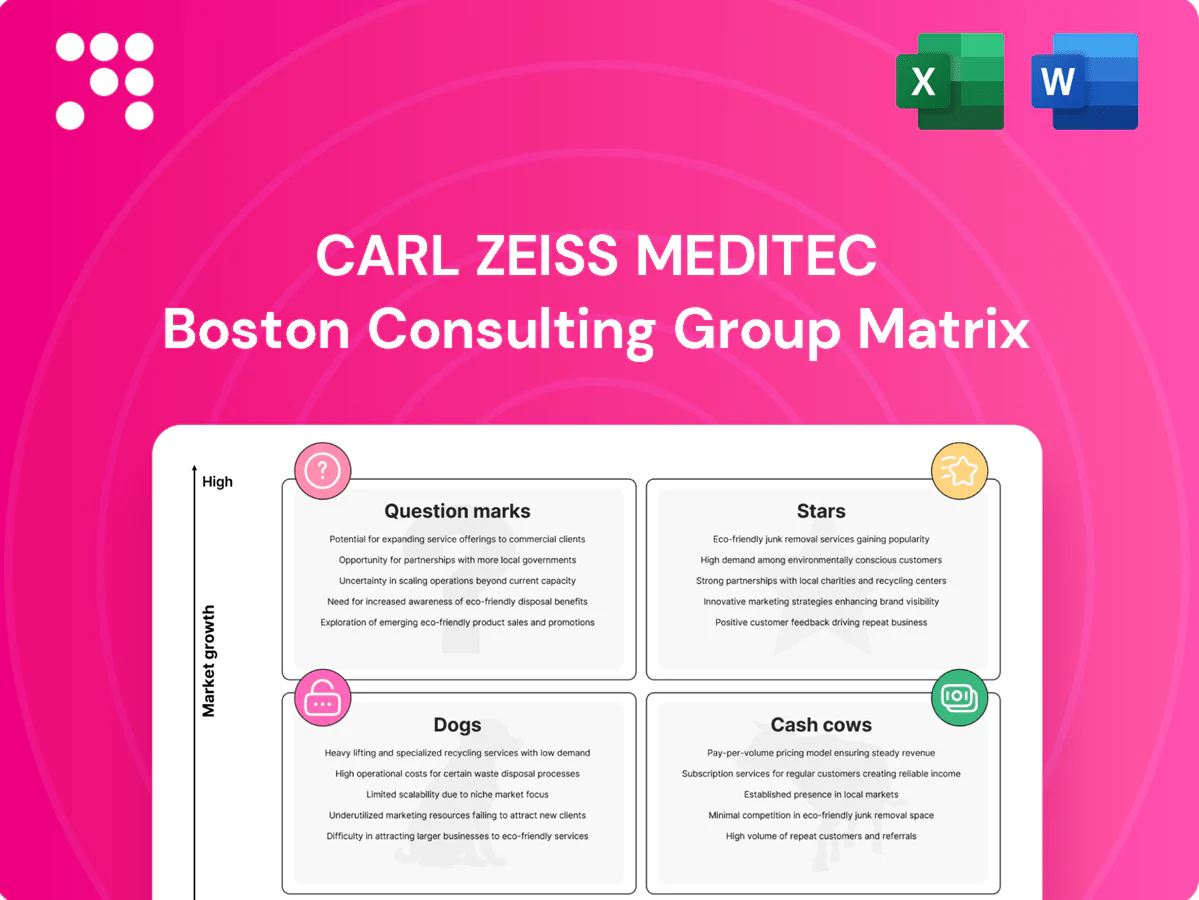
WidePoint Boston Consulting Group Matrix

Actionable Strategy Starts Here
This preview shows the shape of the opportunity—but the full WidePoint BCG Matrix gives you the full map: quadrant placements, data-backed calls on Stars, Cash Cows, Dogs and Question Marks, plus clear next steps. Buy the complete report and get a detailed Word narrative and a high-level Excel summary ready to present. Skip the guesswork—purchase now for actionable strategy you can implement this quarter.
Stars

TM2 for federal clients
TM2 sits in the Stars quadrant with high-growth demand and a leading share in the security-first federal mobility market; U.S. federal IT budgets exceeded $100B in 2024, fueling contracts for secure mobile services. It keeps agency fleets compliant, visible, and under budget where errors are costly. Ongoing investment in certifications and integrations is required to retain the lead and convert growth into steady cash generation.
Managed mobility security
End-to-end managed mobility security sits squarely in the Stars quadrant as both risk and spend rose in 2024—global security and risk management spending reached about $188B while the mobile workforce hit 1.88 billion. WidePoint’s locked-down solutions drive adoption in high-compliance environments, defending share. Continue investing in automation and richer reporting to improve margins and retention. Stay aggressive expanding partner ecosystems to widen the moat.

Zero-trust identity for mobile
Zero-trust identity for mobile aligns with surging credential-to-device deployments in the public sector, driven by federal zero-trust directives and roughly $22.7B in FY2024 federal cybersecurity funding. Strong fit with compliance-heavy use cases yields steady wins and high renewal rates. Continued R&D investment is required to track evolving standards and threats. Hold share now to convert growth into durable margin later.

Carrier expense analytics
Exploding data and 2024 budget pressure make carrier expense analytics a star in WidePoint’s BCG Matrix: TEM reportedly cuts telecom spend 10–30% and uncovers roughly 20% average waste, so visibility into usage and waste is both sticky and high-value. Keep investing in AI anomaly detection and benchmark datasets to remain top tier, defend existing logos while upselling advanced insights.
- Tag: Stickiness — usage/waste visibility drives retention
- Tag: ROI — TEM saves 10–30% (industry range, 2024)
- Tag: Investment — AI anomaly detection + benchmarks
- Tag: Sales — defend logos, upsell advanced insights
Mission-critical program management
Stars: Mission-critical program management for WidePoint (NYSE American: WYY) leverages large, complex mobility contracts that create high barriers to entry once embedded; execution wins continue to attract regulated federal and commercial workloads. Continued funding of PMO tooling and transparency keeps customer churn near zero while normalized growth converts these programs into reliable cash machines. Recent multiyear mobility program wins underpin predictable revenue streams.
Federal mobility - seize $100B+ market; TEM saves 10-30%
WidePoint Stars: high-growth, high-share in security-first federal mobility with U.S. federal IT budgets >$100B (2024) and $22.7B federal cyber funding; global security spend ~$188B (2024). TEM saves 10–30% in carrier costs; mobile workforce ~1.88B. Continue investing in automation, zero-trust, and partner expansion to convert growth into margins.
| Tag | Metric (2024) |
|---|---|
| Federal IT | >$100B |
| Cyber Funding | $22.7B |
| Security Spend | $188B |
| TEM ROI | 10–30% |
What is included in the product
 Detailed Word Document
WidePoint BCG Matrix: clear quadrant analysis with strategic guidance—which units to invest in, hold, or divest.

 Customizable Excel Spreadsheet
One-page WidePoint BCG Matrix that pinpoints problem units and clear growth paths—clean, export-ready for exec decks.
Cash Cows

Long-term federal contracts
Long-term federal contracts form WidePoint’s cash cows: mature programs with entrenched relationships and predictable renewals, anchored in a US federal IT budget of about $96B in 2024. These accounts deliver high share, low incremental growth and strong cash yield; focus on optimizing delivery costs and SLAs to widen margin. Milk prudently while protecting core accounts to sustain recurring cash flow.
Telecom lifecycle management
Telecom lifecycle management at WidePoint sits in the cash cows quadrant: procure-to-pay processes are standardized and repeatable, handling steady volumes across lines and agencies with low growth. Leaning into automation and catalog discipline can increase throughput and reduce cost-per-order; industry automation adoption reached 64% by 2024. Cash generated funds newer bets and R&D investments.

Device kitting and provisioning
Device kitting and provisioning is operationally tight with scaled workflows and limited addressable-market expansion, yielding predictable cash flows. Automation and process engineering can cut provisioning time by up to 60% (Gartner 2024), translating into margin expansion of roughly 5–10 percentage points as volume rises. Prioritize capital tooling and orchestration platforms over heavy marketing spend. Keep throughput efficient and consistently printing.

Help desk and steady-state support
Help desk and steady-state support are classic Cash Cows for WidePoint: high attach to existing contracts with little greenfield, SLA-driven predictable hours and minimal promotional spend, generating reliable cash to cover corporate overhead. In 2024 industry benchmarks showed first-call resolution near 70% and predictable utilization drives margin stability, while targeted self-service and deflection programs can cut unit cost by 15–25%.
- Stable attach to existing programs
- SLA-driven, predictable hours
- Minimal promo spend
- Improve self-service to lower unit cost (15–25% potential)
- Reliable cashflow covers overhead
Legacy billing platforms
Legacy billing platforms remain embedded and hard to rip out; by 2024 growth has cooled but they still generate steady recurring cash for WidePoint. Continuous small enhancements and a relentless focus on uptime and cost-to-serve keep churn low and customer satisfaction stable. Harvest cash while funding migration paths to next-gen platforms.
- Embedded, sticky revenue — cash cow
- 2024: growth muted; high recurring margin
- Operational focus: uptime, cost-to-serve
- Strategy: harvest, fund migrations
Fed IT: $96B, 64% auto, 60% prov cut
Long-term federal contracts, telecom lifecycle, device provisioning and help desk are WidePoint cash cows: high share, low growth, strong cash generation supporting R&D. 2024: US federal IT spend ~$96B, automation adoption 64%, provisioning time cut potential 60%, FCR ~70%. Prioritize cost-to-serve, automation, uptime to maximize margins.
| Unit | 2024 metric | Margin impact |
|---|---|---|
| Federal contracts | $96B market | High |
| Telecom | 64% automation | ↑ |
| Provisioning | 60% time cut | ↑↑ |
| Help desk | FCR 70% | Stable |
Delivered as Shown
WidePoint BCG Matrix
The file you’re previewing here is the exact WidePoint BCG Matrix you’ll receive after purchase. No watermarks, no placeholders — just the fully formatted, analysis-ready report. It’s built by strategy pros and formatted for clarity, so you can edit, print, or present right away. After purchase the full file is delivered instantly to your inbox with no surprises.

Original: $10.00
-70%$10.00
$3.00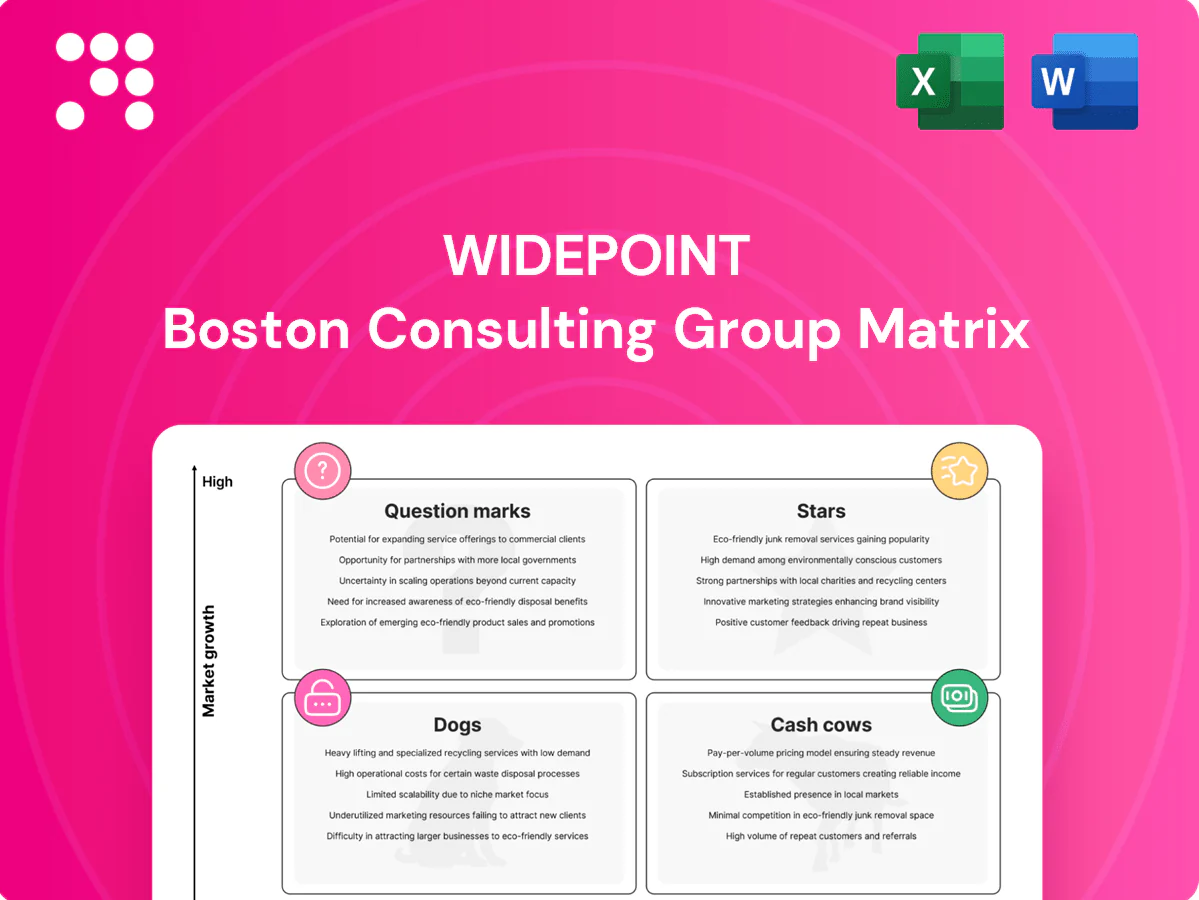
Description
Actionable Strategy Starts Here
This preview shows the shape of the opportunity—but the full WidePoint BCG Matrix gives you the full map: quadrant placements, data-backed calls on Stars, Cash Cows, Dogs and Question Marks, plus clear next steps. Buy the complete report and get a detailed Word narrative and a high-level Excel summary ready to present. Skip the guesswork—purchase now for actionable strategy you can implement this quarter.
Stars
TM2 for federal clients
TM2 sits in the Stars quadrant with high-growth demand and a leading share in the security-first federal mobility market; U.S. federal IT budgets exceeded $100B in 2024, fueling contracts for secure mobile services. It keeps agency fleets compliant, visible, and under budget where errors are costly. Ongoing investment in certifications and integrations is required to retain the lead and convert growth into steady cash generation.
Managed mobility security
End-to-end managed mobility security sits squarely in the Stars quadrant as both risk and spend rose in 2024—global security and risk management spending reached about $188B while the mobile workforce hit 1.88 billion. WidePoint’s locked-down solutions drive adoption in high-compliance environments, defending share. Continue investing in automation and richer reporting to improve margins and retention. Stay aggressive expanding partner ecosystems to widen the moat.
Zero-trust identity for mobile
Zero-trust identity for mobile aligns with surging credential-to-device deployments in the public sector, driven by federal zero-trust directives and roughly $22.7B in FY2024 federal cybersecurity funding. Strong fit with compliance-heavy use cases yields steady wins and high renewal rates. Continued R&D investment is required to track evolving standards and threats. Hold share now to convert growth into durable margin later.
Carrier expense analytics
Exploding data and 2024 budget pressure make carrier expense analytics a star in WidePoint’s BCG Matrix: TEM reportedly cuts telecom spend 10–30% and uncovers roughly 20% average waste, so visibility into usage and waste is both sticky and high-value. Keep investing in AI anomaly detection and benchmark datasets to remain top tier, defend existing logos while upselling advanced insights.
- Tag: Stickiness — usage/waste visibility drives retention
- Tag: ROI — TEM saves 10–30% (industry range, 2024)
- Tag: Investment — AI anomaly detection + benchmarks
- Tag: Sales — defend logos, upsell advanced insights
Mission-critical program management
Stars: Mission-critical program management for WidePoint (NYSE American: WYY) leverages large, complex mobility contracts that create high barriers to entry once embedded; execution wins continue to attract regulated federal and commercial workloads. Continued funding of PMO tooling and transparency keeps customer churn near zero while normalized growth converts these programs into reliable cash machines. Recent multiyear mobility program wins underpin predictable revenue streams.
Federal mobility - seize $100B+ market; TEM saves 10-30%
WidePoint Stars: high-growth, high-share in security-first federal mobility with U.S. federal IT budgets >$100B (2024) and $22.7B federal cyber funding; global security spend ~$188B (2024). TEM saves 10–30% in carrier costs; mobile workforce ~1.88B. Continue investing in automation, zero-trust, and partner expansion to convert growth into margins.
| Tag | Metric (2024) |
|---|---|
| Federal IT | >$100B |
| Cyber Funding | $22.7B |
| Security Spend | $188B |
| TEM ROI | 10–30% |
What is included in the product
Detailed Word Document
WidePoint BCG Matrix: clear quadrant analysis with strategic guidance—which units to invest in, hold, or divest.
Customizable Excel Spreadsheet
One-page WidePoint BCG Matrix that pinpoints problem units and clear growth paths—clean, export-ready for exec decks.
Cash Cows
Long-term federal contracts
Long-term federal contracts form WidePoint’s cash cows: mature programs with entrenched relationships and predictable renewals, anchored in a US federal IT budget of about $96B in 2024. These accounts deliver high share, low incremental growth and strong cash yield; focus on optimizing delivery costs and SLAs to widen margin. Milk prudently while protecting core accounts to sustain recurring cash flow.
Telecom lifecycle management
Telecom lifecycle management at WidePoint sits in the cash cows quadrant: procure-to-pay processes are standardized and repeatable, handling steady volumes across lines and agencies with low growth. Leaning into automation and catalog discipline can increase throughput and reduce cost-per-order; industry automation adoption reached 64% by 2024. Cash generated funds newer bets and R&D investments.
Device kitting and provisioning
Device kitting and provisioning is operationally tight with scaled workflows and limited addressable-market expansion, yielding predictable cash flows. Automation and process engineering can cut provisioning time by up to 60% (Gartner 2024), translating into margin expansion of roughly 5–10 percentage points as volume rises. Prioritize capital tooling and orchestration platforms over heavy marketing spend. Keep throughput efficient and consistently printing.
Help desk and steady-state support
Help desk and steady-state support are classic Cash Cows for WidePoint: high attach to existing contracts with little greenfield, SLA-driven predictable hours and minimal promotional spend, generating reliable cash to cover corporate overhead. In 2024 industry benchmarks showed first-call resolution near 70% and predictable utilization drives margin stability, while targeted self-service and deflection programs can cut unit cost by 15–25%.
- Stable attach to existing programs
- SLA-driven, predictable hours
- Minimal promo spend
- Improve self-service to lower unit cost (15–25% potential)
- Reliable cashflow covers overhead
Legacy billing platforms
Legacy billing platforms remain embedded and hard to rip out; by 2024 growth has cooled but they still generate steady recurring cash for WidePoint. Continuous small enhancements and a relentless focus on uptime and cost-to-serve keep churn low and customer satisfaction stable. Harvest cash while funding migration paths to next-gen platforms.
- Embedded, sticky revenue — cash cow
- 2024: growth muted; high recurring margin
- Operational focus: uptime, cost-to-serve
- Strategy: harvest, fund migrations
Fed IT: $96B, 64% auto, 60% prov cut
Long-term federal contracts, telecom lifecycle, device provisioning and help desk are WidePoint cash cows: high share, low growth, strong cash generation supporting R&D. 2024: US federal IT spend ~$96B, automation adoption 64%, provisioning time cut potential 60%, FCR ~70%. Prioritize cost-to-serve, automation, uptime to maximize margins.
| Unit | 2024 metric | Margin impact |
|---|---|---|
| Federal contracts | $96B market | High |
| Telecom | 64% automation | ↑ |
| Provisioning | 60% time cut | ↑↑ |
| Help desk | FCR 70% | Stable |
Delivered as Shown
WidePoint BCG Matrix
The file you’re previewing here is the exact WidePoint BCG Matrix you’ll receive after purchase. No watermarks, no placeholders — just the fully formatted, analysis-ready report. It’s built by strategy pros and formatted for clarity, so you can edit, print, or present right away. After purchase the full file is delivered instantly to your inbox with no surprises.