WidePoint SWOT Analysis

Dive Deeper Into the Company’s Strategic Blueprint
Explore our WidePoint SWOT Analysis to reveal the company’s competitive advantages, key vulnerabilities, and strategic growth levers. This concise preview highlights core findings; the full report delivers research-backed detail, actionable recommendations, and editable Word/Excel files. Purchase the complete SWOT to plan, pitch, or invest with confidence.
Strengths

Deep TM2 domain expertise
WidePoint (NASDAQ: WYY) leverages deep TM2 domain expertise—focused lifecycle management, security, and analytics—delivering faster time-to-value and higher solution efficacy versus generalist IT firms; this niche positioning supports premium pricing and aligns with a 2024 unified endpoint/mobility management market estimated at about $6.5B, boosting addressable-market capture potential.
Strong foothold in U.S. federal
Serving U.S. federal agencies validates WidePoint’s security, compliance, and reliability standards and leverages its past government procurement performance to create practical barriers to entry for competitors. Multi-year federal contracts provide revenue stability and predictable visibility into backlog and cash flow. That federal credibility also eases entry into regulated commercial sectors such as healthcare and finance.

Integrated cybersecurity and analytics
Combining cybersecurity with billing and usage analytics creates a holistic value proposition that lets clients manage cost, risk, and performance in one stack; integrated offerings also support cross-sell and upsell to deepen account penetration. Data-driven insights increase retention and switching costs by identifying churn signals and usage patterns. The IBM 2024 Cost of a Data Breach Report cites an average breach cost of $4.45M, underscoring the value of integrated defenses.

Proven compliance and certifications
Proven compliance and certifications enable WidePoint to operate smoothly in stringent federal environments, reducing procurement friction for new public-sector opportunities and shortening sales cycles; FedRAMP had authorized over 400 cloud offerings by mid-2025, illustrating market expectations for certified vendors. This compliance maturity also reassures enterprise buyers with similar requirements and lowers deployment risk and time-to-revenue.
- Reduces procurement friction
- Shortens sales cycles
- Reassures enterprise buyers
- Lowers deployment risk
Flexible IT infrastructure services
Complementary IT infrastructure offerings round out WidePoint's TM2 core, giving customers a single partner for mobility, security, and backend support, which reduces vendor sprawl and integration complexity; IDC estimated managed services spending near $300B in 2024, underscoring demand for bundled solutions.
- Single-vendor delivery
- Lower integration cost
- Bundling drives revenue diversification
Niche endpoint platform wins federal deals, tapping $6.5B market
WidePoint's TM2 niche drives premium pricing and faster time-to-value in a ~$6.5B unified endpoint/mobility market; federal contracts give revenue stability and procurement barriers (FedRAMP ~400 offerings by mid-2025). Integrated security, billing and analytics increases retention versus standalone vendors; managed services demand (~$300B in 2024) supports bundling upside; average breach cost $4.45M (2024) highlights value of defenses.
| Metric | Value |
|---|---|
| Addressable market | $6.5B |
| Managed services | $300B (2024) |
| Avg breach cost | $4.45M (2024) |
| FedRAMP offerings | ~400 (mid-2025) |
What is included in the product
 Detailed Word Document
Provides a concise SWOT analysis of WidePoint, identifying internal strengths and weaknesses and external opportunities and threats to assess competitive position, growth drivers, operational gaps, and market risks shaping the company’s strategic outlook.

 Customizable Excel Spreadsheet
Provides a concise WidePoint SWOT matrix for fast, visual strategy alignment, easing stakeholder briefings and accelerating informed decisions.
Weaknesses

Concentration in government demand
Heavy reliance on federal customers leaves WidePoint exposed to U.S. budget cycles and policy shifts, with over 70% of revenue tied to government-related contracts as reported in recent filings. Procurement delays and continuing resolutions—seen repeatedly in FY2023–FY2024—have compressed cash flow timing and billings. Periodic contract re-competes create cliff risks, and the firm's push into commercial verticals remains limited relative to federal concentration.
Limited scale versus large integrators
Competing with global IT giants pressures pricing and margin capture, especially as the global managed security services market reached about $35.9B in 2024 with larger integrators leveraging scale and volume discounts. Limited scale can constrain R&D investment and national sales reach, slowing product parity and market entry. Lower brand awareness in new markets lengthens enterprise sales cycles, often stretching procurement timelines to 6–9 months.

Narrow product breadth
Narrow product breadth centered on TM2 and adjacent services can leave functional gaps versus end-to-end platforms, limiting appeal to enterprise buyers who often seek single-vendor suites; in 2024, 68% of IT buyers surveyed preferred broader vendor ecosystems. Dependence on partner integrations increases implementation complexity and time-to-value, and dilutes WidePoint’s control over customer experience and service quality, risking churn and lower upsell potential.

Exposure to contract-based revenue
Project- and contract-driven revenue at WidePoint creates lumpiness: delays or slippage in awards and start dates directly compress quarterly revenue recognition and can produce volatile quarter-to-quarter results.
Heavy dependence on renewals concentrates revenue risk with a subset of clients, and variable project margins—driven by mix of services and contract terms—complicate forecasting and cash-flow visibility.
- Revenue lumpiness from project timing
- Quarterly sensitivity to award/start-date slippage
- High renewal concentration risk
- Margin variability hinders forecasting
Potential talent and hiring constraints
Security-cleared and specialized mobility talent is scarce, driving higher recruitment and retention costs during growth phases; turnover risks losing program knowledge and can disrupt delivery, slowing innovation and implementation speed.
- Scarcity of cleared mobility specialists
- Rising recruitment/retention costs
- Knowledge loss on turnover
- Slower innovation and implementation
Federal-dependent (>70%) IT services risk procurement cliff, scale lag vs $35.9B peers
Heavy reliance on federal work (>70% revenue) exposes WidePoint to U.S. budget cycles and procurement delays, compressing cash flow and creating cliff risks. Limited scale versus $35.9B managed security leaders and narrow TM2-focused product breadth hinder competitiveness and slow commercial expansion. Scarcity of cleared mobility specialists raises hiring/retention costs and risks delivery continuity.
| Metric | Value |
|---|---|
| Gov't revenue share | >70% |
| Managed security market (2024) | $35.9B |
| Enterprise sales cycle | 6–9 months |
Same Document Delivered
WidePoint SWOT Analysis
This is the actual WidePoint SWOT analysis document you’ll receive upon purchase—no surprises, just professional quality. The preview below is taken directly from the full report you'll get. Once purchased, the complete, editable version is unlocked immediately for download.

Original: $10.00
-70%$10.00
$3.00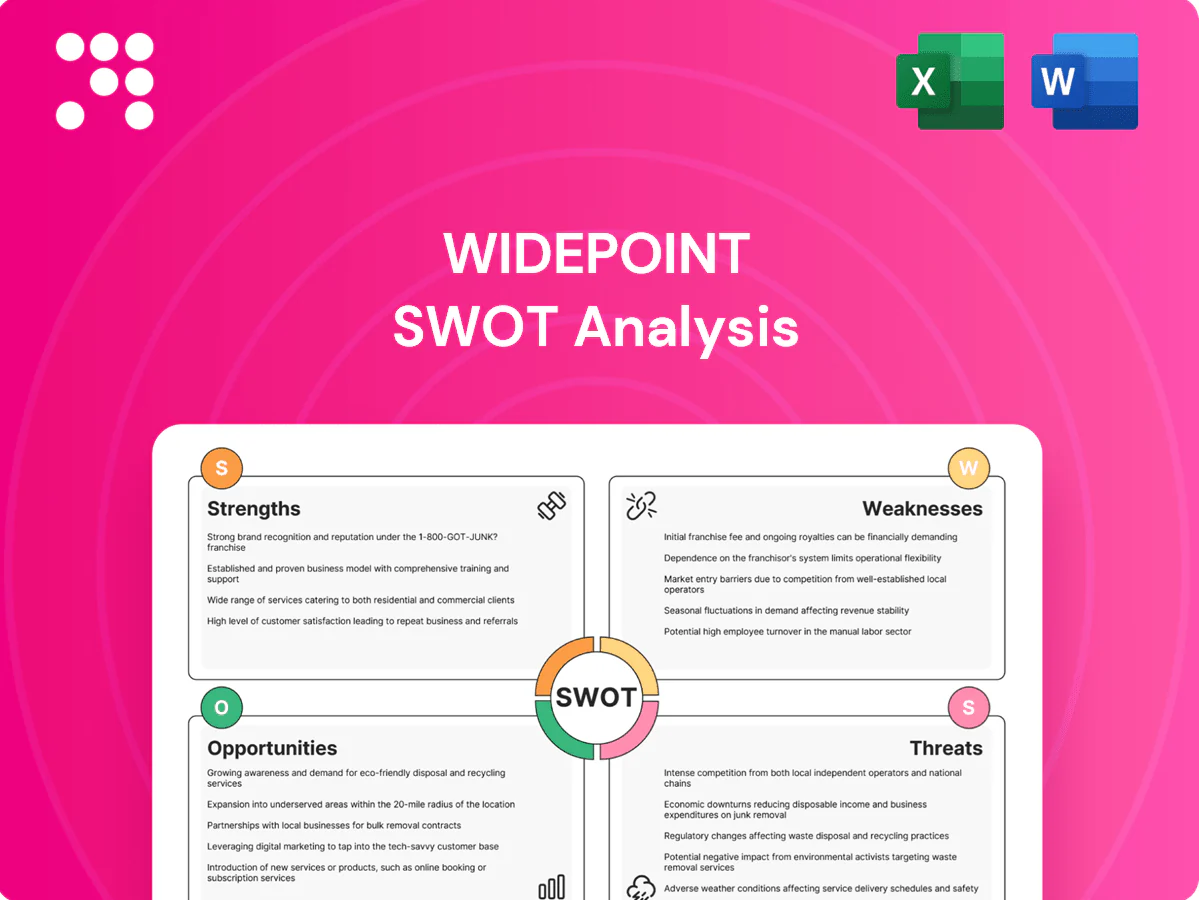
Description
Dive Deeper Into the Company’s Strategic Blueprint
Explore our WidePoint SWOT Analysis to reveal the company’s competitive advantages, key vulnerabilities, and strategic growth levers. This concise preview highlights core findings; the full report delivers research-backed detail, actionable recommendations, and editable Word/Excel files. Purchase the complete SWOT to plan, pitch, or invest with confidence.
Strengths
Deep TM2 domain expertise
WidePoint (NASDAQ: WYY) leverages deep TM2 domain expertise—focused lifecycle management, security, and analytics—delivering faster time-to-value and higher solution efficacy versus generalist IT firms; this niche positioning supports premium pricing and aligns with a 2024 unified endpoint/mobility management market estimated at about $6.5B, boosting addressable-market capture potential.
Strong foothold in U.S. federal
Serving U.S. federal agencies validates WidePoint’s security, compliance, and reliability standards and leverages its past government procurement performance to create practical barriers to entry for competitors. Multi-year federal contracts provide revenue stability and predictable visibility into backlog and cash flow. That federal credibility also eases entry into regulated commercial sectors such as healthcare and finance.
Integrated cybersecurity and analytics
Combining cybersecurity with billing and usage analytics creates a holistic value proposition that lets clients manage cost, risk, and performance in one stack; integrated offerings also support cross-sell and upsell to deepen account penetration. Data-driven insights increase retention and switching costs by identifying churn signals and usage patterns. The IBM 2024 Cost of a Data Breach Report cites an average breach cost of $4.45M, underscoring the value of integrated defenses.
Proven compliance and certifications
Proven compliance and certifications enable WidePoint to operate smoothly in stringent federal environments, reducing procurement friction for new public-sector opportunities and shortening sales cycles; FedRAMP had authorized over 400 cloud offerings by mid-2025, illustrating market expectations for certified vendors. This compliance maturity also reassures enterprise buyers with similar requirements and lowers deployment risk and time-to-revenue.
- Reduces procurement friction
- Shortens sales cycles
- Reassures enterprise buyers
- Lowers deployment risk
Flexible IT infrastructure services
Complementary IT infrastructure offerings round out WidePoint's TM2 core, giving customers a single partner for mobility, security, and backend support, which reduces vendor sprawl and integration complexity; IDC estimated managed services spending near $300B in 2024, underscoring demand for bundled solutions.
- Single-vendor delivery
- Lower integration cost
- Bundling drives revenue diversification
Niche endpoint platform wins federal deals, tapping $6.5B market
WidePoint's TM2 niche drives premium pricing and faster time-to-value in a ~$6.5B unified endpoint/mobility market; federal contracts give revenue stability and procurement barriers (FedRAMP ~400 offerings by mid-2025). Integrated security, billing and analytics increases retention versus standalone vendors; managed services demand (~$300B in 2024) supports bundling upside; average breach cost $4.45M (2024) highlights value of defenses.
| Metric | Value |
|---|---|
| Addressable market | $6.5B |
| Managed services | $300B (2024) |
| Avg breach cost | $4.45M (2024) |
| FedRAMP offerings | ~400 (mid-2025) |
What is included in the product
Detailed Word Document
Provides a concise SWOT analysis of WidePoint, identifying internal strengths and weaknesses and external opportunities and threats to assess competitive position, growth drivers, operational gaps, and market risks shaping the company’s strategic outlook.
Customizable Excel Spreadsheet
Provides a concise WidePoint SWOT matrix for fast, visual strategy alignment, easing stakeholder briefings and accelerating informed decisions.
Weaknesses
Concentration in government demand
Heavy reliance on federal customers leaves WidePoint exposed to U.S. budget cycles and policy shifts, with over 70% of revenue tied to government-related contracts as reported in recent filings. Procurement delays and continuing resolutions—seen repeatedly in FY2023–FY2024—have compressed cash flow timing and billings. Periodic contract re-competes create cliff risks, and the firm's push into commercial verticals remains limited relative to federal concentration.
Limited scale versus large integrators
Competing with global IT giants pressures pricing and margin capture, especially as the global managed security services market reached about $35.9B in 2024 with larger integrators leveraging scale and volume discounts. Limited scale can constrain R&D investment and national sales reach, slowing product parity and market entry. Lower brand awareness in new markets lengthens enterprise sales cycles, often stretching procurement timelines to 6–9 months.
Narrow product breadth
Narrow product breadth centered on TM2 and adjacent services can leave functional gaps versus end-to-end platforms, limiting appeal to enterprise buyers who often seek single-vendor suites; in 2024, 68% of IT buyers surveyed preferred broader vendor ecosystems. Dependence on partner integrations increases implementation complexity and time-to-value, and dilutes WidePoint’s control over customer experience and service quality, risking churn and lower upsell potential.
Exposure to contract-based revenue
Project- and contract-driven revenue at WidePoint creates lumpiness: delays or slippage in awards and start dates directly compress quarterly revenue recognition and can produce volatile quarter-to-quarter results.
Heavy dependence on renewals concentrates revenue risk with a subset of clients, and variable project margins—driven by mix of services and contract terms—complicate forecasting and cash-flow visibility.
- Revenue lumpiness from project timing
- Quarterly sensitivity to award/start-date slippage
- High renewal concentration risk
- Margin variability hinders forecasting
Potential talent and hiring constraints
Security-cleared and specialized mobility talent is scarce, driving higher recruitment and retention costs during growth phases; turnover risks losing program knowledge and can disrupt delivery, slowing innovation and implementation speed.
- Scarcity of cleared mobility specialists
- Rising recruitment/retention costs
- Knowledge loss on turnover
- Slower innovation and implementation
Federal-dependent (>70%) IT services risk procurement cliff, scale lag vs $35.9B peers
Heavy reliance on federal work (>70% revenue) exposes WidePoint to U.S. budget cycles and procurement delays, compressing cash flow and creating cliff risks. Limited scale versus $35.9B managed security leaders and narrow TM2-focused product breadth hinder competitiveness and slow commercial expansion. Scarcity of cleared mobility specialists raises hiring/retention costs and risks delivery continuity.
| Metric | Value |
|---|---|
| Gov't revenue share | >70% |
| Managed security market (2024) | $35.9B |
| Enterprise sales cycle | 6–9 months |
Same Document Delivered
WidePoint SWOT Analysis
This is the actual WidePoint SWOT analysis document you’ll receive upon purchase—no surprises, just professional quality. The preview below is taken directly from the full report you'll get. Once purchased, the complete, editable version is unlocked immediately for download.